
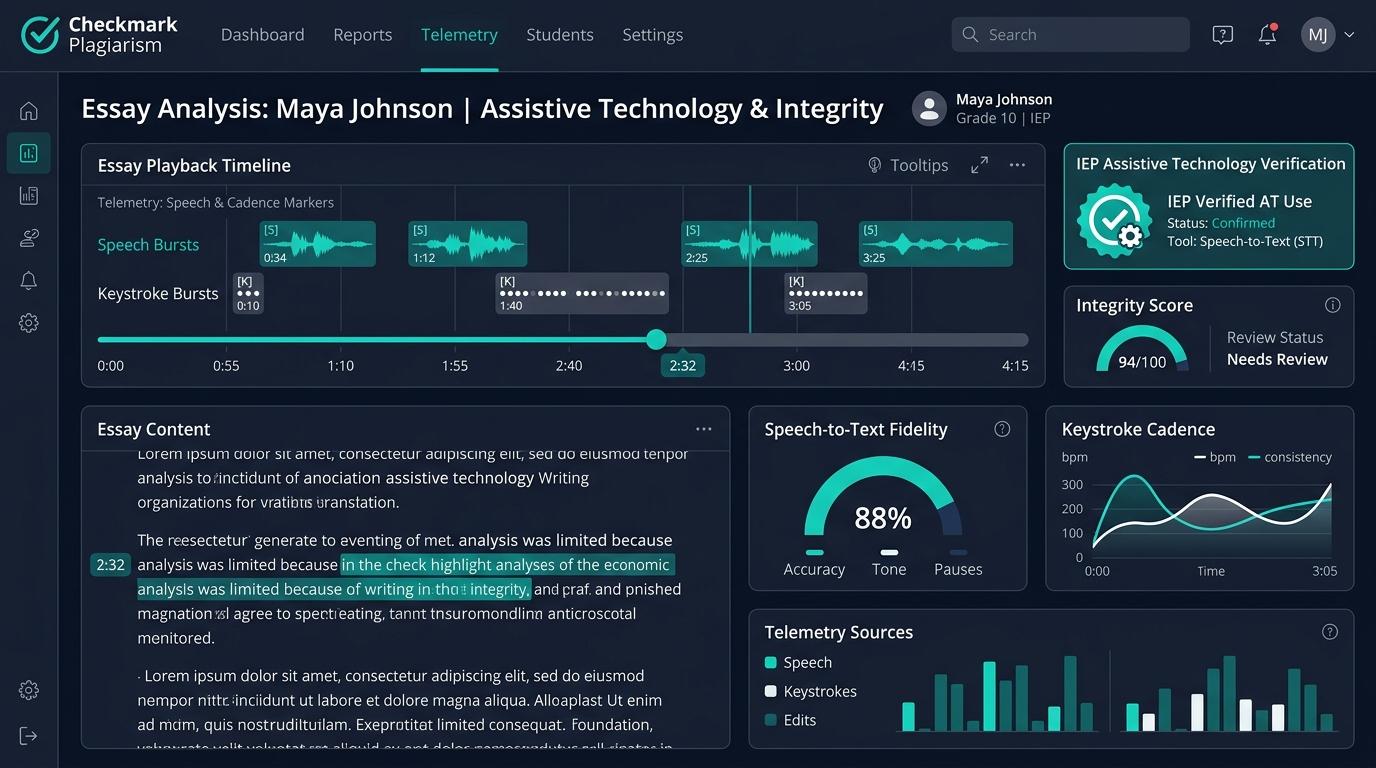
As generative artificial intelligence reshapes educational assessment, students with documented disabilities who rely on lawful Speech-to-Text (STT) and Assistive Technology (AT) accommodations are increasingly caught in the crosshairs of flawed, probabilistic AI detectors. Generic AI classifiers routinely misinterpret the bursty text injection cadences, conversational syntax, phonetic spelling normalizations, and constrained vocabulary profiles of assistive dictation engines (e.g., Dragon NaturallySpeaking, Google Voice Typing, Apple Dictation, Texthelp Read&Write, Co:Writer) as synthetic Large Language Model (LLM) generation. Penalizing a student for utilizing lawful accommodations violates federal civil rights statutes—including the Individuals with Disabilities Education Act (IDEA, 20 U.S.C. § 1400 et seq.), Section 504 of the Rehabilitation Act (29 U.S.C. § 794), and Title II of the Americans with Disabilities Act (ADA, 42 U.S.C. § 12131 et seq.)—exposing school districts to costly Office for Civil Rights (OCR) complaints and due process litigation. Guided by the core philosophy of “Stop guessing, start trusting,” Checkmark Plagiarism provides Special Education Directors, 504/IEP Case Managers, Assistive Technology Specialists, and General Education Co-Teachers with empirical, multi-dimensional writing telemetry. Through patent-pending Essay Playback™, microsecond keystroke-and-dictation replay, unredacted external paste buffer inspection, passage-level confidence sliders, and private educator flags, Checkmark empowers multidisciplinary teams to definitively separate genuine oral composition from unauthorized generative AI ghostwriting.
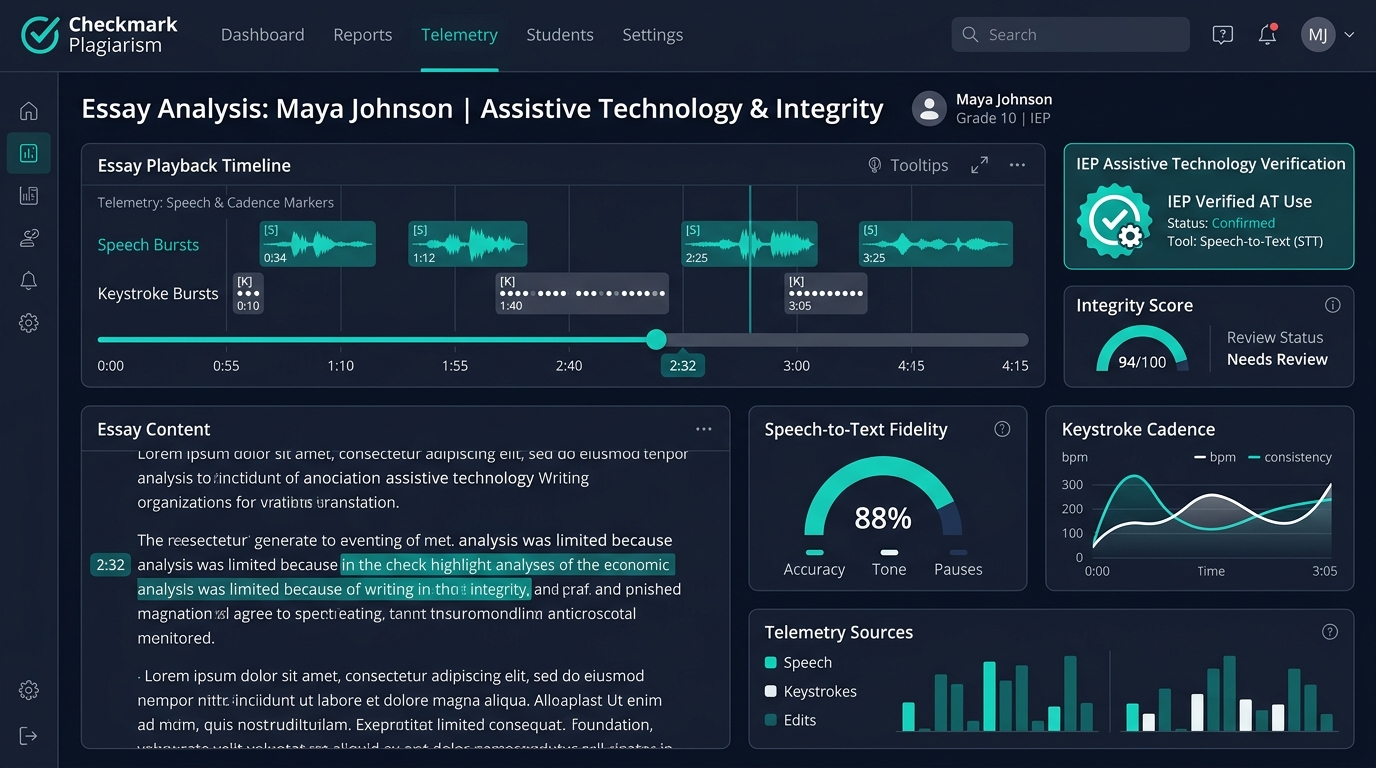
Checkmark Plagiarism provides the pedagogical and technical foundation for process-based academic integrity by combining patent-pending Essay Playback™ with passage-level AI detection, comprehensive plagiarism checking, quote-anchored rubric autograding, and direct LMS integrations for Canvas LMS, Google Classroom, and Buzz LMS.
1. The Accessibility and Equity Crisis: Assistive Technology Under Algorithmic Attack
The rapid integration of generative artificial intelligence into academic coursework has triggered a secondary crisis across secondary and postsecondary institutions: the algorithmic disenfranchisement of neurodivergent and accommodation-dependent students.
To safeguard academic integrity, schools and school districts have deployed automated, commercial AI detection software. However, these systems rely on opaque statistical heuristics—primarily perplexity (a mathematical measurement of word predictability) and burstiness (the variation in sentence length and syntactic complexity). While these metrics were engineered to flag synthetic text generated by models like GPT-4, Claude, or Gemini, they exhibit severe algorithmic bias when applied to student drafts produced through assistive writing technologies.
Students with dysgraphia, SLD in written expression, ADHD, or fine-motor deficits employ authorized tools: Dragon, Google Voice Typing, Apple Dictation, Co:Writer, or Read&Write.
Generic detectors misclassify rapid speech text dumps as unauthorized copy-pastes, and treat word prediction vocabulary scaffolds as low-perplexity synthetic generation.
Microsecond keystroke and dictation-burst replay, paste inspection, passage confidence sliders, and private educator flags validate authentic human drafting.
Why Legacy AI Classifiers Fail on Accommodated Student Writing
Special Education Case Managers and Assistive Technology (AT) Specialists are fielding an unprecedented volume of false-positive academic dishonesty referrals. The failure of generic AI classifiers is rooted in the structural mechanics of how assistive writing tools operate:
- The Automatic Speech Recognition (ASR) “Burst Injection” Illusion: When a student with severe dysgraphia, cerebral palsy, or fine-motor fatigue dictates a paragraph into an Automatic Speech Recognition (ASR) engine (such as Google Voice Typing or Apple Dictation), the operating system transcribes the acoustic stream locally or in cloud memory. Once the student pauses or completes a verbal utterance, the software delivers a 30-to-80-word block of text into the document canvas simultaneously. To a coarse document version tracker or naive revision checker, this instantaneous block delivery mimics an unauthorized copy-paste from an external generative AI chatbot.
- Constrained Perplexity from Word Prediction & Assistive Dictionaries: Assistive software suites like Co:Writer and Texthelp Read&Write offer vocabulary scaffolding and contextual word prediction for students with specific learning disabilities (SLD) in written expression or executive dysfunction. These tools suggest the most statistically probable next word based on phonemic cues and topic dictionaries. When an accommodated student writes with word prediction, their resulting text naturally exhibits uniform, highly predictable lexical patterns (low perplexity)—the primary statistical signal that generic AI detectors use to label text as machine-generated.
- Phonetic and Grammatical Auto-Normalization: Many modern STT tools automatically correct phonetic spelling errors, capitalize proper nouns, and insert standard punctuation based on acoustic inflection. When a neurodivergent student dictates an essay, the output possesses clean surface mechanics despite containing non-linear oral logic. Legacy detectors, unable to evaluate the human thought process behind the words, flag the combination of surface fluency and conversational structure as an LLM “hallmark.”
- Modular, Fragmented Drafting Patterns: Students with Attention Deficit Hyperactivity Disorder (ADHD), executive functioning challenges, or traumatic brain injury (TBI) rarely write linearly from the thesis statement down to the concluding sentence. They frequently dictate thesis fragments into external scratchpads (e.g., Apple Notes, Google Keep), copy their modular thoughts into an essay editor, and rearrange them using speech commands. Generic detectors interpret these non-linear jumps as fraudulent “text assembly.”
The Psychological Cost: Rejection Sensitive Dysphoria and Accommodation Abandonment
For neurodivergent students, a wrongful accusation of generative AI cheating is profoundly damaging.
Many students with ADHD, autism spectrum condition (ASC), and learning differences experience Rejection Sensitive Dysphoria (RSD)—an overwhelming emotional response to perceived criticism, failure, or unjust condemnation. When a student who has labored for hours speaking into a microphone, managing speech dysfluencies, and re-reading sentences through text-to-speech feedback is abruptly told by a teacher, “The AI checker gave your essay a 91% AI probability score,” the trauma can derail years of academic progress:
Traumatized students abandon their legally mandated assistive tools. They attempt physical keyboards or handwriting, enduring severe motor cramps, extreme cognitive fatigue, and an inevitable decline in written expression.
Students develop severe anxiety surrounding writing prompts, choosing to accept failing grades or avoid assignments altogether rather than submit voice-dictated work that might trigger automated algorithmic flags.
The critical alliance between student, parents, special education case manager, and general education teacher collapses into an adversarial dispute centered around an unprovable statistical score.
To stop this harm, school districts must replace opaque percentage-based detectors with transparent writing process telemetry that validates lawful accommodations while providing objective evidence of independent authorship.
2. Linguistic and Acoustic Mechanics: Speech-to-Text Dictation vs. Generative LLM Ghostwriting
Distinguishing between authentic oral composition and synthetic LLM generation requires a deep understanding of linguistic mechanics, speech processing acoustics, and language model architecture. While both modalities can produce fluent digital text, their structural, syntactical, and lexical signatures are diametrically opposed.
- Conversational, Paratactic Flow: Frequent coordinating conjunctions (“and”, “so”, “because”) and run-on verbal thoughts.
- Acoustic Collisions & Homophones: ASR substitutes phonetically identical words (“their/there”, “accept/except”).
- Natural Oral Dysfluency: Preserves false starts, filler phrases, and verbal self-corrections.
- Authentic Developmental Voice: Dialectal variations, regional registers, and English learner phonology are preserved.
- Micro-Pauses & Breathing Gaps: Timestamped pauses between speech bursts for acoustic breathing and thought formulation.
- Tripartite Formulaic Architecture: Highly symmetrical paragraphs opening with topic sentences and standard transitions (“Furthermore”, “Moreover”).
- Hypotactic Syntactic Density: Flawless grammatical parallelism with multi-layered subordinate clauses.
- Absence of Phonetic Errors: Zero homophone confusion; spelling and grammar are textbook-perfect.
- Monotonous Perplexity: Uniformly low statistical perplexity across every single paragraph.
- Uniterated Monolithic Output: Materializes in a single paste or mechanical transcription without drafting hesitation.
Approved Speech-to-Text (STT) Assistive Writing Technologies
In modern educational settings, students utilize a range of approved speech recognition and assistive writing suites:
- Dragon NaturallySpeaking / Dragon Professional (Nuance): High-precision desktop ASR software customized for professional and academic dictation, utilizing specialized acoustic models and custom vocabulary lists.
- Google Voice Typing / Docs Speech Recognition: Cloud-based voice typing built directly into Google Docs and Chrome OS, widely utilized across 1:1 Chromebook district deployments.
- Apple Dictation (macOS / iOS / iPadOS): On-device and cloud-based neural speech recognition integrated into MacBooks and iPads, frequently paired with accessibility switch controls.
- Texthelp Read&Write / OrbitNote: Comprehensive accessibility toolbar featuring speech-to-text, talking spell checkers, vocabulary banks, and text-to-speech auditory proofreading.
- Co:Writer (Don Johnston / Texthelp): Specialized assistive writing tool combining advanced phonetic word prediction, topic-specific vocabulary dictionaries, and integrated speech recognition.
- WordQ / SpeakQ (Quillsoft): Assistive writing suite pairing word prediction with acoustic speech-input confirmation.
The Linguistic Signatures of Oral Drafting
When a human student composes using speech-to-text tools, they are translating oral cognition into digital text. Human speech differs fundamentally from written text:
-
Paratactic and Associative Syntax: Spoken thought relies heavily on parataxis—linking independent clauses with coordinating conjunctions (“and”, “so”, “but”, “because”) rather than deeply nested subordinate clauses. Accommodated students dictating essays will frequently produce rolling, run-on sentences that reflect their stream of consciousness:
“The author explains why the ecosystem collapses and it shows that when the wolves left the deer ate all the trees and so the river banks eroded because there was nothing holding the soil.”
- Oral Dysfluency and Acoustic Retraces: Even when students speak carefully, oral composition includes vocalized hesitations, false starts, and immediate verbal self-corrections. A student might say “The main reason—I mean the secondary factor was...”, which the STT engine transcribes literally unless edited out.
-
Phonetic Misrecognitions and Acoustic Collisions: Automatic Speech Recognition engines transcribe based on acoustic phonemes rather than semantic intent. As a result, STT submissions frequently feature homophonic substitutions that a human typist or an LLM would never make:
- Substituting “their” for “there”, “cereal” for “serial”, or “wreckingize” for “recognize”.
- Dropped word endings in connected speech (e.g., transcribing “most of the time” as “most the time” or “going to” as “gonna”).
- Acoustic boundary errors (e.g., transcribing “an apple” as “a napple” or “recognize speech” as “wreck a nice beach”).
- Dialectal and Sociolinguistic Variations: Speech-to-text engines faithfully capture regional accents, African American Vernacular English (AAVE), Appalachian English, and English Language Learner (ELL) phonology. A student speaking with regional vernacular will produce transcription artifacts that reflect their authentic voice.
The Synthetic Signatures of Generative LLMs
In contrast, Large Language Models (LLMs) do not compose through acoustic speech or human cognition; they predict tokens based on statistical distribution across vast training corpora:
- Tripartite Formulaic Architecture: Generative AI writing exhibits rigid, predictable structural patterns. Paragraphs typically open with a high-level topic sentence, followed by two symmetrically balanced explanatory sentences, and conclude with a summarizing sentence introduced by formulaic discourse markers (“Furthermore,” “Moreover,” “In conclusion,” “It is crucial to consider...”).
- Hypotactic Syntactic Density: LLMs generate complex, multi-layered subordinate clauses with flawless grammatical parallelism. Sentences are uniformly polished, devoid of the run-on momentum or fragmented pauses characteristic of spoken dictation.
- Absence of Acoustic and Phonetic Confusion: An LLM will never confuse homophones based on acoustic similarity. While an LLM may occasionally hallucinate facts or citations, its orthography and grammar remain mechanically pristine.
- Uniform Low Perplexity (Statistical Monotony): LLMs select tokens with high mathematical probability. Consequently, generative AI text demonstrates an absence of idiosyncratic vocabulary, colloquial spoken idioms, or personal voice.
Comprehensive Comparison Matrix: Speech-to-Text vs. Generative AI
| Dimension | Approved Speech-to-Text (STT) Dictation | Generative AI Ghostwriting (LLMs) |
|---|---|---|
| Compositional Modality | Real-time human vocalization translated via acoustic ASR algorithms | Algorithmic token prediction based on neural network training |
| Syntactic Structure | Paratactic, conversational flow; run-on verbal thoughts; frequent coordinating conjunctions | Hypotactic, highly balanced tripartite paragraphs; nested subordinate clauses |
| Grammatical Artifacts | Unpunctuated clauses, missing commas, verbal self-corrections, capitalization drops | Flawless grammatical parallelism, textbook punctuation, standard transitions |
| Lexical Errors | Phonetic homophone substitutions (“their/there”, “accept/except”), acoustic collisions | Hallucinated citations, but flawless spelling, grammar, and vocabulary selection |
| Drafting Telemetry | Intermittent speech bursts (20–80 words) separated by vocal breathing and cognitive pauses | Single monolithic external paste or mechanical, unpaused transcription |
| Revision Dynamics | Frequent backspacing to correct speech engine recognition errors; audio re-listening | Zero in-document revision; immediate final-form prose pasted directly into editor |
| Perplexity Signature | High localized perplexity spikes mixed with conversational predictability | Monotonously low perplexity throughout every paragraph and section |
| Voice & Individuality | Preserves student’s authentic developmental voice, regional dialect, and spoken register | Homogenized, detached, professional “institutional” register |
3. The Federal Legal and Civil Rights Mandate: IDEA, Section 504, and Title II of the ADA
When general education teachers or administrative honor boards issue academic dishonesty penalties based on unverified AI detection scores, they are not merely risking pedagogical friction—they are actively violating federal disability civil rights laws.
School districts must understand the stringent legal frameworks governing assistive technology accommodations, procedural due process, and algorithmic discrimination.
- FAPE in the LRE: Mandates Free Appropriate Public Education.
- AT Mandate (34 CFR § 300.105): Districts must provide and permit mandated assistive devices without punitive barrier.
- MDR Mandate (34 CFR § 300.530(e)): Manifestation Determination Reviews are legally required before disciplinary placement changes.
- Equal Access: Prohibits discrimination against qualified individuals in federally funded programs.
- Non-Penalization: Bars penalizing students whose lawful accommodations trigger automated screening filters.
- Disparate Impact: Outlaws assessment policies that disproportionately flag students using auxiliary aids.
- Effective Communication (28 CFR § 35.160): Ensures accessible technology is supported.
- Methods of Administration (28 CFR § 35.130(b)(3)): Forbids administrative criteria that defeat or impair educational objectives for students with disabilities.
- No Black-Box Reliance: Districts should not treat unvalidated automated AI detectors as sole evidence for adverse disciplinary action.
- Corrective Action: A district found to have discriminated can face corrective action and, ultimately, the loss of federal funding.
1. Individuals with Disabilities Education Act (IDEA, 20 U.S.C. § 1400 et seq.)
Under IDEA, every eligible public school student with a disability is entitled to a Free Appropriate Public Education (FAPE) delivered in the Least Restrictive Environment (LRE) through an Individualized Education Program (IEP).
- The Assistive Technology Mandate (34 CFR § 300.105): Districts must make assistive technology devices and services available to a child with a disability if required as part of the child’s special education, related services, or supplementary aids and services. When an IEP specifies accommodations such as “Speech-to-Text software (Google Voice Typing/Dragon) for all extended written assignments”, this accommodation is a legally binding federal contract.
- Denial of FAPE via Disciplinary Action: If a teacher assigns a zero, revokes credit, or initiates a disciplinary referral because an unvalidated AI detector flagged an essay produced via speech-to-text dictation, the district has substantively failed to implement the IEP, constituting a direct denial of FAPE.
- Manifestation Determination Review (MDR) Mandate (34 CFR § 300.530(e)): Under IDEA, before a district can execute a disciplinary change of placement (such as suspension, expulsion, or removal from advanced courses) exceeding 10 consecutive school days for alleged misconduct, the IEP team must convene an MDR. The team must determine whether the conduct was caused by, or had a direct and substantial relationship to, the student’s disability, or was the direct result of the district’s failure to implement the IEP. Bypassing this review with automated AI scores is an egregious statutory breach.
2. Section 504 of the Rehabilitation Act of 1973 (29 U.S.C. § 794)
Section 504 prohibits any program receiving federal financial assistance from discriminating against qualified individuals with disabilities.
- Equal Access and Non-Penalization: Under Section 504 regulations (34 CFR Part 104), schools must provide aids, benefits, and services that afford students with disabilities equal opportunity to achieve educational outcomes. Penalizing a student whose lawful 504 speech-to-text tool triggers an AI detector constitutes unlawful disability-based discrimination.
- Disparate Impact of Algorithmic Integrity Tools: Even if a school’s academic integrity policy appears neutral on its face, deploying AI detection software that disproportionately flags students utilizing assistive technology creates an unlawful disparate impact under federal civil rights enforcement jurisprudence.
3. Title II of the Americans with Disabilities Act (ADA, 42 U.S.C. § 12131 et seq.)
Title II extends non-discrimination protections to all services, programs, and activities provided by state and local government entities, including public school districts, community colleges, and state universities.
- Auxiliary Aids and Services (28 CFR § 35.160): Public entities must take appropriate steps to ensure that communications with individuals with disabilities are as effective as communications with others, including the provision of accessible software.
- Methods of Administration (28 CFR § 35.130(b)(3)): Title II explicitly forbids public educational entities from utilizing administrative criteria or methods that have the purpose or effect of defeating or substantially impairing the accomplishment of the educational objectives for students with disabilities.
Office for Civil Rights (OCR) Enforcement Risks
The U.S. Department of Education’s Office for Civil Rights (OCR) enforces Section 504 and Title II of the ADA in public schools. Parents can file OCR complaints alleging wrongful AI misconduct accusations on accommodated students, and districts should be ready to show that their assessment methods are reliable and do not discriminate on the basis of disability.
Relying on a commercial AI detector’s black-box “85% AI” score is a weak basis for discipline in an OCR investigation or state due process hearing. Districts must maintain objective, verifiable telemetry showing the student’s authentic drafting process.
4. The Assistive Technology and Telemetry Evidentiary Matrix
To evaluate student writing fairly and maintain rigorous academic integrity, schools must transition from speculative probabilistic models to empirical writing process telemetry.
The following matrix compares the three primary methods used by educators to evaluate writing authenticity in accommodated environments:
| Evaluation Criteria | Generic Probabilistic AI Classifiers | Traditional Classroom Observation | Checkmark Essay Playback™ Writing Telemetry |
|---|---|---|---|
| Core Mechanism | Static text analysis measuring linguistic perplexity and burstiness | Visual proctoring by teachers, paraprofessionals, or co-teachers | Microsecond temporal logging of keystrokes, ASR text injections, and revisions |
| STT Burst Handling | ❌ Misinterprets 50-word voice buffer dumps as illicit external copy-pastes | Teacher witnesses student speaking into microphone in person | ✅ Captures sequential ASR buffer dumps with timestamped vocal pauses and breath intervals |
| Word Prediction Tracking | ❌ Penalizes constrained vocabulary choices as synthetic low perplexity | Paraprofessional assists student with Co:Writer interface | ✅ Logs discrete word-selection events and typing triggers from assistive toolbars |
| Paste Buffer Inspection | ❌ Blind to clipboard contents; cannot distinguish notes from ChatGPT | Can only observe if paraprofessional is standing directly behind screen | ✅ Preserves 100% unredacted external paste text with direct jump-to-timeline playback |
| Granularity of Output | Single opaque whole-document percentage (e.g., “78% AI”) | Anecdotal narrative notes in student IEP accommodation logs | Passage-level confidence sliders tied directly to specific paragraphs and sentences |
| Asynchronous / Homework Coverage | ❌ Generates unreliable scores on unmonitored home writing sessions | ❌ Zero coverage; cannot observe student composing at home or in resource room | ✅ Continuous capture across Google Docs, Canvas LMS, Buzz LMS, and Word |
| Impact on Neurodivergent Students | Induces Rejection Sensitive Dysphoria, anxiety, and accommodation masking | Creates anxiety if proctoring feels intrusive or surveillance-heavy | Invisible, supportive, non-intrusive background telemetry protecting student rights |
| Legal Compliance (IDEA / 504 / OCR) | ❌ Violates procedural due process; exposes district to civil rights sanctions | Defensible for in-class work, but lacks permanent objective digital artifacts | ✅ Generates definitive, exportable empirical defense dossiers for IEP annual reviews |
5. Step-by-Step IEP Team Audit Protocol for Disputed Submissions
When an accommodated student’s essay raises authenticity concerns or triggers an automated flag from an external LMS scanner, Special Education Case Managers, Assistive Technology Specialists, and General Education Teachers must execute a standardized, legally defensible, and restorative audit protocol.
Phase 1: Accommodation Triangulation & Baseline Verification
Before initiating any dialogue with the student or making assumptions regarding authorship, the multidisciplinary team must establish the student’s legal accommodation baseline:
- Review the Active IEP / 504 Plan Annex: Confirm authorized accommodations (Speech-to-Text, Word Prediction, Assistive Spell Check, Extended Time).
- Examine the Assistive Technology Tooling Environment: Identify software versions (Google Voice Typing on Chromebook, Apple Dictation on iPad, or Nuance Dragon on desktop).
- Review Historical Oral Expression Profiles: Consult with the Speech-Language Pathologist (SLP) to understand the student’s natural oral syntax and typical dysfluency patterns.
Phase 2: Keystroke Dynamics & Acoustic Dictation Replay in Essay Playback™
- Scrub Through Timeline at 1x–8x Speed: Observe rhythmic text insertions corresponding to natural human speech utterances rather than instantaneous paste drops.
- Verify Speech-to-Text Injection Intervals: Confirm typical 15-to-60-word blocks followed by 5-to-30-second pauses while the student breathes or plans the next thought.
- Identify In-Document Self-Corrections: Micro-revisions where the student used mouse/keyboard to fix ASR misrecognitions provide irrefutable proof of active human cognition.
Phase 3: External Clipboard & Paste Buffer Investigation
- Inspect Raw Clipboard Contents: Checkmark preserves 100% of raw external clipboard text. Click any paste event to view the full unedited payload.
- Differentiate Legitimate Scaffolds from LLM Output:
- Legitimate Assistive Paste: Bulleted brainstorming ideas or graphic organizers copied from Inspiration Maps, Google Keep, or an IEP template.
- Illicit LLM Paste: Polished multi-paragraph prose with chatbot preambles (“Certainly! Here is an essay...”) and no drafting history.
- Utilize “Jump-to-Playback”: Jump straight to the exact millisecond of the paste event to inspect how the student incorporated the text.
Phase 4: Passage-Level Confidence Calibration & Linguistic Triage
- Calibrate Passage Confidence Sliders: Review individual passage evidence cards in the sidebar instead of relying on opaque whole-paper percentages.
- Evaluate Linguistic Context: Examine flagged sentences for oral syntax markers (paratactic conjunctions, phonetic normalizations). If an isolated paragraph was flagged because word prediction constrained perplexity, mark that card as resolved.
- Verify Honest Short-Text Disclaimers: For short responses or fragments under ~150 words, Checkmark displays
N/Ato eliminate false-positive anomalies.
Phase 5: Restorative, Evidence-Based IEP Accommodation Conferences
- Maintain a Non-Punitive Posture: Frame discussions around “Stop guessing, start trusting.” Validate that accommodations functioned properly.
- Interactive Screen-Sharing of Essay Playback™: Invite the student to narrate their drafting steps using the replay: “Walk us through how you used Google Voice Typing for your second argument.”
- Update Private Educator Flag Status: Mark flags as Resolved. Flags remain strictly private to educators, protecting the student from gradebook stigma.
- Archive Defense Dossier: Store verified telemetry in the student’s confidential IEP file for future progress monitoring and annual reviews.
6. Real Classroom Case Scenarios: Applying Writing Telemetry in Practice
To illustrate how writing telemetry operates in complex special education environments, consider three realistic classroom case studies.
Student & Assignment: Marcus, 11th grade with severe dysgraphia and IEP accommodation for Google Voice Typing, submitted a 950-word DBQ essay on the Industrial Revolution.
The Flag: AP History teacher ran the essay through a generic AI detector, which flagged it as 94% AI Generated due to 60-word speech text injections.
Checkmark Telemetry Findings:
- 52-minute session with 22 distinct voice-typing bursts (25–55 words each).
- 15-to-45-second cognitive pauses while reviewing physical source documents.
- At 14:12, Marcus stopped dictating to manually correct speech engine spelling error (“standered of liveing” → “standard of living”).
- Oral syntax with authentic conversational parataxis.
Student & Assignment: Maya, 8th grade with Section 504 Plan for ADHD, authorized to use Co:Writer Universal for written expression.
The Flag: Persuasive essay received an 82% AI Probability alert from an LMS plugin due to low statistical perplexity on technical terms.
Checkmark Telemetry Findings:
- Passage cards showed only paragraphs with technical terms (“photovoltaic”, “thermodynamics”) were flagged.
- Keystroke replay logged Maya typing initial letters (“ph”), pausing 2.4s to view prediction window, and selecting number key.
- External Paste Inspector confirmed zero clipboard paste events.
Student & Assignment: Tyler, 12th grade with 504 Plan for STT, submitted a 1,500-word AP Lit paper claiming he dictated it into Apple Notes and pasted it over.
The Anomaly: Flawless hypotactic prose, zero oral dysfluencies, and total document active time of only 1 minute 14 seconds.
Checkmark Telemetry Findings:
- Timeline showed instantaneous 1,480-word paste at 00:32 with zero subsequent revisions.
- External Paste Inspector revealed raw original clipboard header: “Certainly! Here is an in-depth comparative essay analyzing...”
- Zero ASR buffer intervals or speech recognition homophone edits.
7. How Checkmark Plagiarism Empowers Special Education Teams and Protects Accommodated Students
Checkmark Plagiarism is engineered specifically to eliminate the guesswork, algorithmic bias, and legal vulnerabilities inherent in legacy academic integrity tools. By combining multidimensional evidence streams into a unified educator dashboard, Checkmark supports lawful accommodations while upholding academic standards.
Microsecond keystroke, dictation-burst, and revision video reconstruction. 1x to 8x scrubbable speed controls allow case managers to visualize speech API injections, vocal pauses, and spell-check backspaces in minutes.
Preserves 100% of raw external clipboard text, even if rewritten or deleted. Differentiates lawful graphic organizers and outlines from third-party LLM chatbot outputs with direct “Jump-to-Playback” linking.
Replaces opaque whole-paper percentages with localized, paragraph-by-paragraph evidence cards with calibrated sliders distinguishing human style from AI patterns, plus short-text N/A disclaimers.
Flag statuses remain strictly private to educators, protecting neurodivergent students from RSD trauma and gradebook stigma. Student data is never used to train commercial AI models.
8. Frequently Asked Questions (FAQs)
1. Why do commercial AI detectors flag Speech-to-Text (STT) voice typing as artificial intelligence?
Commercial AI detectors evaluate text using statistical metrics like perplexity (word predictability) and burstiness (variation in sentence lengths). When students dictate using tools like Google Voice Typing or Dragon, the speech recognition engine injects text into the document in sudden 30-to-80-word blocks. Furthermore, assistive word prediction and phonetic spell checkers standardize grammar and vocabulary. Opaque AI detectors misinterpret these instantaneous text deliveries and constrained vocabulary patterns as synthetic prose generated by Large Language Models like ChatGPT.
2. Does penalizing an accommodated student based on an AI detector score violate federal law?
Yes. Under the Individuals with Disabilities Education Act (IDEA, 34 CFR § 300.105), Section 504 of the Rehabilitation Act (29 U.S.C. § 794), and Title II of the Americans with Disabilities Act (ADA), students with documented disabilities are legally entitled to access approved assistive technology accommodations without facing discriminatory barriers or punitive grading. Disciplining a student or lowering their grade based solely on an uncalibrated, probabilistic AI score violates procedural due process, constitutes a denial of a Free Appropriate Public Education (FAPE), and exposes the school district to federal Office for Civil Rights (OCR) sanctions.
3. How does Checkmark Essay Playback™ prove that a student used voice dictation rather than ChatGPT?
Checkmark’s patent-pending Essay Playback™ logs continuous writing telemetry at the millisecond level. When an educator replays a voice-dictated session at 1x–8x speed, they see rhythmic text injections (20–60 words) separated by 10-to-30-second cognitive and breathing pauses. The replay also captures active human editing, such as backspacing to fix phonetic homophone errors or re-reading sentences via text-to-speech. In contrast, illicit generative AI use appears as a single monolithic paste from an external clipboard or mechanical, unpaused transcription without drafting iterations.
4. What should a Special Education Case Manager do if a general education co-teacher accuses an IEP student of AI cheating?
The case manager should immediately request a temporary hold on any disciplinary action or grading penalties. The team should open the student’s submission in Checkmark Plagiarism to review the Essay Playback™ timeline, inspect the External Paste Inspector for clipboard origins, and review the student’s active IEP accommodation annex. If the telemetry confirms authentic speech-to-text dictation and iterative drafting, the case manager marks the private flag as Resolved and archives the telemetry dossier in the student’s progress monitoring file.
5. How can school districts prevent AI detectors from creating an unlawful “disparate impact” on neurodivergent students?
Districts should establish clear policy guidelines prohibiting the use of opaque percentage-based AI detectors as sole evidence for academic misconduct. District assessment policies should mandate multi-dimensional writing process telemetry (such as Checkmark Essay Playback™), require passage-level evidence reviews, and enforce mandatory consultation with the student’s 504/IEP case manager prior to initiating any integrity inquiry for students with documented accommodations.
6. Can students bypass detection by dictating text generated by ChatGPT into their microphone?
If a student reads text generated by ChatGPT off a smartphone or second screen into a speech-to-text microphone, the resulting text will still exhibit the synthetic linguistic signatures of LLMs (uniform low perplexity, hyper-balanced hypotactic syntax, and formulaic discourse markers). Furthermore, Checkmark’s telemetry will reveal unnatural, steady oral cadence without authentic brainstorming hesitations, vocabulary exploration, or source document cross-referencing. When paired with Checkmark’s passage-level confidence cards and side-by-side plagiarism source viewers, educators can easily identify synthetic prose.
7. How does Checkmark Plagiarism protect student data privacy under FERPA and state laws?
Checkmark maintains a strict zero-retention and zero-model-training policy. Student writing submissions, telemetry data, and keystroke logs are never used to train public or proprietary machine learning models. All data is protected with encryption in transit and at rest, fully complying with FERPA, COPPA, and state-specific student data privacy mandates.