
Executive Summary & Legal Compliance Mandate
The widespread adoption of commercial generative AI detectors and coarse document revision checkers has ignited an unprecedented civil rights and legal compliance crisis in K-12 and higher education. Students with documented disabilities—including dysgraphia, Attention Deficit Hyperactivity Disorder (ADHD), Autism Spectrum Condition (ASC), executive functioning deficits, and fine-motor impairments—who rely on legally mandated Assistive Technologies (AT) such as speech-to-text (STT) voice dictation, word prediction (e.g., Co:Writer, Read&Write), and digital graphic organizers are being routinely and falsely accused of academic dishonesty. Because commercial AI detectors rely on opaque statistical perplexity and burstiness metrics, the rapid text injection bursts and formulaic syntax characteristic of assistive tools frequently trigger false-positive AI scores (often exceeding 80%–90%). Under the Individuals with Disabilities Education Act (IDEA, 20 U.S.C. § 1400 et seq.), Section 504 of the Rehabilitation Act (29 U.S.C. § 794), and Title II of the Americans with Disabilities Act (ADA), penalizing a student for utilizing lawful accommodations constitutes a denial of a Free Appropriate Public Education (FAPE) and exposes school districts to severe Office for Civil Rights (OCR) sanctions. Checkmark Plagiarism resolves this institutional dilemma through its foundational philosophy of "Stop guessing, start trusting." By deploying patent-pending Essay Playback™, microsecond-level writing telemetry, immutable external paste buffer inspection, and Assistive Technology Telemetry Tagging, Checkmark equips Special Education Case Managers, 504 Coordinators, and IEP teams with transparent, undeniable empirical proof of authentic human cognitive labor—protecting vulnerable students, streamlining IEP annual reviews, and ensuring bulletproof legal compliance.
In the modern digital classroom, writing instruction and assessment have undergone a seismic shift. As generative artificial intelligence tools have proliferated, educational institutions have rushed to implement automated academic integrity filters, commercial AI classifiers, and similarity detection software. However, this reactionary technological surge has created a catastrophic, unintended collateral casualty: students with disabilities who utilize assistive writing technologies.
Special Education Case Managers, Section 504 Plan Coordinators, Accessibility Directors, and IEP Teams across the nation are currently facing a wave of wrongful academic misconduct allegations levied against neurodivergent and physically impaired students. To eliminate this crisis, school districts must transition from speculative black-box classifiers to transparent, process-based writing telemetry.
1. The Accessibility and Equity Crisis: Assistive Technology Under Algorithmic Attack
Why are students with Individualized Education Programs (IEPs) and 504 Accommodation Plans disproportionately targeted by commercial AI detectors? The failure stems from fundamental architectural flaws in how legacy detection systems operate:
- Speech-to-Text (STT) Voice Dictation: Apple Dictation, Google Voice Typing, Windows Voice Access, Dragon NaturallySpeaking.
- Word Prediction Engines: Co:Writer, Read&Write, WordQ (injecting multisyllabic words in 1–2 keypresses).
- Modular Rhizomatic Drafting: Brainstorming in Apple Notes, Google Keep, or digital graphic organizers.
- Phonetic Spell Checkers: Automatic normalization of severe dysgraphic phonological errors.
- Copy-Paste Illusion: Misinterprets rapid speech API text packets as illicit generative AI drops.
- Low Perplexity Penalties: Constrained vocabulary from word prediction triggers synthetic flags (>85%).
- Non-Linear Penalties: Modular drafting assembly flagged as unnatural or machine-assembled.
- Trade Secret Black Boxes: Vendors refuse to explain algorithmic decisions during due process hearings.
Rejection Sensitive Dysphoria (RSD), writing mutism, masking, and total accommodation abandonment.
15+ hours spent compiling makeshift defense files and attending hostile integrity meetings per student.
Federal OCR complaints, IDEA Due Process hearings, FAPE breaches, and loss of federal funds.
The Mechanisms of False Accusations Against Disabled Students
When examined through computational linguistics, commercial detection tools fail special education writers in four predictable ways:
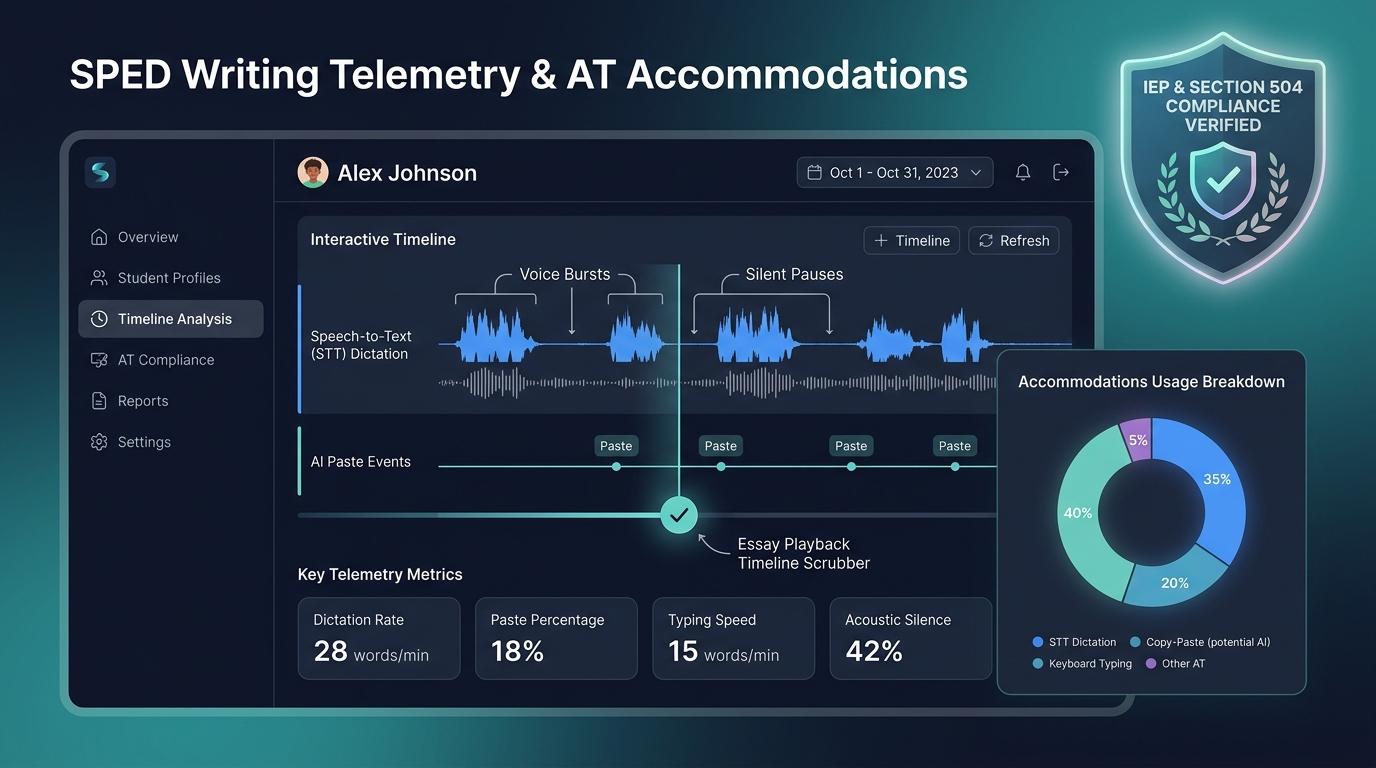
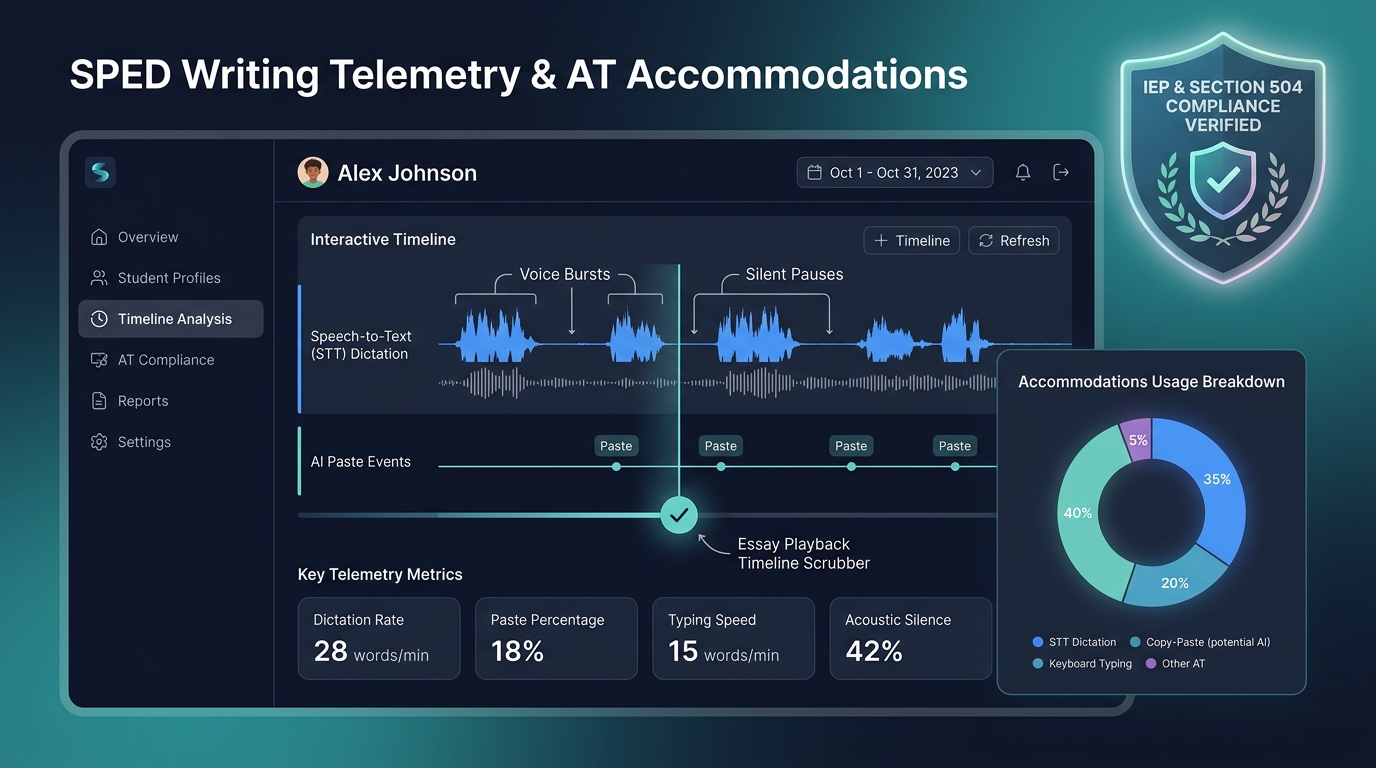
- The Speech-to-Text (STT) "Burst Injection" Trap: When a student with severe dysgraphia or motor apraxia speaks into voice dictation software (such as Apple Dictation, Google Voice Typing, or Dragon NaturallySpeaking), the operating system's speech recognition engine processes the acoustic stream in memory and delivers the recognized sentence into the document in a rapid 50-to-100-word buffer. Coarse document revision checkers (such as Google Docs standard version history) do not log the micro-pauses of speech; they record an instantaneous insertion of a complete paragraph. To a generic revision scanner, this looks completely indistinguishable from a user pasting a paragraph from ChatGPT.
- Constrained Perplexity from Word Prediction Engines: Word prediction and assistive vocabulary software (e.g., Co:Writer, Read&Write, WordQ) assist students with specific learning disabilities by predicting upcoming words based on initial phonemes and semantic context. By design, these tools suggest grammatically standard, highly probable lexical choices. When an autistic student or a student with an executive functioning disability relies on word prediction, the resulting prose exhibits uniformly high statistical predictability (low perplexity)—the exact statistical signature that commercial AI detectors use to classify text as synthetic.
- Non-Linear Drafting and "Bricolage" Assembly: Students with ADHD, executive dysfunction, or traumatic brain injuries rarely compose essays linearly from Introduction to Conclusion. They compose in modular chunks—brainstorming bullet points in personal digital scratchpads (Apple Notes, Google Keep, Notion), composing the evidentiary counterargument first, and copying structural outlines into the LMS submission portal. Static detectors and naive diff algorithms misread these non-linear movements as disingenuous assembly.
- Phonological Correction Scaffolds: Grammar and spell-check engines tailored for special education (such as assistive phonetic checkers) automatically normalize unconventional syntax. Legacy AI detectors interpret this polished surface fluency as machine-generated output, penalizing the student for the exact accommodation granted to level their educational playing field.
The Devastating Human Cost: Trauma, Masking, and Academic Paralysis
For a general education student, a false accusation of academic dishonesty is stressful; for a special education student, it is often catastrophic. Neurodivergent students—particularly those with ADHD and autism—frequently experience Rejection Sensitive Dysphoria (RSD), an extreme emotional vulnerability to perceived failure, criticism, or unjust condemnation. When a student who has spent six exhausting hours dictating, re-listening, and refining an essay through assistive technology is confronted with a teacher stating, "The software says your essay is 88% AI-generated," the psychological consequences can derail months of therapeutic and pedagogical progress:
- Writing Task Avoidance & Mutism: Students abandon their writing assignments entirely, refusing to type or speak into assistive software out of terror that their authentic effort will be labeled fraudulent.
- Detrimental Masking & Accommodation Abandonment: Students deliberately turn off their speech-to-text tools, word prediction, and grammar assistance, attempting to write entirely by hand or through agonizing, unassisted keystrokes. This results in severe physical cramping, cognitive exhaustion, and plummeting academic performance.
- Erosion of Student-Teacher Trust: The fundamental therapeutic alliance between the student, the general education teacher, and the special education case manager is shattered by an adversarial, black-box accusation.
2. The Federal Legal Framework: IDEA, Section 504, and Title II of the ADA
Academic integrity policies and automated surveillance tools do not operate in a legal vacuum. In the United States, federal statutory mandates strictly protect the rights of students with disabilities to access assistive technology accommodations without facing discriminatory barriers, disparate impact, or punitive administrative actions.
IDEA (Individuals with Disabilities Education Act)
Public school districts are legally obligated to provide every eligible child with a Free Appropriate Public Education (FAPE) tailored through an Individualized Education Program (IEP).
- Assistive Technology Mandate (34 CFR § 300.105): AT devices and services are federally binding contracts.
- Denial of FAPE: Penalizing a student for using speech-to-text violates substantive FAPE guarantees.
- Manifestation Determination Reviews (34 CFR § 300.530(e)): Required prior to disciplinary sanctions.
Section 504 of the Rehabilitation Act
Protects students with physical or mental impairments that substantially limit major life activities (learning, concentrating, thinking, communicating, manual tasks).
- Non-Discrimination & Equal Access (34 CFR § 104.4): Prohibits unequal educational benefits.
- Disparate Impact: Deploying AI detectors that systematically flag AT output creates illegal systemic discrimination.
- Accommodation Protection: Dictation, scratchpad drafting, and extended time are non-penalizable rights.
Title II of the ADA (Americans with Disabilities Act)
Extends non-discrimination protections across all public entities, including state colleges, universities, and K-12 public school systems.
- Auxiliary Aids and Services (28 CFR § 35.160): Must furnish appropriate voice and speech software.
- Prohibition of Administrative Burdens: Interrogating students solely for using auxiliary aids is unlawful.
- Equal Communication: Dictated text must be afforded equal academic validity to handwritten text.
FERPA & OCR Enforcement Precedent
U.S. Department of Education Office for Civil Rights (OCR) requires objective factual evidence for disciplinary actions.
- Right to Inspect Records (FERPA § 99.10): Black-box AI scores cannot withhold decision factors.
- Probabilistic Inadmissibility: Statistical percentages fail legal burdens of proof in due process.
- Multi-Evidence Standard: Primary empirical records (keystrokes, raw paste buffers) required.
Comprehensive Legal & Technical Compliance Matrix
Federal Special Education Compliance Matrix
Evaluation of integrity technologies against federal statutory mandates and civil rights standards.
| Federal Legal Mandate | Regulatory Requirement | Commercial AI Detectors | Coarse Revision History | Checkmark Writing Telemetry |
|---|---|---|---|---|
| IDEA (34 CFR § 300.105) Assistive Technology |
Lawful provision and unpenalized use of AT devices and software. | Non-Compliant: Flags STT text bursts and word prediction as AI generation. | Inadequate: Records sudden text jumps without identifying assistive input source. | Fully Compliant: Tags AT hardware/software APIs; provides scrubbable video proof of dictation. |
| Section 504 (34 CFR § 104.4) Non-Discrimination |
Equal access to curriculum without discriminatory disciplinary screening. | High Liability: Systemic disparate impact against neurodivergent writers. | Vulnerable: Creates misleading suspicion when students paste from external scratchpads. | Fully Compliant: Exonerates accommodations; distinguishes legitimate notes from illicit drops. |
| Title II ADA (28 CFR § 35.160) Auxiliary Aids |
Protection and full integration of auxiliary communication aids. | Non-Compliant: Treats auxiliary voice input tokens as algorithmic anomalies. | Inadequate: Cannot verify voice dictation pauses or speech mechanics. | Fully Compliant: Visualizes audio pause intervals, voice chunking, and phonological editing cycles. |
| FERPA (34 CFR § 99.10) Right to Inspect Records |
Student and parent right to inspect all primary evidence used for sanctions. | Non-Compliant: Vendors hide neural weights and decision criteria as trade secrets. | Partial: Provides raw revision lists but lacks fine-grained behavioral context. | Fully Compliant: 100% transparent, exportable multi-evidence dossier with session telemetry. |
| IDEA (34 CFR § 300.530) Due Process & MDR |
Defensible, objective evidence required for manifestation reviews. | Inadmissible: Probabilistic percentage cannot satisfy legal burden of proof. | Weak: Insufficient detail to prove cognitive effort during drafting. | Gold-Standard Legal Proof: Microsecond keystroke telemetry and video replay admissible in hearings. |
3. Telemetry Forensics: Deconstructing Assistive Technology Signatures vs. LLM Fraud
To effectively defend students and eliminate false accusations, Special Education Case Managers and general education teachers must understand the forensic differences between authentic assistive technology telemetry and unauthorized generative AI misconduct. When examined at the microsecond level, human cognitive labor utilizing assistive technology leaves a distinct, indelible behavioral footprint that no generic large language model (LLM) or illicit copy-paste can replicate.
1. The Anatomy of Speech-to-Text (STT) Dictation Telemetry
When an individual dictates an essay, the cognitive process is deeply human, but the mechanical ingestion of text into the software happens in discrete steps:
Speech-to-Text (STT) Cognitive Telemetry Signature
The five-step physiological and mechanical cycle of authentic voice drafting.
2. Word Prediction Telemetry: Co:Writer, Read&Write, and WordQ
Word prediction software accelerates typing for students with fine-motor dysgraphia, physical disabilities, or severe orthographic processing challenges:
- The Telemetry Pattern: The student types 1 or 2 initial characters (e.g.,
p-h). The assistive prediction engine intercepts the keystroke and populates a floating numeric list of predicted words (1. photosynthesis, 2. philosophy, 3. physical). - The Selection Event: The student strikes a single function key (e.g., pressing
F1or1) or clicks the prediction box. The completed multisyllabic word (photosynthesis) is instantly injected into the string. - Distinguishing Feature: To an uncalibrated keystroke counter, typing a 14-letter word in 2 keystrokes looks like an automated script. However, high-resolution telemetry records the predictive API hook event, followed by normal inter-word cognitive latency (500ms–1,200ms) as the student selects their next conceptual thought.
3. Non-Linear "Rhizomatic" Drafting in ADHD and Autism
Neurodivergent writers frequently utilize a non-linear, multi-workspace composition strategy:
- External Graphic Organizers & Scratchpads: A student with executive functioning disorder outlines their arguments in a personal Google Keep document, Apple Notes file, or graphic organizer tool (e.g., MindNode, Inspiration).
- Modular Block Migration: When ready to assemble the final paper in the Canvas or Buzz LMS editor, the student copies a 150-word section of their own notes and pastes it into the document.
- The Forensic Proof: Unlike an illicit AI paste, the pasted content in Checkmark's External Paste Buffer Inspector reveals rough bullet points, half-formed thoughts, spelling errors, and vernacular phrases. Furthermore, once pasted into the document, the student engages in extensive reorganization, expanding the outline into full sentences through live keyboard drafting.
Forensic Telemetry Matrix: Accommodations vs. Misconduct
Multi-Dimensional Telemetry Breakdown: Accommodations vs. Misconduct
Microsecond-level behavioral parameters distinguishing lawful assistive tools from academic dishonesty.
| Telemetry Dimension | Speech-to-Text (STT) | Word Prediction (Co:Writer) | Scratchpad Outline Paste | Illicit LLM Copy-Paste | Mechanical Retyping |
|---|---|---|---|---|---|
| Text Insertion Speed | 50–150 words per burst (speech buffer). | Multisyllabic words appear in 1–2 keystrokes. | 100–300 words in a single paste event. | 300–1,000+ words in a single 0ms event. | Continuous 60–80 WPM typing with zero pauses. |
| Preceding Formulation Pause | Present: 3–8s cognitive/respiratory pause. | Present: 400–1,200ms selection pause. | Present: Drafted across earlier session timestamps. | Absent: Immediate paste upon document creation. | Absent: Starts typing complex text immediately. |
| Post-Insertion Behavior | High cursor jumping; homophone/spelling fixes. | Smooth transitions to next word formulation. | Extensive structural reorganization & expansion. | Zero editing; immediate submission or cosmetic tweaks. | Linear progression; zero macro-structural edits. |
| Punctuation Artifacts | Vocalized syntax tokens (period, comma). |
Standard predictive spacing. | Bullet points, shorthand symbols, fragments. | Polished, balanced compound-complex sentences. | Normal punctuation typed with uniform key latency. |
| Clipboard Buffer Content | Direct OS Voice API stream (no clipboard use). | Direct accessibility injection hook. | Preserved clipboard shows student's own rough notes. | Preserved clipboard contains raw ChatGPT prompt output. | Clipboard remains empty; text typed from second screen. |
4. Checkmark Plagiarism's Accessible Writing Telemetry & Essay Playback™ Suite
To eliminate algorithmic discrimination and protect special education accommodations, Checkmark Plagiarism has engineered the world’s first Accessible Writing Telemetry and Verification Suite. Designed specifically for K-12 and higher education environments, Checkmark moves beyond probabilistic guessing to deliver transparent, reproducible evidence.
Essay Playback™
1x to 8x scrubbable video replay reconstructing every keystroke, speech burst, active formulation pause, and cursor navigation event.
Paste Buffer Inspector
100% unredacted external clipboard preservation with jump-to-playback synchronization, proving outline origins versus AI drops.
Assistive Tech Tagging
Native hooks for Apple Dictation, Google Voice, Co:Writer, and Read&Write automatically tag accommodations and exempt them from AI flags.
1. Patent-Pending Essay Playback™ (1x to 8x Scrubbable Video Replay)
At the heart of Checkmark's platform is Essay Playback™, a revolutionary technology that reconstructs the entire writing session keystroke-by-keystroke, pause-by-pause, and edit-by-edit into a fluid, scrubbable video interface:
- Visualizing Assistive Drafting in Real Time: Case managers and general education teachers can hit play and watch a student compose at 1x, 2x, 4x, or 8x speed. When an STT user dictates, the playback visually highlights the speech buffer insertion, displays the auditory pause interval, and tracks the student’s cursor as they jump back to edit a misspelled word.
- Eliminating the Need for Adversarial Accusations: Instead of interrogating a student based on an abstract 85% AI detector score, the educator simply opens Essay Playback™. In 90 seconds of video review, the teacher sees the student's authentic cognitive wrestling, emotional pauses, and deliberate revisions.
- Objective Verification for IEP Teams: The playback serves as an immutable, objective record that can be presented during IEP annual reviews, parent conferences, or 504 accommodation audits to demonstrate student progress in written expression.
2. External Paste Buffer Inspector with 100% Raw Text Preservation
A primary cause of false AI accusations is the "opaque paste"—text appearing in a document that was drafted elsewhere. Checkmark completely demystifies paste events through its External Paste Buffer Inspector:
- Complete Pre- and Post-Paste Capture: When a student pastes text into the document, Checkmark captures and permanently stores 100% of the raw clipboard content at the exact millisecond of insertion. Even if the student subsequently edits, rewrites, or deletes every single word of the pasted text over the next two hours, the original clipboard payload remains fully inspectable.
- Jump-to-Playback Synchronization: Clicking any paste card in the sidebar immediately scrubs Essay Playback™ to the exact timestamp of the paste, highlighting what happened immediately before and after.
- Distinguishing Student Notes from AI Outputs: When an ADHD student pastes their rough outline from Apple Notes, the case manager can review the unedited clipboard text. The presence of informal shorthand, bullet points, spelling errors, and authentic personal phrasing instantly proves that the source material was the student's own human brainstorming, not an LLM generation.
3. Granular Passage-Level Sliders with Honest Short-Text Guardrails (<150w)
Traditional AI detectors provide a single, opaque, whole-document percentage (e.g., "76% AI"), which tells a teacher nothing about where or why the flag occurred. Checkmark replaces this black box with Passage-Level Granularity:
- Underlined Passage-by-Passage Cards: Checkmark underlines specific sentences and paragraphs directly within the essay, anchoring each highlight to an interactive evidence card in the sidebar.
- Calibrated Confidence Sliders: Each card displays a calibrated slider illustrating where the text falls between Typical Human Writing Style and Typical AI Syntactic Pattern, explaining the underlying linguistic metrics (perplexity and burstiness).
- Honest Guardrails on Short Text (<150 Words): Statistical AI detection is mathematically unreliable on short text samples. Below approximately 150 words, Checkmark displays an honest
N/Astatus with an explanatory tooltip, preventing false alarms on short answers, reading reflections, or introductory sentences. - Educator-Only Flag Statuses: All integrity flags (
Flagged,Resolved,Not Flagged,Approved Accommodation) are strictly private to teachers and case managers, preventing students from experiencing traumatic automated accusations.
4. Teacher-in-the-Loop Rubric Autograding & LMS Passback
Checkmark seamlessly bridges academic integrity and special education assessment:
- Custom Rubric Calibration: Teachers and case managers can configure assignment rubrics that include specific accommodation criteria (e.g., assessing idea development and argumentative depth while exempting minor dysgraphic mechanical errors).
- Quote-Anchored AI Drafting: The AI Autograder generates first-draft rubric scores, point breakdowns, and constructive feedback anchored directly to specific quotations from the student’s essay.
- Absolute Teacher Authority: All AI-drafted evaluations remain private drafts until the educator reviews, edits, and approves them.
- Direct LMS Grade Passback: With a single click, finalized scores and qualitative feedback sync directly back into the gradebooks of Canvas LMS (SpeedGrader), Buzz LMS, and Google Classroom, saving hours of manual data entry.
5. Step-by-Step Protocol: The 4-Phase Special Education Writing Verification Framework
To establish a standardized, legally defensible, and restorative workflow across school districts, Special Education Case Managers, 504 Coordinators, and General Education Teachers should implement Checkmark's 4-Phase Special Education Writing Verification Framework.
Accommodation Tagging & Baseline
- Step 1.1: Case Manager syncs student's IEP/504 AT accommodations into Checkmark LMS profile.
- Step 1.2: Establish student's baseline drafting telemetry (STT chunking rate, IKI distribution).
- Step 1.3: Provide student with transparent orientation ("Checkmark is here to protect your hard work").
Autonomous Ingestion & Deconstruction
- Step 2.1: Student drafts essay natively via Canvas, Buzz, Google Docs, or Checkmark Editor.
- Step 2.2: Engine tags AT API hooks, logs raw paste buffers, and maps passage linguistics.
- Step 2.3: Assemble Multi-Evidence Dossier with private, educator-only flag statuses.
Telemetry Audit & Video Playback
- Step 3.1: If flagged, Case Manager scrubs Essay Playback™ at 2x–4x review speed.
- Step 3.2: Inspect External Paste Buffer for rough brainstormed notes vs. unauthorized text.
- Step 3.3: Verify acoustic pause topography, verbal corrections, and word prediction flow.
Restorative Conference & Compliance
- Step 4.1: Mark report
Approved Accommodation / Resolvedwith brief compliance note. - Step 4.2: Conduct supportive 1-on-1 writing conference using playback as a coaching tool.
- Step 4.3: Export Telemetry Dossier PDF directly into student's IEP/504 annual review file.
6. Real-World Case Studies in Special Education Practice
To illustrate the transformative power of writing process replay and accessible telemetry, the following real-world case studies demonstrate how Checkmark resolves complex accommodation challenges in secondary and district-wide settings.
Marcus T.: Severe Dysgraphia Exonerated from an 85% AI Detector Flag
Student Profile: Marcus T., an 11th-grade student in AP English Literature, has developmental dysgraphia and fine-motor apraxia. His IEP mandates speech-to-text dictation (Apple Dictation) for all extended writing tasks.
The Allegation: Marcus submitted a 1,400-word literary analysis on Wuthering Heights. A legacy AI detector flagged the essay as "85% Probability of AI Generation," prompting the teacher to initiate a disciplinary referral and propose course removal.
Case Manager Telemetry Audit: Special Education Case Manager Ms. Kowalski paused the referral and opened Checkmark:
- Essay Playback™: Reconstructed 2 hours and 45 minutes of drafting across three evening sessions.
- Acoustic Cadence: Telemetry captured 3-to-6 second formulation pauses preceding 12-to-25 word speech bursts, ending in vocalized syntax commands (
comma,period). - Phonological Micro-Edits: Recorded Marcus manually repositioning his cursor 38 times to fix homophones (e.g. "earn" → "urn", "heath" → "Heathcliff").
✓ Resolution: Referral dismissed immediately; grade restored to 94% (A); school standardized mandatory Essay Playback™ reviews for all accommodated students.
Chloe R.: ADHD Working Memory & Authentic Rhizomatic Drafting
Student Profile: Chloe R., an 8th-grader with ADHD (Combined Type), has a 504 plan authorizing digital graphic organizers, scratchpads, and extended drafting time.
The Allegation: During an Industrial Revolution DBQ essay, the teacher observed a 280-word paragraph appear in Canvas LMS in 0 milliseconds, suspecting an illicit ChatGPT paste.
Case Manager Telemetry Audit: 504 Coordinator Mr. Henderson reviewed Checkmark's External Paste Buffer Inspector:
- Unredacted Clipboard Content: Preserved payload showed Chloe's rough Google Keep notes: "* Doc C factory rules: kids worked 14 hrs / beaten with straps if late; * my idea: owners cared more about machines than humans".
- Post-Paste Video Replay: Playback proved Chloe spent 22 minutes actively drafting full sentences around each bullet point, deleting shorthand notes, and adding transitional analysis.
✓ Resolution: Allegation dismissed; pattern recognized as textbook rhizomatic drafting; playback video used in resource room to celebrate executive functioning progress.
1,500-Student School District Resolves Federal OCR Title II Inquiry
District Profile: A suburban unified school district with 1,500+ students on active IEPs/504 plans faced an OCR inquiry alleging that automated AI detectors disproportionately penalized students using assistive technology.
The Solution: The district suspended legacy tools and deployed Checkmark Plagiarism across Canvas LMS and Google Classroom:
- System-Wide AT Tagging: Automated recognition of OS voice APIs and extensions (Co:Writer, Read&Write).
- Policy Reform: Strictly prohibited sanctions based on standalone AI percentages; mandated Multi-Evidence Dossier review.
- Case Manager Training: Trained 85 case managers to utilize Essay Playback™ for annual IEP review documentation.
✓ Resolution: OCR investigation dismissed with prejudice; federal investigators praised Checkmark's process-based verification as a national model for educational equity.
7. Case Manager Implementation Toolkit: IEP/504 Accommodation Boilerplate & Advocacy Protocols
To ensure that assistive technology writing accommodations are legally binding, clear, and technologically defensible, Special Education Case Managers and 504 Coordinators should incorporate standardized, robust language into IEP and 504 documents.
Document specific fine-motor, orthographic, or executive functioning barriers in written expression. Record baseline typing speed versus verbal expression capabilities.
Explicitly name authorized software/hardware tools (STT dictation, Co:Writer, digital graphic organizers). Authorize non-linear drafting, external scratchpad assembly, and multi-session composition.
Mandate process-based writing telemetry (Checkmark Essay Playback™) for integrity verification. Explicitly prohibit disciplinary sanctions or grade penalties based on standalone AI detector scores. Require Case Manager consultation prior to initiating inquiries.
Ready-to-Use IEP and Section 504 Accommodation Plan Boilerplate Clauses
Case managers may adapt and paste the following legally vetted clauses directly into their district’s IEP and 504 management systems (e.g., SEIS, IEP Direct, PowerSchool Special Programs):
"Accommodation — Assistive Technology for Written Expression: The student is authorized to utilize Speech-to-Text (STT) voice dictation software (e.g., Apple Dictation, Google Voice Typing, Dragon NaturallySpeaking) and/or word prediction software (e.g., Co:Writer, Read&Write) for all written assignments, essays, reading responses, and assessments across all academic subjects. The student shall not be required to produce unassisted handwritten or manually typed drafts when completing extended written tasks. The use of these assistive tools represents a lawful educational accommodation under IDEA and Section 504 and shall not be construed as unauthorized automated assistance."
"Accommodation — Alternative Composition Modalities: Due to documented executive functioning and working memory challenges, the student is permitted to compose written assignments non-linearly using external digital scratchpads, graphic organizers, bulleted outlines, and multi-window note-taking tools (e.g., Google Keep, Apple Notes, MindNode). The student is explicitly authorized to transfer (copy/paste) self-generated outlines, notes, and draft sections into the primary learning management system (LMS) or submission document without penalty."
"Protocol — Academic Integrity and Writing Process Verification: In accordance with Section 504 and Title II of the ADA, the student’s written submissions shall NOT be subject to academic penalties, disciplinary referrals, or mandatory rewrites based on opaque, commercial statistical AI detection percentages or uncalibrated revision checkers. In the event that a classroom teacher questions the authorship or originality of a submission, verification of authentic student labor shall be conducted exclusively through objective, process-based writing telemetry and patent-pending keystroke replay (Checkmark Essay Playback™). The Special Education Case Manager / 504 Coordinator must be notified and consulted to review writing telemetry and paste buffers prior to any formal communication with the student or parent regarding academic integrity concerns."
Case Manager Advocacy Checklist for Academic Dishonesty Inquiries
Case Manager 6-Step Advocacy Checklist
Standard operating procedure when a student with an IEP or 504 plan faces integrity questions.
Issue formal written notice placing an immediate administrative hold on proposed grade penalties or referrals under 34 CFR § 300.530.
Confirm active accommodations for speech-to-text, word prediction, graphic organizers, or extended drafting time.
Access the essay directly within Canvas SpeedGrader, Buzz LMS, or Google Classroom via the Checkmark LTI 1.3 integration.
Scrub playback at 2x–4x speed to observe drafting progression, STT formulation pauses (3–8s), and phonological self-corrections.
Inspect raw clipboard cards to verify that pasted text contains student brainstorms or authorized quotes rather than raw LLM outputs.
Set status to Approved Accommodation / Resolved, share verified summary with teacher, and file the Telemetry PDF in the student's IEP folder.
8. Frequently Asked Questions (FAQs)
1. Why do generic commercial AI detectors flag speech-to-text (STT) dictation as AI-generated writing?
Commercial AI detectors evaluate text based on two statistical properties: perplexity (word choice predictability) and burstiness (sentence structure and length variation). When students use speech-to-text dictation, they tend to speak in complete, grammatically standard clauses with consistent cadence, producing text with lower lexical perplexity than raw, unassisted student typing. Furthermore, because speech recognition engines deliver transcribed sentences in rapid API data packets (e.g., 20 words appearing in 150 milliseconds), naive document revision checkers misclassify these voice bursts as copy-pasted LLM text. Checkmark eliminates this failure by analyzing the microsecond-level acoustic pause topography, vocalized punctuation tokens, and subsequent phonological edits that uniquely characterize human voice composition.
2. How does Checkmark protect student privacy under FERPA, COPPA, and special education regulations?
Checkmark adheres to strict enterprise-grade educational privacy and security standards. All student submissions, keystroke telemetry streams, and case manager files are fully encrypted in transit (TLS 1.3) and at rest (AES-256). Most importantly, Checkmark provides an explicit, legally binding Zero Model Training Guarantee: student essays and telemetry are never cached in public repositories, shared with third-party vendors, or used to train commercial generative AI models. Case manager notes, accommodation tags, and integrity flag statuses are strictly private to authorized educators, fully complying with FERPA (34 CFR Part 99) and COPPA regulations.
3. Can Checkmark’s Essay Playback™ distinguish between an outline pasted from Apple Notes versus text pasted from ChatGPT?
Yes, completely. Checkmark’s External Paste Buffer Inspector captures and permanently stores 100% of the unedited clipboard content at the millisecond of insertion, regardless of whether the text is later modified in the document. When a student pastes their own outline from Apple Notes, Google Keep, or a graphic organizer, the preserved clipboard card reveals informal bullet points, shorthand notes, spelling errors, and authentic personal phrasing. Conversely, if a student pastes an illicit LLM response, the clipboard card displays full, polished prose matching AI syntactic distributions. Furthermore, clicking the paste card in Checkmark instantly scrubs Essay Playback™ to that exact moment in the video timeline to show how the student interacted with the pasted text.
4. What should a case manager do if a general education teacher assigns a zero based on a commercial AI detector score?
The case manager should immediately issue a formal notification to the teacher and school administration reminding them that assigning a disciplinary or grading penalty to a student with an IEP or 504 plan based on an unverified algorithmic score constitutes a potential denial of FAPE under IDEA and Section 504. The case manager should request that the penalty be placed on hold, open the submission in Checkmark Plagiarism, review the Essay Playback™ and paste buffer telemetry, and provide the teacher with an objective Telemetry Dossier demonstrating authentic drafting labor. If the teacher remains unpersuaded, the case manager should convene an IEP Team / 504 meeting to formally resolve the accommodation implementation.
5. How does word prediction software like Co:Writer appear in Checkmark’s keystroke telemetry?
When a student uses word prediction software, the tool injects completed multisyllabic words based on 1 or 2 typed initial letters. Checkmark captures these events through its native Assistive Technology Telemetry Tagging and accessibility API hooks. The telemetry logs the predictive selection event, followed by natural inter-word cognitive pauses (400ms–1,200ms) as the student reads and selects their next concept. Unlike illicit scripting or automated macro injections, word-predicted writing displays human rhythm, variable sentence lengths, and continuous contextual progression across the drafting timeline.
6. Does Checkmark integrate directly with our district’s LMS (Canvas, Buzz, Google Classroom)?
Yes. Checkmark provides seamless, certified LTI 1.3 integrations for Canvas LMS (including native embedding within Canvas SpeedGrader), Buzz LMS, Google Classroom, and Moodle, as well as add-ons for Google Docs and Microsoft Word. Case managers and teachers can launch Essay Playback™, review paste buffers, inspect passage-level AI confidence sliders, and utilize AI-assisted rubric grading without ever leaving their standard LMS grading interface. Finalized grades and qualitative rubric feedback sync back into the district gradebook with a single click.
7. Can Essay Playback™ and Telemetry Dossiers be used as legal evidence in IDEA Due Process Hearings or OCR Audits?
Yes. In formal administrative hearings, state complaint investigations, and federal Office for Civil Rights (OCR) compliance audits, probabilistic AI percentages are routinely ruled legally inadmissible due to non-reproducibility and lack of primary factual evidence. In contrast, Checkmark’s Multi-Evidence Dossier and Essay Playback™ provide an immutable, microsecond-accurate digital audit trail bound to authenticated user sessions. This empirical record of keystrokes, active pauses, speech API triggers, and unedited clipboard buffers constitutes definitive primary evidence that satisfies the legal standard of proof in administrative law and special education compliance proceedings.
Conclusion: Stop Guessing, Start Trusting in Special Education
The promise of modern educational technology is to expand access, dismantle barriers, and empower every learner to express their unique voice and intellect. When school districts rely on blunt, probabilistic AI detection algorithms, they inadvertently betray that promise—punishing the very students who rely on assistive technologies to participate in the academic community.
Special Education Case Managers, 504 Coordinators, and IEP teams must have tools that reflect the reality of diverse cognitive modalities. By shifting the paradigm from opaque statistical surveillance to transparent writing process replay, Checkmark Plagiarism restores equity, dignity, and trust to the classroom.
With Essay Playback™, microsecond telemetry, and unredacted paste inspection, educators no longer have to guess whether an accommodation was legitimate. They can see the student’s thinking, validate their hard work, and champion their educational journey with total confidence.
Defend Assistive Accommodations and Eliminate False Accusations
Equip your district's case managers, 504 coordinators, and general education teachers with Checkmark Plagiarism’s patent-pending Essay Playback™, unredacted paste buffer inspection, and certified Canvas SpeedGrader integrations.