
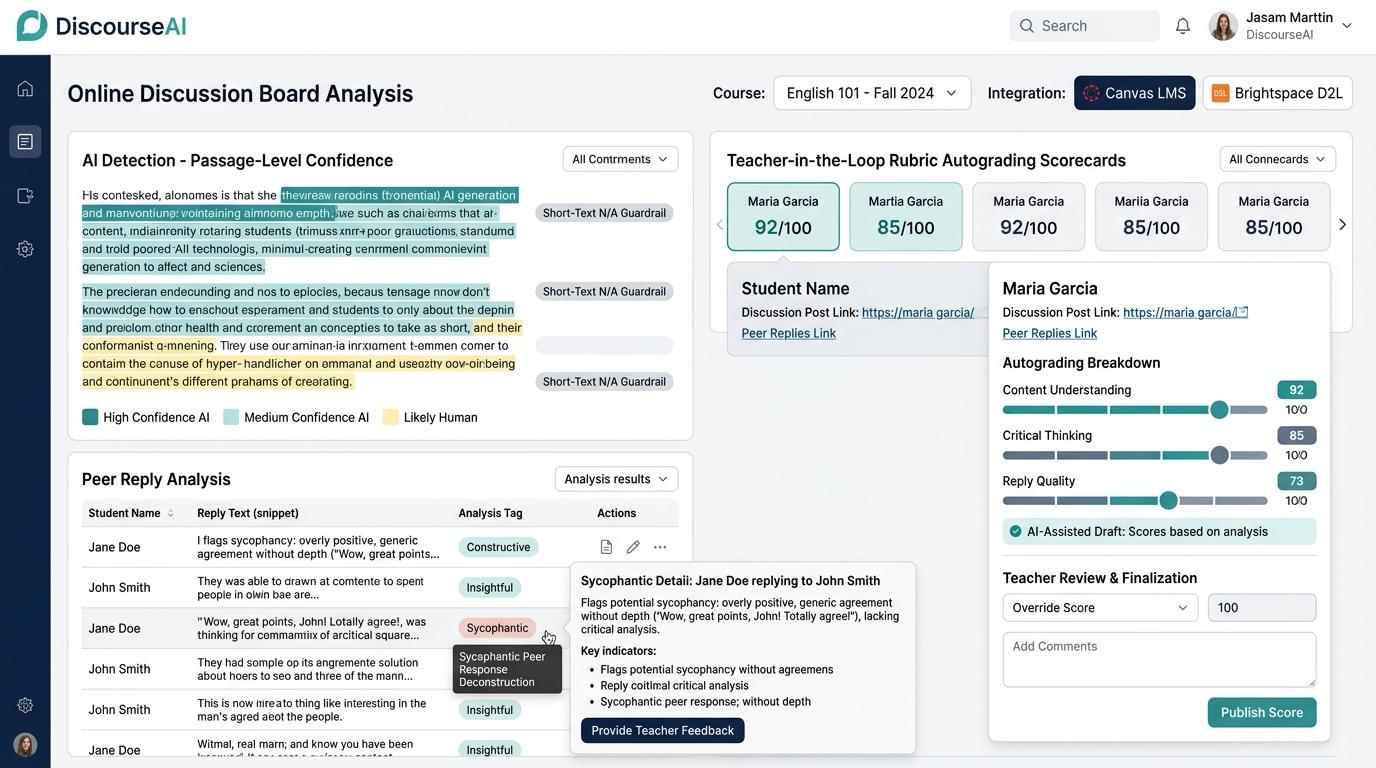
Asynchronous discussion boards—the foundational cornerstone of online higher education, community college coursework, and hybrid learning—are facing an existential authenticity crisis. Armed with Large Language Models (LLMs), students can generate polished 300-word initial discussion posts in seconds and fulfill mandatory “reply to two peers” requirements using sycophantic, formulaic AI prompts (“Great post, [Name]! I really loved how you articulated...”). Standalone black-box AI detectors fail catastrophically in discussion forums because short texts (under 150–200 words) lack the statistical token volume required for reliable perplexity and burstiness analysis, triggering unacceptably high false-positive rates on earnest, formulaic student writing. Rooted in Checkmark Plagiarism's core philosophy of “Stop guessing, start trusting,” this guide delivers an authoritative roadmap for online faculty, department chairs, and instructional designers. By pairing passage-level linguistic calibration, cross-cohort peer-matching, honest short-text guardrails (N/A disclaimers under 150 words), and authentic instructional prompt engineering, educators can dismantle AI discussion fatigue, protect student trust, and restore genuine intellectual discourse across Canvas LMS and D2L Brightspace.
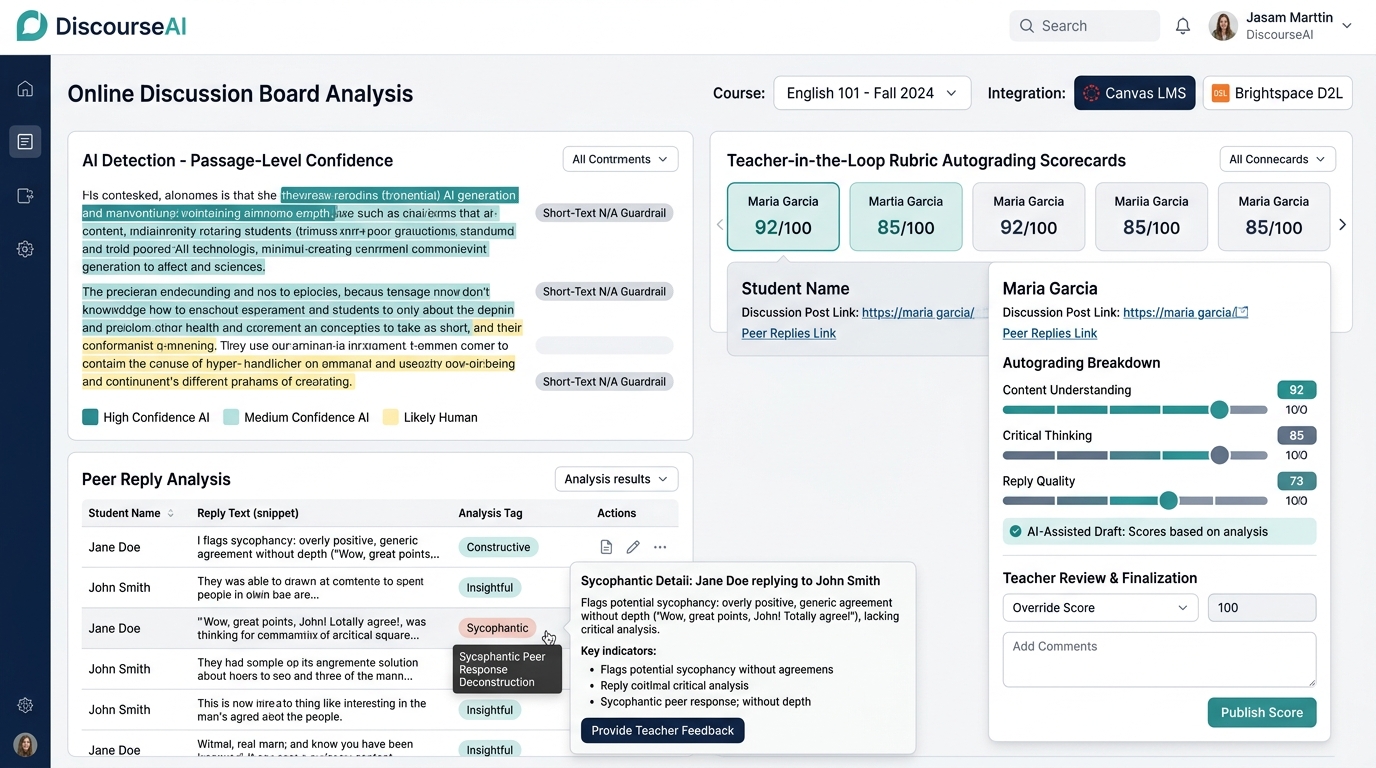
Checkmark Plagiarism equips online faculty and instructional designers with transparent academic integrity tooling, combining passage-level AI detection with patent-pending Essay Playback™ writing telemetry, cross-cohort peer matching, and teacher-in-the-loop rubric autograding embedded directly within Canvas LMS SpeedGrader and D2L Brightspace Quick Eval.
1. The Asynchronous Crisis: How Generative AI Broke the LMS Discussion Board
For over two decades, the asynchronous discussion board has served as the primary proxy for classroom attendance, participation, and peer-to-peer engagement in online learning. In platforms like Canvas LMS and D2L Brightspace, the standard pedagogical formula has remained virtually unchanged:
While this model was designed to foster collaborative inquiry and critical reflection, it has long suffered from what instructional designers term “discussion board fatigue”—a transactional mindset where students treat posting as a compliance hurdle rather than an authentic dialogue.
The emergence of generative AI has transformed this underlying fatigue into full-scale industrial automation. Online faculty and community college adjuncts managing 150 to 300 students across multiple asynchronous sections now face forums flooded with synthetically generated prose, hallucinated textbook citations, and robotic peer flattery.
- Read assigned module literature.
- Synthesize concepts with lived experience.
- Draft personal, voice-driven initial post.
- Read peers' genuine arguments and counter-claims.
- Challenge, refine, or build on peer claims.
- Copy LMS prompt into LLM.
- Prompt: “Write a 3-paragraph post with citations.”
- Paste response directly into Canvas thread.
- Copy peer's post → Prompt: “Write an agreeable reply.”
- Paste sycophantic peer response before 11:59 PM deadline.
When bots converse with bots in an LMS forum while an underpaid adjunct grades them with a generic rubric, the educational contract collapses. Online instructors cannot simply ban AI or abandon discussion boards entirely without eliminating the primary vehicle for regular and substantive interaction (RSI) mandated by federal Title IV accreditation standards.
Instructors need a comprehensive strategy that combines technical telemetry, linguistic pattern literacy, and authentic pedagogical redesign.
2. Anatomy of Synthetic Discussion Content: Deconstructing Posts & Peer Replies
Detecting AI in discussion boards requires understanding the specific structural, linguistic, and behavioral markers that LLMs produce when prompted to complete asynchronous assignments.
Generative models rely on statistical next-token prediction, which produces distinctive structural artifacts when operating in conversational or semi-formal academic contexts.
The Synthetic 3-Paragraph Essayette
Initial posts opening with verbatim prompt restatements, followed by rigid three-point elaboration triads and panoramic non-committal conclusions.
The Sycophantic Echo Chamber
Peer replies featuring hyperbolic praise (“Great post, [Name]!”), restatement of classmate ideas disguised as validation, and tacked-on philosophical questions.
The Phantom Citation Composite
Confabulated textbook page numbers, non-existent studies attributed to real journal titles, and fabricated quotes designed to fulfill citation rubrics.
Archetype 1: The 3-Paragraph Synthetically Polished Initial Post
When an LLM is asked to answer a discussion prompt (e.g., “Discuss the role of monetary policy in curbing inflation, referencing Chapter 12”), it defaults to a recognizable macro-structure characterized by:
- The Comprehensive Prompt Restatement: The post opens with an elegant, perfectly balanced topic sentence that mirrors the prompt's syntax without adopting a personal conversational stance.
- The “Rule of Three” Body Paragraph: LLMs exhibit an overwhelming statistical preference for organizing arguments into triads (“First, open market operations... Second, reserve requirements... Finally, the discount rate...”), often joined by rigid transitional adverbials (“Furthermore,” “Moreover,” “Additionally,” “Consequently”).
- The Panoramic Conclusion: The final paragraph summarizes the preceding points in a sweeping, non-committal fashion (“Ultimately, balancing these mechanisms is essential for fostering macroeconomic stability in an ever-evolving global economy”).
- The Complete Absence of Grounded Specifics: Unlike authentic student writing—which frequently includes idiosyncratic examples, personal anecdotes, references to current news events, or confused questions about difficult textbook sections—the AI post remains uniformly smooth, detached, and abstract.
Archetype 2: The Sycophantic “Great Post, [Name]!” Peer Reply
Peer replies represent the single most heavily automated component of online coursework. Because peer replies carry lower point values (often 5 to 10 points) but require reading another student's work, students frequently feed their classmate's initial post into an LLM with the prompt: “Write a 100-word response agreeing with this post.”
This workflow generates a distinctive linguistic fingerprint known as the Sycophantic Validation Loop:
[1] “Great post, Marcus! I completely agree with your insightful perspective on the implications of supply chain bottlenecks during the post-pandemic recovery.
[2] You made an excellent point regarding how inventory shortages directly compound consumer inflation, which really highlights the delicate balance between supply and demand.
[3] Furthermore, your explanation of just-in-time manufacturing clearly demonstrated why diversifying logistics providers is crucial for mitigating future disruptions.
[4] Overall, your post was very well-written and thoroughly explained. Keep up the great work! How do you think international trade agreements will adapt to these challenges?”
Key Markers of the Sycophantic AI Peer Reply:
- Zero Dialectical Friction: The reply never politely disagrees, highlights a flaw in the original poster's logic, or introduces an alternative perspective.
- The “Echo Chamber” Paraphrase: It takes the key noun phrases from the peer's post and re-wraps them in passive academic adjectives.
- The Tacked-On Rubric Question: Because many course rubrics state “Must include a follow-up question to advance the discussion,” LLMs routinely generate a broad, philosophical question at the end that reads like a textbook review prompt rather than an authentic student query.
Archetype 3: The Hallucinated Textbook & Module Citation
To satisfy rubric criteria requiring citations, students often prompt models to “include quotes and page numbers from Chapter 5 of the assigned text.”
Because LLMs do not have persistent memory of specific textbook editions unless explicitly fine-tuned or provided with retrieval-augmented generation (RAG), they generate phantom citations:
“On page 142, the author talks about how cognitive dissonance makes people defend bad choices, which reminded me of the Enron example we watched in week 2.”
→ Matches assigned reading, connects directly to course module videos, displays informal but authentic synthesis.
“As Festinger notes, 'Cognitive dissonance operates as a fundamental psychological catalyst, compelling individuals to rationalize conflicting cognitions' (Festinger, 2018, p. 284).”
→ Leon Festinger passed away in 1989 (2018 is a phantom reprint), the quote is synthetically generated, and page 284 does not contain this passage.
When an online instructor checks the assigned PDF or physical textbook for the cited quote or page number, the text does not exist. The student did not manually copy the quote from an unassigned book; the model confabulated a quote that matched the semantic requirements of the prompt.
Archetype 4: Temporal & Telemetry Anomalies in Canvas and Brightspace
Beyond textual markers, learning management systems log critical behavioral telemetry that exposes automated posting behavior:
| Telemetry Marker | Authentic Student Behavior | AI-Generated / Automated Behavior |
|---|---|---|
| Drafting Duration in LMS Editor | Continuous typing with natural pauses, intermittent backspaces, and incremental draft saves over 15–45 minutes. | Total editor interaction time under 45 seconds; entire 350-word post appears via a single instantaneous paste event. |
| Initial-to-Reply Latency | Initial post submitted Thursday; peer replies submitted Saturday/Sunday after reading classmates' contributions. | Initial post and both peer replies submitted within a 3-minute window at 11:58 PM on Sunday night. |
| Peer Selection Pattern | Student selects peers whose topics interest them or who posted early in the week. | Student selects the very first two threads at the top of the forum (or the shortest threads) and pastes instant AI replies. |
| Cross-Thread Syntactic Clustering | Diverse sentence structures, varying vocabulary levels, unique informal idioms across the cohort. | Multiple students across different sections submit replies containing identical structural frameworks (“Great post! I really appreciated how...”). |
3. The Pedagogical & Evidentiary Dilemma of Short-Text AI Detection
While the markers described above are recognizable to experienced educators, enforcing academic integrity in discussion forums presents severe statistical and ethical challenges.
Online instructors cannot rely on generic, black-box AI detection scores when evaluating discussion board submissions.
1. The Statistical Collapse of Perplexity and Burstiness on Short Texts
Traditional AI writing detection models evaluate two primary statistical metrics:
- Perplexity: A measure of how likely a given sequence of words is to appear based on the model's training distribution. Low perplexity indicates that the text follows predictable, high-probability token paths (typical of AI), while high perplexity indicates unpredictable, creative, or idiosyncratic word choices (typical of human writers).
- Burstiness: A measure of sentence length and structural variation. Human writers exhibit high burstiness—mixing short, punchy declarative statements with long, complex, meandering clauses. AI models exhibit low burstiness—producing sentences of remarkably uniform length, cadence, and syntactic complexity.
Requires large token sample size (N > 250 words) to smooth out natural linguistic variance.
On 2-sentence peer replies, variance calculation collapses due to insufficient sample count.
When applied to a 2,500-word research paper, these statistical metrics have sufficient token volume to smooth out anomalies and generate stable probability distributions. However, on a 150-word discussion post or an 80-word peer reply, the sample size is far too small. A single technical term, a direct textbook quote, or an unusual grammatical choice can cause the calculated perplexity to swing wildly from 10% to 95%.
2. The False-Positive Trap: Formulaic Prompts Mandate Formulaic Responses
The highest risk of false-positive AI flags occurs when instructors assign low-level, formulaic prompts.
Consider a standard introductory business prompt: “Define Porter's Five Forces and provide one example of how supplier power affects retail pricing.”
Because there are only a finite number of ways to clearly define Porter's Five Forces in 150 words:
- A diligent, honest human student will write a structured, predictable paragraph with low burstiness and low perplexity.
- An LLM prompted with the same question will produce virtually the exact same text.
If an instructor runs this honest student's submission through a generic, whole-document AI detector, the detector may return an “88% AI Probability” score simply because the prompt demanded formulaic academic syntax. Accusing a student of academic dishonesty based on an opaque percentage on a 150-word post destroys student-teacher rapport, causes severe anxiety, and creates indefensible administrative disputes.
3. Checkmark's Honest Short-Text Guardrails: “Stop Guessing, Start Trusting”
To protect both faculty and students from unfair accusations, Checkmark Plagiarism implements strict Short-Text Guardrails:
The <150 Word Rule
Automatically displays N/A with an explicit informational banner: “Sample size insufficient for reliable statistical AI analysis.”
Passage-Level Granularity
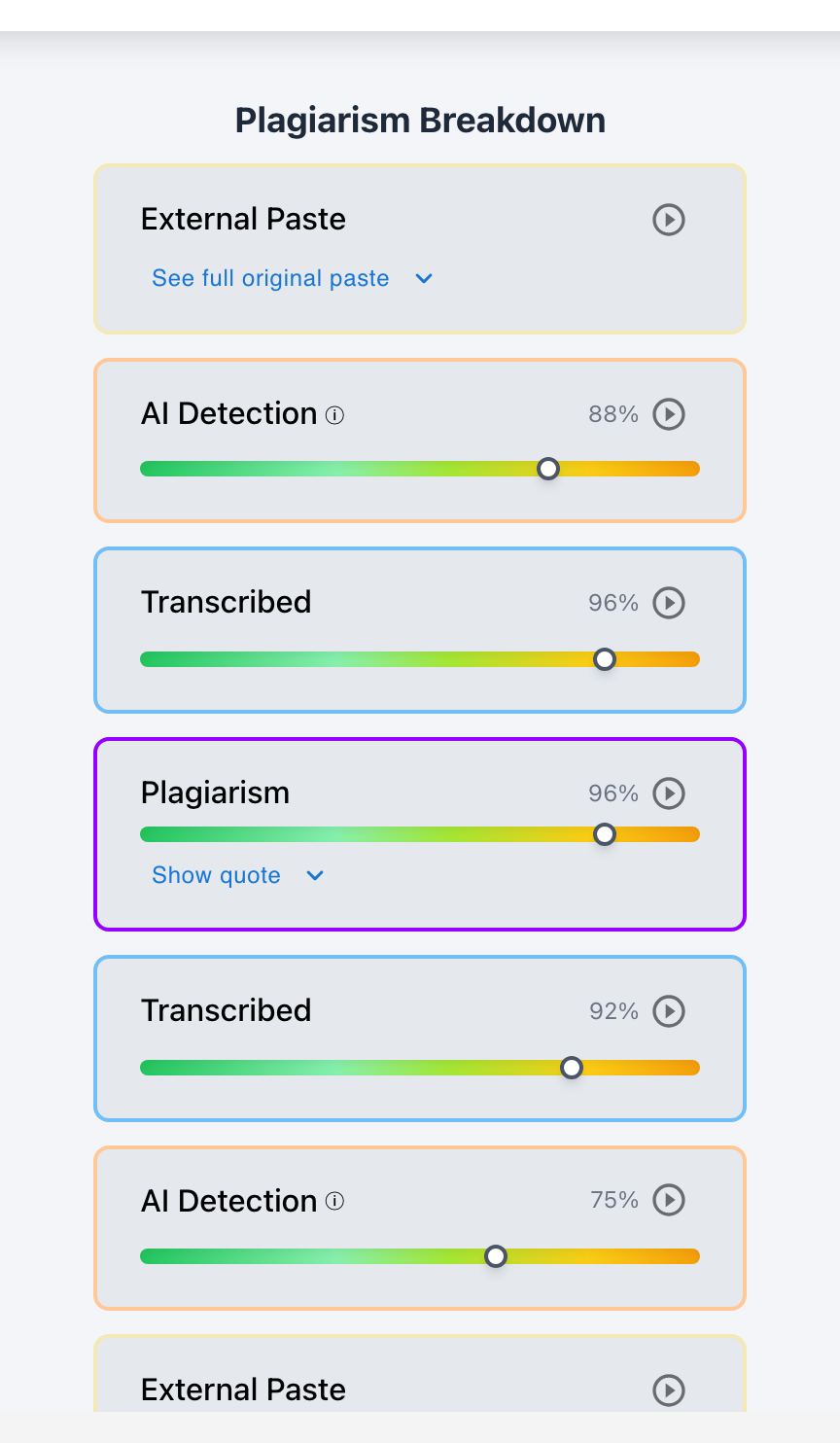
Highlights specific suspect sentences alongside calibrated confidence sliders (typical human writing style vs. typical AI pattern) rather than whole-doc scores.
Educator-Only Flag Status
All integrity flags (Flagged, Resolved, Not Flagged) remain private to educators, allowing instructors to investigate context before deciding whether a conference is warranted.
4. Telemetry & Detection Matrix: Evaluating LMS Forum Verification Tools
Online instructors and instructional technology committees must evaluate how different verification approaches handle the unique technical constraints of LMS discussion forums.
| Feature / Capability | Standalone Black-Box AI Detectors | Native LMS Plagiarism Scanners | Checkmark Plagiarism Multi-Factor Suite |
|---|---|---|---|
| LMS Discussion Ingestion | Manual copy-paste required for every post and peer reply. | Scans initial posts only; often ignores nested peer replies. | Automated LTI 1.3 Deep Linking across initial posts and threaded peer replies. |
| Short-Text Guardrails | 🔴 False-positive volatility | Reports vague similarity without text-length disclaimers. | 🟢 Strict <150 Word N/A Guardrail |
| Granularity of AI Analysis | Single opaque whole-document percentage (e.g. “72% AI”). | None or binary flag. | Passage-Level Highlight Cards with calibrated confidence sliders and linguistic metrics. |
| Student-to-Student Peer Matching | 🔴 None | Basic similarity matching against external web databases. | 🟢 Cross-Cohort Peer Matching |
| Writing Process Telemetry | None. | None. | Patent-Pending Essay Playback™ (keystroke velocity, paste capture, drafting timeline). |
| Rubric Autograding & Passback | None (purely punitive detection tool). | None. | Teacher-in-the-Loop AI Rubric Autograding with direct grade passback to SpeedGrader & Quick Eval. |
| Data Privacy & Student Training | Frequently caches text to train commercial LLMs. | Stores submissions in proprietary vendor databases. | 🟢 Zero Model Training • FERPA/COPPA |
Secure LTI 1.3 / API Token handshake extracts threaded discussion forums (initial posts, nested peer replies, and exact timestamps).
Separates initial posts vs. peer replies. Automatically applies the <150 Word N/A Guardrail to short replies while indexing cohort cross-matching.
Evaluates passage-level perplexity and burstiness, flags uncited textbook quotes, identifies hallucinated references, and scans billions of live web sources.
Presents two-way linked evidence cards alongside teacher-in-the-loop rubric autograding scorecards with one-click grade passback to the LMS gradebook.

5. Step-by-Step Online Faculty Audit Protocol for Canvas & Brightspace
When auditing asynchronous discussion boards for AI misconduct, online instructors and adjuncts should follow a systematic, objective, four-phase protocol designed to identify genuine violations while protecting honest students.
Batch Triage
- Scan submission timestamps (11:58 PM dump).
- Identify identical structural templates across threads.
- Spot “Great post, [Name]!” reply loops.
Citation Audit
- Review Checkmark passage-level cards.
- Verify cited textbook quotes via Ctrl+F.
- Check for dead links, phantom DOIs, or confabulated authors.
Peer Matching
- Cross-reference text across all course sections.
- Distinguish patchwriting from AI fabrication.
- Review Essay Playback™ where drafting docs exist.
Restorative Inquiry
- Send supportive, non-punitive email inquiry.
- Focus on student comprehension and process.
- Provide formative revision tied to learning outcomes.
Phase 1: Batch Forum Triage & Telemetry Screening
Before reading individual posts line-by-line, conduct a rapid high-level scan of the entire discussion board:
- Scan Timestamp Clusters in SpeedGrader / Quick Eval: In Canvas SpeedGrader, view the student's submission history. Did the student post their initial response and both peer replies within a 90-second window? In Brightspace Discussions, view the student's post statistics for posts submitted within seconds of opening the topic.
- Identify Sycophantic Reply Loops: Look for replies where the student begins with generic hyperbolic praise and simply paraphrases the original poster's words without adding new information.
- Cluster Macro-Structural Patterns: If five different students in the same class use the exact same three-part structure (“First, it is important to note... Furthermore... In conclusion...”), they likely copied the prompt directly into ChatGPT without custom prompting.
Phase 2: Passage-Level Linguistic & Citation Verification
When a specific post raises suspicion, examine the individual passages using Checkmark's evidence cards:
- Evaluate Sentence-Level Burstiness: Does the post maintain an unnaturally uniform sentence length (18–24 words per sentence) across every paragraph? Does it lack informal cadence, contractions, or personal perspective?
- Audit Citations and Direct Quotes: Perform a rapid keyword search (Ctrl+F) in the assigned digital textbook for any quoted phrases. If the student cites a specific page number, check that page to confirm the concept is actually there. If the student references an external study, check whether that study exists or is a confabulated hallucination.
Phase 3: Peer Matching & External Source Triangulation
- Run Cross-Section Cohort Analysis: Checkmark automatically scans submissions across all sections of the same course taught by the instructor or department, highlighting cases where a student in Section 001 copied an initial post from Section 002.
- Differentiate Citation Errors from AI Generation: If a student copied a paragraph from an online article without quotation marks, Checkmark flags it as an Uncited Source Match with a direct clickable link to the source (indicating traditional patchwriting). If the text has 0% web similarity but exhibits high syntactic uniformity and hallucinated citations, it indicates generative AI fabrication.
Phase 4: Restorative Inquiry & Formative Coaching
Accusing an online student of using AI via a hostile email or an automatic zero often triggers defensive denial and escalates to administrative appeals. Instead, use a restorative, evidence-anchored inquiry model:
Subject: Question regarding your Week 4 Discussion Post in [Course Name]
Dear [Student Name],
I was reviewing your initial discussion post and peer replies for Week 4 on [Topic]. I noticed that your post includes several insightful observations and cites a study by [Author, Year].
When I cross-referenced this citation with our assigned module literature, I was unable to locate the specific page numbers referenced, and the writing style differs notably from your earlier introductory reflection.
As part of our commitment to authentic academic discourse, I'd love to learn more about your research process. Could you reply with:
- The link or source document where you accessed the [Author] citation?
- A brief 2–3 sentence summary in your own words explaining how this concept applies to your current workplace or personal experience?
Alternatively, I am happy to jump on a quick 5-minute Zoom call during my office hours [Insert Times] to discuss your post. Looking forward to hearing from you!
Best regards,
Professor [Instructor Name]
- Zero Hostile Accusations: The email never uses inflammatory words like “cheating,” “caught,” or “AI detector.”
- Focuses on Intellectual Ownership: An honest student will readily explain where they found the source or clarify a formatting mistake. A student who used an LLM will typically admit they used an assistant or struggle to explain the concepts, opening a productive formative coaching pathway.
6. Instructional Redesign: Engineering “Uncheatable” & High-Engagement Discussion Boards
While automated detection tools provide essential guardrails, the most effective long-term defense against AI discussion abuse is instructional redesign.
Prompts that ask for generic summaries of textbook chapters invite AI completion because LLMs excel at summarizing public information. To foster authentic discourse, online instructors and instructional designers must redesign prompts to require situated, personal, and dialectical synthesis.
“Read Chapter 6 on Maslow's Hierarchy of Needs. Explain the difference between deficiency needs and growth needs. Reply to two peers.”
AI Vulnerability: 100%. ChatGPT can generate 50 unique variations of this summary in 3 seconds.
“1. Identify a time in your current or past workplace where a manager mistakenly treated a 'deficiency need' as a 'growth need' (or vice versa).
2. Based on your specific situation, what concrete policy change should leadership have made?
3. Peer Reply: Select one peer whose scenario differed fundamentally from yours. Politely challenge their policy change by introducing a potential unintended budget or staffing consequence.”
AI Vulnerability: Very Low. Requires authentic lived experience, localized organizational context, and dialectical peer friction.
Five Proven Instructional Strategies for Discussion Board Integrity
Experiential & Localized Anchoring
Require students to ground every theoretical concept in their own professional, geographic, or personal lived experience.
The “Draft & Defend” Protocol
Students draft initial posts with Essay Playback™ enabled, submitting a verified writing process link alongside their LMS post.
Assigned Role-Play Scaffolding
Assign opposing stakeholder roles (e.g. CFO vs. Union Rep vs. Auditor) to eliminate agreeable, sycophantic peer replies.
Multimodal Submissions
Students submit a 90-second casual video/audio reflection via Canvas Studio or Brightspace Media, reserving text for peer replies.
Multi-Stage Collaborative Problem-Solving
Structure forums as collaborative case studies where Student A posts the diagnostic case, Student B proposes the operational treatment plan, and Student C calculates the risk-benefit tradeoff.
Comparison: Traditional Prompts vs. Authenticity-Engineered Prompts Across Disciplines
| Discipline | Flawed / AI-Vulnerable Discussion Prompt | Authenticity-Engineered Discussion Prompt |
|---|---|---|
| Nursing & Healthcare | “Explain the difference between Type 1 and Type 2 diabetes management in geriatric patients.” | “Review the clinical chart in Case Study 4. Identify the two most conflicting medication orders for this specific patient, explain which one you would withhold first during your shift, and justify your decision based on hospital protocol.” |
| Business & Management | “Discuss the pros and cons of remote work policies for modern corporations.” | “Interview one colleague or friend currently working in a hybrid or remote role. Ask them for the single biggest communication breakdown they experienced this month. Post their anonymized case and propose an operational fix.” |
| Secondary Education / ELA | “Summarize the main themes of alienation in The Catcher in the Rye.” | “Select one passage (under 5 lines) from Holden Caulfield's conversation with Mr. Antolini that you found personally frustrating or confusing. Explain why you reacted that way and connect it to a modern social media dynamic.” |
| Computer Science & IT | “Explain how public-key cryptography works and why RSA is widely used.” | “Generate a public/private key pair using OpenSSL in your virtual lab terminal. Intentionally corrupt 1 byte of the encrypted message, post the resulting decryption error log, and explain what happened at the bit level.” |
7. How Checkmark Plagiarism Solves the Online Discussion Dilemma
Checkmark Plagiarism delivers an integrated, educator-centric solution built specifically to address the unique challenges of asynchronous discussions, high student volume, and short-text limitations in Canvas LMS and D2L Brightspace.
1. Passage-Level AI Evidence Cards
Underlines specific suspect sentences directly in SpeedGrader and Quick Eval with calibrated confidence sliders (Human Style vs. AI Pattern) rather than vague whole-document percentages.
2. Honest Short-Text Guardrails (<150 Words)
Automatically displays N/A on short peer replies to prevent false-positive accusations on formulaic student writing.
3. Side-by-Side Plagiarism & Peer Matching
Compares posts against billions of live web pages, uncredited textbook chapters, and other student submissions across all course sections with direct clickable source links.
4. Teacher-in-the-Loop AI Autograder & SpeedGrader Sync
Autogrades discussion threads against custom rubrics, generating quote-anchored formative feedback that faculty can review, edit, and push directly to LMS gradebooks with one click.
5. Zero Data Retention & FERPA Privacy Compliance
Guarantees student discussion posts and essays are never stored to train public AI models.

8. Frequently Asked Questions (FAQ)
1. Can generic AI detectors reliably identify AI in 100-word peer replies?
No. Generative AI detectors rely on statistical measures (perplexity and burstiness) that require adequate text length (N > 250 words) to achieve statistical reliability. On short texts under 150 words—such as standard peer replies—statistical variance is extremely high, leading to frequent false positives on honest, formulaic student writing. This is why Checkmark displays N/A for samples under 150 words rather than presenting an unreliable percentage.
2. What should I do if a student's initial post is flagged, but their peer replies show N/A?
Evaluate the initial post on its own merits using passage-level evidence cards and citation verification. Check whether the initial post contains hallucinated textbook quotes, non-existent sources, or identical structural framing found in other students' submissions. Use the peer replies formatively to assess whether the student demonstrates genuine conversational comprehension during a restorative conference.
3. How does Checkmark detect when a student copies an initial post from another section?
Checkmark's cross-cohort repository matching indexes all submissions within your institution's course sections. If a student in your Monday asynchronous section submits a post with substantial text overlap or paraphrased syntactic similarity to a post submitted in your Wednesday section, Checkmark highlights the match side-by-side with a timestamp comparison.
4. Is it possible for a student to “humanize” an AI discussion post using tools like QuillBot or Undetectable AI?
While text humanizers alter surface vocabulary to evade primitive whole-document perplexity filters, they cannot fake authentic course-specific context, verified textbook citations, or natural keystroke drafting dynamics. Furthermore, Checkmark's multi-factor linguistic analysis evaluates deep syntactic rhythms that text humanizers frequently disrupt, creating recognizable grammatical anomalies.
5. How does Checkmark protect student data and comply with FERPA in online courses?
Checkmark adheres to strict zero-training and zero-retention principles. Student discussion posts, essays, and peer replies are never used to train public or proprietary large language models. All data is encrypted in transit and at rest, maintaining full compliance with FERPA, COPPA, and institutional privacy standards.
6. Can I use Checkmark's AI Autograder without losing personal connection with my online students?
Yes. Checkmark's autograder operates strictly on a teacher-in-the-loop model. It generates draft rubric evaluations and quote-anchored feedback suggestions to save instructors hours of repetitive administrative typing. Instructors retain complete authority to edit comments, add personal encouragement, adjust point allocations, and approve feedback before it is published to the LMS gradebook.
7. How should I handle a student who insists their flagged discussion post was written entirely by them?
Follow Phase 4 of the Online Faculty Audit Protocol: conduct a restorative, non-punitive conference. Rather than debating AI detector scores, focus on the student's mastery of the content. Ask them to explain the concepts in their own words, provide the link to any cited sources, or explain how their argument connects to their workplace experience. If the student can articulate the concepts clearly, provide a formative revision opportunity and focus on fostering their ongoing intellectual growth.
Conclusion: Restoring Trust and Substance to Online Discourse
The rise of generative AI does not signify the death of the online discussion board; it signifies the end of lazy, formulaic compliance assignments.
When online courses rely on superficial prompts and punitive black-box detectors, everyone loses—students resort to automated shortcuts, and instructors drown in robotic grading fatigue.
By transitioning to authenticity-engineered discussion prompts, enforcing honest short-text guardrails, and leveraging Checkmark Plagiarism's transparent, passage-level integrity suite, online faculty, department chairs, and instructional designers can build virtual learning environments founded on genuine intellectual curiosity, defensible evidence, and mutual trust.
Stop guessing. Start trusting. Equip your online faculty with the tools to cultivate authentic student voices across every asynchronous course.