
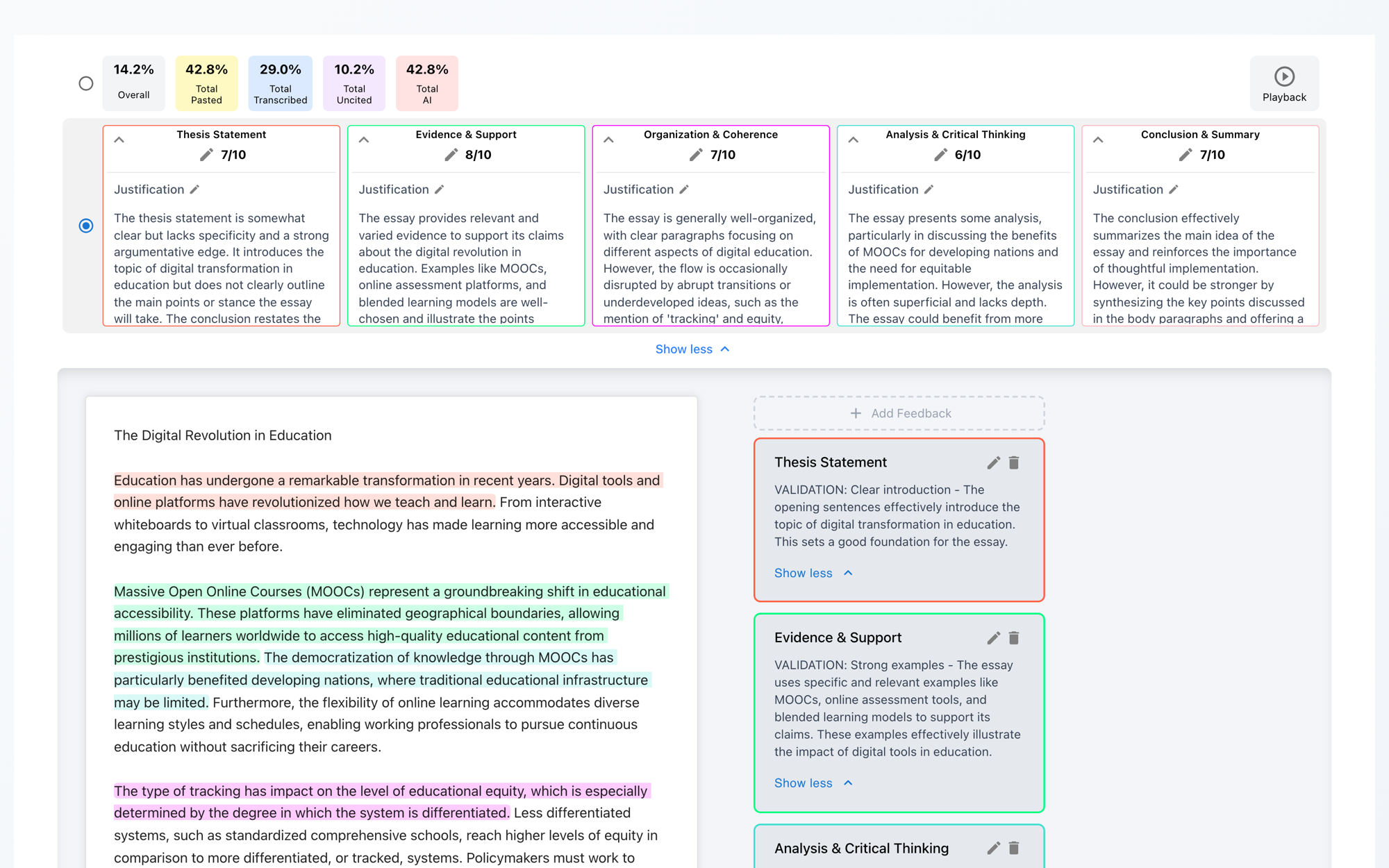
For Instructional Technology Coordinators, District IT Directors, and Virtual Academy Leaders utilizing Agilix Buzz LMS, scaling authentic writing assessment across personalized, continuous-enrollment, and competency-based pathways presents a severe operational bottleneck: the manual grading backlog. Traditional writing evaluation forces educators to juggle disconnected AI detection tools, web plagiarism scanners, and external spreadsheets, manually transcribing criterion scores into Buzz's mastery gradebook. By deploying Checkmark Plagiarism via 1EdTech LTI 1.3 Advantage—leveraging OpenID Connect (OIDC), Assignment and Grade Services (AGS 2.0), Names and Role Provisioning Services (NRPS 2.0), and Deep Linking 2.0 (LTI-DL)—districts can establish an enterprise-grade, bi-directional assessment bridge. This integration couples grounded, quote-anchored AI rubric autograding and patent-pending Essay Playback™ (keystroke dynamics and 100% paste preservation) directly inside Buzz Course Master templates and derivative child sections. Educators retain 100% pedagogical authority through a Teacher-in-the-Loop moderation console, slashing grading latency from 9+ days to under 48 hours while maintaining strict FERPA/COPPA zero-data-retention compliance.
Checkmark Plagiarism provides seamless enterprise interoperability for virtual and blended districts through its comprehensive suite of AI rubric autograding, writing process replay, passage-level AI detection, side-by-side plagiarism checking, and native Agilix Buzz LMS integration.
The Virtual & Competency-Based Assessment Dilemma in Agilix Buzz LMS
Agilix Buzz LMS occupies a distinct and vital position within the K–12 and postsecondary educational technology landscape. As the leading engine for statewide virtual academies, regional educational service agencies (RESAs), personalized learning districts, and competency-based education (CBE) consortia, Buzz is architected specifically for flexible, student-centered pacing.
Unlike traditional semester-bound learning management systems, Buzz thrives on non-linear learning workflows:
- Continuous Enrollment Pipelines: Students matriculate, progress, and finish courses at individualized velocities throughout 365 calendar days.
- Multi-Tiered Domain Hierarchies: District administrators manage complex parent-child domain structures where curriculum is authored once in Course Masters, inherited across Base Courses, and instantiated in thousands of Derivative Child Sections.
- Dual-Architecture Gradebooks: Buzz calculates both traditional points-based letter grades and standards-aligned Competency & Mastery Matrices, mapping individual assessment criteria to state and district performance indicators.
• AGS 2.0 Real-Time Grade Passback
• AGS 2.0 Real-Time Grade Passback
The Asynchronous Grading Bottleneck
While Buzz excels at automarking objective formative assessments (quizzes, interactive modules, and digital workbooks), open-response qualitative writing assignments present a critical structural chokepoint.
In an asynchronous or mastery-based virtual academy, when a student submits a major synthesis essay, persuasive argument, or DBQ (Document-Based Question), their forward curriculum progression often pauses until that essay is evaluated against state mastery rubrics.
When instructors manage cohorts of 120 to 180 remote students, manual essay evaluation creates an unsustainable grading backlog:
A 9-day feedback delay completely breaks personalized learning velocity. By the time an instructor returns an essay with rubric feedback, the student has either stalled their pacing or moved into subsequent units without remediating foundational writing deficiencies.
The Breakdown of Legacy Integrity & Grading Tools
Instructional Technology Coordinators attempting to solve this challenge with legacy edtech software encounter three systemic failure modes:
- The “Black-Box Score” Crisis: Legacy AI detectors output a single whole-document percentage (e.g., “78% AI Detected”) with zero passage-level explanation or behavioral evidence. In virtual settings, where teachers lack daily face-to-face rapport, false-positive flags destroy teacher-student trust and trigger contentious administrative appeals.
- The Manual Gradebook Transcription Tax: Disconnected grading assistants require teachers to review essays in one browser tab, manually toggle to Buzz's grading screen, click individual rubric cells, copy-paste narrative feedback, and manually trigger mastery completions. This multi-tab workflow consumes 12 to 15 minutes per submission in pure clerical mechanics.
- Broken LTI 1.1 / CSV Pipelines: Outdated LTI 1.1 integrations only support raw numeric score passback to a single gradebook cell. They cannot communicate individual rubric criterion scores, cannot attach grounded textual evidence, and frequently fail when syncing derivative child courses under Buzz's domain inheritance model.
| Assessment Feature | Legacy Tooling Pipeline | Checkmark LTI 1.3 Suite |
|---|---|---|
| Security Protocol | OAuth 1.0a / Shared Secret | OAuth 2.0 / OIDC & Asymmetric JWKS |
| Course Master Inheritance | Broken / Manual Section Re-linking | Native Deep Linking 2.0 (1-Click Sync) |
| Roster & Role Provisioning | Nightly CSV Sync / Batch Delays | Real-Time NRPS 2.0 On-Demand Roster |
| Gradebook Passback Scope | Aggregate Points Only | AGS 2.0 LineItem + Criterion Rubrics |
| Mastery Matrix Alignment | None (Manual Objective Transfer) | Direct Objective-Level Competency Binding |
| Rubric Feedback Grounding | Generic / Hallucinated Boilerplate | Quote-Anchored Student Text Citations |
| Integrity Verification Model | Opaque Single % Guess | Multi-Factor Triad + Keystroke Telemetry |
| Writing Process Evidence | None (Static Text Only) | Patent-Pending Essay Playback™ (100% Paste Capture) |
| Avg. Teacher Grading Time / Paper | 22.0 Minutes | 4.5 Minutes (79% Reduction) |
| Student Feedback Latency | 7–10 Business Days | < 24–48 Hours |
1EdTech LTI 1.3 Advantage & Buzz LMS Architecture
To achieve seamless, enterprise-grade interoperability across Agilix Buzz domain trees, districts must leverage the full 1EdTech LTI 1.3 Advantage specification. LTI 1.3 replaces legacy, vulnerable shared-secret models with modern asymmetric public-key cryptography and modular RESTful sub-services.
• LineItem Sync
• Rubric Breakdown
• Formative Marginalia
• Section Roster Sync
• RBAC Role Mapping
• Continuous Admissions
• Master Course 1-Click
• Standard Rubric Binding
• Custom Policies
1. Security Framework: OAuth 2.0, OIDC, and Asymmetric Cryptographic Handshake
The LTI 1.3 Core establishes a secure, zero-trust connection between Agilix Buzz and Checkmark Plagiarism.
When a student or teacher opens a Checkmark-enabled assignment in Buzz, the communication executes through a three-legged OpenID Connect (OIDC) authentication flow:
iss, login_hint, lti_message_hint).state and cryptographic nonce.id_token JWT with its private RSA key, and returns to launch endpoint.- Login Initiation: Buzz sends an HTTP POST request to Checkmark’s OIDC initiation endpoint (
/api/lti13/oidc/login), containing theiss(platform issuer:https://agilixbuzz.com),login_hint(obscured user identifier),target_link_uri, andlti_message_hint. - Authentication Request: Checkmark responds by redirecting the user’s browser back to Buzz’s authorization endpoint with a cryptographically secure
statestring and a uniquenonceto prevent replay attacks. - Signed JWT ID Token Issuance: Buzz generates a signed JSON Web Token (
id_token) utilizing its private RSA key and returns it to Checkmark’s launch URL. - JWKS Verification: Checkmark retrieves Buzz’s public key set from the platform’s JWKS URL, validates the cryptographic signature, confirms the token has not expired (
exp), and ensures thenoncematches the original launch request.
This workflow guarantees that no passwords, shared secrets, or identifiable student directory records are exposed in transit.
2. Assignment and Grade Services (AGS 2.0 / LineItem API)
The LTI 1.3 Assignment and Grade Services standard (https://purl.imsglobal.org/spec/lti-ags/scope/lineitem) powers bi-directional grade synchronization.
Checkmark utilizes AGS 2.0 to communicate three synchronized data streams back to Buzz upon teacher authorization:
- Numeric Score Passback: Transmits the scaled point total (e.g.,
88.5 / 100) directly to the Buzz gradebook column associated with the assignment'slineitem. - Criterion-Level Rubric Breakdown: Delivers structured JSON metadata containing the exact performance tier achieved across each analytic rubric criterion (e.g., Thesis: 4/4, Evidence: 3/4, Synthesis: 3/4, Conventions: 4/4).
- Formatted Teacher Comments & Formative Marginalia: Passes comprehensive, quote-anchored instructor justifications into Buzz’s student feedback panel.
In Buzz, these line items can be dynamically linked to Course Competencies, ensuring that when Checkmark passes a rubric score, Buzz automatically updates the student's mastery trajectory against specific state academic standards.
3. Names and Role Provisioning Services (NRPS 2.0)
In virtual academies with rolling admissions, students frequently join or drop sections mid-cycle. NRPS 2.0 (https://purl.imsglobal.org/spec/lti-nrps/scope/contextmembership.readonly) completely eliminates manual roster exports or delayed overnight batch syncs.
When an instructor opens the Checkmark dashboard within Buzz, Checkmark calls Buzz’s NRPS endpoint to obtain the active section membership list. Checkmark maps Buzz institutional roles using standardized 1EdTech Role URIs:
http://purl.imsglobal.org/vocab/lis/v2/membership#Instructor→ Granted full access to the Teacher Moderation Console, Essay Playback™ controls, rubric customization, and grade passback triggers.http://purl.imsglobal.org/vocab/lis/v2/membership#Learner→ Restricted to the student composition environment, assignment prompt details, self-reflection prompts, and released formative feedback.http://purl.imsglobal.org/vocab/lis/v2/membership#Administrator→ Granted cross-domain auditing permissions, integration configuration, and FERPA/COPPA compliance report access.
4. Deep Linking 2.0 (LTI-DL)
For Instructional Technology Coordinators building standardized curriculum, Deep Linking 2.0 (https://purl.imsglobal.org/spec/lti-dl/scope/contentitem) is the cornerstone of scalable deployment.
Instead of requiring individual teachers to manually configure LTI URLs, keys, and custom parameters in every class section, deep linking allows curriculum authors to configure Checkmark assignments directly inside Buzz Master Courses:
- The coordinator clicks Add Activity → External Tool (Checkmark Plagiarism) in the Buzz Master Course Editor.
- Checkmark launches an embedded Deep Linking selection window.
- The coordinator selects the assignment prompt, sets formatting parameters (minimum word counts, short-text guardrail limits), binds the standardized district analytic rubric, and configures integrity settings.
- Checkmark returns a signed
ContentItemJSON response to Buzz. Buzz automatically embeds the fully configured activity into the master syllabus. - When Buzz spawns hundreds of derivative child courses for individual teachers, all Checkmark parameters, rubric definitions, and AGS line item endpoints are automatically inherited without error.
Checkmark Plagiarism's Teacher-in-the-Loop AI Rubric Autograding Suite for Buzz
Checkmark Plagiarism transforms essay assessment in Buzz LMS by replacing subjective guessing and clerical transcription with an integrated, multi-dimensional evaluation suite.
1. Grounded Quote-Anchored Evidence Extraction
Generic AI grading assistants frequently suffer from “hallucinatory evaluation”—assigning a student a low score for “weak evidence” without citing where the weakness occurs, or praising “sophisticated syntax” based on generalized probability distributions.
Checkmark's autograder operates on a grounded quote-anchored evidence model:
- Syntax & Discourse Parsing: The engine analyzes the submission’s structural architecture against the specific descriptors in the Buzz-linked rubric.
- Exact Evidence Extraction: For every rubric criterion (e.g., Textual Analysis & Supporting Evidence), Checkmark extracts the exact sentence-level quotes from the student's essay that demonstrate mastery or reveal structural deficiencies.
- Grounded Feedback Cards: In the evaluation sidebar, each criterion score is accompanied by an interactive evidence card displaying the exact excerpt, an explanation tied directly to the rubric benchmark, and a targeted formative coaching question.
“Fitzgerald's recurring green light functions not merely as Gatsby's longing for Daisy, but as an indictment of the industrialized commodification of the American Dream.”
“To achieve an Advanced (4.0) score, connect this thematic commodification directly to the Valley of Ashes imagery introduced in Chapter 2.”
2. The Teacher Moderation Console: “Stop Guessing, Start Trusting”
Checkmark strictly rejects fully autonomous AI grading. In high-stakes educational environments, automated systems must serve as an assistant to the professional educator—never the final judge.
Within the Teacher Moderation Console embedded inside Buzz:
- Pre-Calibrated Draft Suggestions: The educator opens the student submission and sees Checkmark's suggested rubric selections and quote-anchored rationale highlighted across the interface.
- Rapid Calibration: If the teacher agrees with the analysis, they can accept the criterion marks with a single keystroke or click.
- Granular Educator Overrides: If the teacher disagrees with a suggested tier (for example, recognizing a creative rhetorical device that the AI marked as non-standard), the teacher simply clicks the desired rubric cell. The point totals recalculate instantly.
- Custom Narrative Annotation: Instructors can freely edit, append, or replace any AI-generated commentary before release.
- Single-Click Passback Authorization: No grades or comments enter the Buzz gradebook until the teacher explicitly clicks “Authorize & Sync Gradebook”.
3. Patent-Pending Essay Playback™ & Keystroke Dynamics
To eliminate the fear and mistrust surrounding generative AI, Checkmark provides what no generic detector can: verifiable writing process telemetry.
- Keystroke-by-Keystroke Video Replay: Instructors can scrub through the entire writing session at 1x to 8x speed, watching the student brainstorm, pause to compose, backspace, rephrase, and restructure paragraphs in real time.
- External Paste Buffer Capture with 100% Text Preservation: When text is pasted from an outside application, Checkmark immediately flags the event, records the exact timestamp, and preserves the entire original pasted text block in a dedicated evidence card—even if the student subsequently edits or rewrites every word. A “Jump to Replay” button transports the teacher directly to the moment of insertion.
- Transcription Detection: Checkmark’s telemetry engine monitors typing velocity and burst cadence. If a student attempts to bypass paste detection by manually retyping text from a smartphone or second monitor, the system flags the anomalous lack of cognitive pauses and backspaces characteristic of manual transcription.
- Protection for Authentic Writers: Keystroke dynamics provide conclusive, defensible proof to protect honest students from false AI accusations, demonstrating authentic human effort from the first character to the final submission.
4. Multi-Factor Academic Integrity Verification Triad
Checkmark integrates writing process analysis with advanced textual matching:
Patent-Pending Replay™
- Keystroke dynamic vectors
- 100% clipboard paste history
- Typing cadence vs. transcription
Passage-Level AI Sliders
- Sentence-level probability bars
- Sub-150-word honest guardrails
- Perplexity & burstiness analysis
Side-by-Side Plagiarism
- Billions of live web sources
- Cross-cohort student repository
- Uncited source differentiation
- Passage-Level AI Confidence Sliders: Rather than assigning a blanket percentage to the entire essay, Checkmark underlines specific suspicious sentences or paragraphs. Each flagged passage features an individual sidebar slider illustrating the stylistic probability distribution (typical human variance vs. typical AI predictability/burstiness).
- Honest Sub-150-Word Guardrails: Recognizing that statistical language models produce high false-positive rates on short texts, Checkmark automatically displays
N/Afor short-answer responses under 150 words rather than guessing on insufficient sample sizes. - Side-by-Side Plagiarism & Uncited Source Differentiation: Checkmark scans live web indices, digital publications, and school repositories, rendering side-by-side quote comparisons with direct source links. Crucially, the system separates intentional verbatim copying from uncited source usage, allowing teachers to treat missing citation formatting as a formative coaching moment rather than academic fraud.
Real-World District & Virtual Academy Case Studies
Case Study 1: Statewide 25,000-Student Virtual Academy ELA Rollout
Profile: Statewide 6–12 Virtual Public Charter School | 25,000 Asynchronous Students | Agilix Buzz LMS with 140 Remote ELA Faculty.
MSVA’s Instructional Technology Department integrated Checkmark via LTI 1.3 Advantage across 18 English Language Arts Course Masters in Buzz. Standardized 4-tier state writing rubrics were bound to Checkmark assignments via Deep Linking 2.0. AGS 2.0 LineItem endpoints were mapped directly to state competency performance standards in Buzz's domain master settings.
| Operational Metric | Pre-Implementation | With Checkmark LTI 1.3 |
|---|---|---|
| Average Grading Time per Essay | 23.4 minutes | 4.8 minutes (79% Faster) |
| Turnaround Latency (Submission-Sync) | 9.4 Business Days | 1.6 Business Days (< 38 Hours) |
| Weekly Teacher Grading Hours | 18.5 hours / week | 4.2 hours / week |
| Mastery Objective Auto-Update Rate | 0% (Manual Clerical Transfer) | 100% (AGS 2.0 Direct Passback) |
| False-Positive AI Academic Appeals | 42 appeals / month | 1 appeal / semester |
| Course Completion Rate on Schedule | 68.2% | 89.4% (+21.2% Improvement) |
Pedagogical Impact: By providing instructors with quote-anchored draft evaluations and 1-click Buzz gradebook sync, grading turnaround plummeted by 83%. Remote teachers utilized Essay Playback™ during video conferences to review drafting sessions with students, completely eliminating contentious accusations and restoring trust in asynchronous learning.
Case Study 2: Competency-Based High School District Writing Calibration
Profile: 12 Comprehensive High Schools | 16,000 Students | 68 ELA Teachers | Agilix Buzz LMS Competency Mastery Model.
Prairie Valley utilized Checkmark's Teacher Moderation Console to standardize scoring across 12 high school campuses. District curriculum coordinators configured a universal 10th-grade persuasive writing rubric in the Buzz Master Course.
| Rubric Assessment Category | Legacy Manual Grading | Checkmark Moderated |
|---|---|---|
| Thesis Clarity & Argument Structure | κ = 0.54 (Moderate) | κ = 0.88 (Strong Consensus) |
| Textual Evidence & Source Synthesis | κ = 0.48 (Weak) | κ = 0.86 (Strong Consensus) |
| Rhetorical Organization & Cohesion | κ = 0.51 (Moderate) | κ = 0.84 (Strong Consensus) |
| Command of Conventions & Style | κ = 0.62 (Moderate) | κ = 0.91 (Very Strong Consensus) |
Outcome: By anchoring evaluation criteria to exact textual evidence, inter-rater reliability across all 12 campuses improved from moderate/weak (κ ≈ 0.53) to strong consensus (κ ≈ 0.87). Teachers reclaimed an estimated 14 hours per essay cycle while Buzz’s Competency Matrix received instant, verified criterion data via AGS 2.0.
Case Study 3: Online AP English Literature Cohort Authenticity Investigation
Using Checkmark’s Essay Playback™, the AP instructor verified that the student had typed the entire analysis live within the Buzz editor over 44 minutes, exhibiting natural cognitive composing pauses before formulating complex metaphorical claims. The student was immediately cleared without disciplinary disruption, and the rubric autograder generated an AP-aligned 6-point evaluation that synchronized directly to Buzz.
5-Step Administrator Configuration Guide: Deploying Checkmark in Buzz LMS
This step-by-step technical guide walks Instructional Technology Coordinators and Buzz Domain Administrators through deploying Checkmark Plagiarism using LTI 1.3 Advantage.
Generate LTI 1.3 Registration Credentials in Checkmark Console
- Log in to the Checkmark Administrator Portal (
https://admin.checkmarkplagiarism.com) using district admin credentials. - Navigate to Integrations → LMS Configurations → Add New LMS Connection.
- Select Agilix Buzz LMS and enter your domain URL (e.g.,
https://yourdistrict.agilixbuzz.com). - Copy the generated LTI 1.3 configuration endpoints:
| Platform Issuer (iss) | https://agilixbuzz.com |
| OIDC Auth Login URL | https://api.checkmarkplagiarism.com/lti13/oidc/login |
| OIDC Target Launch URI | https://api.checkmarkplagiarism.com/lti13/launch |
| Public Keyset (JWKS) URL | https://api.checkmarkplagiarism.com/lti13/jwks.json |
| Deep Linking Return URI | https://api.checkmarkplagiarism.com/lti13/deep-link |
Register Checkmark as an External Tool in Agilix Buzz Domain Admin
- Log in to the Agilix Buzz Administrator Console with Domain Administrator rights.
- In the left navigation sidebar, click Domain Settings (gear icon) and select the Integrations tab.
- Select LTI 1.3 / Advantage Providers and click + Add Provider.
- Enter the Application Name (
Checkmark Plagiarism & AI Autograder), Client ID, OIDC Login URL, and Redirect URIs. - Under Public Key Management, select Public Keyset URL (JWKS) and paste Checkmark's JWKS URL.
- Authorize all required scopes:
lineitem,result.readonly,score, andcontextmembership.readonly. - Save the provider and copy the generated Deployment ID back into the Checkmark Admin Console.
Configure Deep Linking 2.0 & Course Master Templates in Buzz
- In Buzz, open your designated District Master Course (e.g., Grade 11 American Literature – Master).
- Click the Editor tab, navigate to the target unit folder, and select + Add Activity → Library / External Tool → Checkmark Plagiarism.
- In the embedded Deep Linking selector, set the prompt, bind the district analytic rubric, configure minimum word counts, and activate the short-text guardrail.
- Click Save & Embed Assignment. Checkmark transmits the signed LTI-DL content item payload; Buzz embeds the activity into the syllabus tree.
- All child sections spawned from this Master Course inherit the configuration automatically.
Bind AGS 2.0 LineItems to Buzz Competencies and Grade Categories
- In the Buzz Course Editor, open the newly embedded activity and click Settings.
- Under Gradebook Settings, assign the activity to its grading category and verify points possible.
- Under Competencies & Learning Objectives, click + Attach Objectives and select state/district standards.
- Map individual Checkmark rubric criteria (Thesis, Evidence, Organization, Conventions) directly to corresponding Buzz mastery sub-objectives.
- Save changes. Authorized autograded scores will now simultaneously update numerical gradebooks and mastery tracking matrices.
Execute End-to-End Validation and Token Exchange Auditing
Execute a pilot verification check with a test student account to confirm seamless functionality:
| Verification Check | Expected Behavior | Status |
|---|---|---|
| 1. OIDC Launch Handshake | Student launches assignment without authorization prompt | ✓ Verified |
| 2. Telemetry Capture | Keystroke replay, typing cadence, and paste events recorded | ✓ Verified |
| 3. NRPS 2.0 Roster Sync | Student dynamically appears in teacher moderation console | ✓ Verified |
| 4. Grounded Rubric Generation | Quote-anchored cards populate sidebar with student citations | ✓ Verified |
| 5. Teacher Moderation | Point override, comment editing, and calibration functional | ✓ Verified |
| 6. AGS 2.0 Grade Passback | Numeric score and feedback HTML update in Buzz Gradebook | ✓ Verified |
| 7. Mastery Matrix Sync | Competency objective bars reflect rubric criterion sub-scores | ✓ Verified |
Technical Data Schemas & Payload Specifications
For District IT Directors and Systems Engineers auditing data interchange, the following JSON payloads illustrate the standard communication structures between Agilix Buzz and Checkmark Plagiarism.
Schema 1: Decoded LTI 1.3 OIDC Launch Claims JWT
{
  "iss": "https://agilixbuzz.com",
  "sub": "buzz_usr_77192a0e",
  "aud": "chk_lti_984f72a1b90c",
  "exp": 1755562800,
  "iat": 1755559200,
  "nonce": "n-0b92f7c18a4d",
  "https://purl.imsglobal.org/spec/lti/claim/message_type": "LtiResourceLinkRequest",
  "https://purl.imsglobal.org/spec/lti/claim/version": "1.3.0",
  "https://purl.imsglobal.org/spec/lti/claim/deployment_id": "buzz_dep_448201",
  "https://purl.imsglobal.org/spec/lti/claim/target_link_uri": "https://api.checkmarkplagiarism.com/lti13/launch",
  "https://purl.imsglobal.org/spec/lti/claim/resource_link": {
    "id": "buzz_act_991823",
    "title": "Synthesis Essay: The Great Gatsby & Modern Wealth",
    "description": "Evaluate the American Dream motif using the provided 4-criterion rubric."
  },
  "https://purl.imsglobal.org/spec/lti/claim/roles": [
    "http://purl.imsglobal.org/vocab/lis/v2/membership#Learner"
  ],
  "https://purl.imsglobal.org/spec/lti/claim/context": {
    "id": "buzz_crs_88301",
    "label": "ELA-11-ASYNC",
    "title": "Grade 11 American Literature - Virtual Cohort"
  },
  "https://purl.imsglobal.org/spec/lti-ags/claim/endpoint": {
    "scope": [
      "https://purl.imsglobal.org/spec/lti-ags/scope/lineitem",
      "https://purl.imsglobal.org/spec/lti-ags/scope/result.readonly",
      "https://purl.imsglobal.org/spec/lti-ags/scope/score"
    ],
    "lineitem": "https://agilixbuzz.com/api/lti/v2/courses/88301/lineitems/55021",
    "lineitems": "https://agilixbuzz.com/api/lti/v2/courses/88301/lineitems"
  },
  "https://purl.imsglobal.org/spec/lti-nrps/claim/namesroleservice": {
    "context_memberships_url": "https://agilixbuzz.com/api/lti/v2/courses/88301/memberships",
    "service_versions": ["2.0"]
  }
}
Schema 2: Deep Linking 2.0 Content Item Selection Response
{
  "type": "ltiResourceLink",
  "title": "Module 3 Argumentative Research Essay",
  "text": "Submit your research draft for automated rubric evaluation and integrity verification.",
  "url": "https://api.checkmarkplagiarism.com/lti13/launch",
  "lineItem": {
    "scoreMaximum": 100,
    "label": "Module 3 Argumentative Research Essay",
    "resourceId": "chk_assign_m3_research",
    "tag": "major_writing_assessment",
    "submissionReview": {
      "reviewableStatus": ["Completed", "Moderated"]
    }
  },
  "custom": {
    "rubric_id": "rubric_state_argumentative_v4",
    "playback_telemetry_enabled": "true",
    "min_word_count": "500",
    "guardrail_short_text": "true",
    "require_teacher_approval": "true"
  }
}
Schema 3: LTI AGS 2.0 Score & Rubric Passback Payload
{
  "timestamp": "2026-08-18T19:45:30.000Z",
  "scoreGiven": 92.5,
  "scoreMaximum": 100.0,
  "comment": "<h3>Evaluator Summary</h3><p>Excellent synthesis of primary historical sources and literary symbolism. Your contextual analysis in paragraph 3 showed remarkable depth.</p><h4>Rubric Breakdown</h4><ul><li><strong>Thesis & Claim Structure:</strong> 4.0/4.0 (Advanced)</li><li><strong>Textual Evidence & Grounding:</strong> 3.5/4.0 (Proficient)</li><li><strong>Rhetorical Organization:</strong> 4.0/4.0 (Advanced)</li><li><strong>Conventions & Mechanics:</strong> 3.75/4.0 (Advanced)</li></ul><p><em>Writing Telemetry Verified: Authentic drafting session logged via Checkmark Essay Playback™.</em></p>",
  "activityProgress": "Completed",
  "gradingProgress": "FullyGraded",
  "userId": "buzz_usr_77192a0e",
  "submission": {
    "startedAt": "2026-08-18T18:02:10.000Z",
    "submittedAt": "2026-08-18T19:20:45.000Z"
  }
}
Enterprise Data Privacy, FERPA/COPPA Compliance & Zero-Retention Architecture
For District Technology Directors and Compliance Officers, integrating third-party AI technology requires uncompromising security safeguards. Checkmark Plagiarism is engineered from the ground up for strict educational data compliance.
1. Strict Zero Model Training Guarantee
Under no circumstances is student prose or keystroke telemetry used to train, fine-tune, or calibrate public or proprietary commercial language models. Submissions are processed through stateless, ephemeral memory enclaves and discarded following report generation and teacher authorization.
2. FERPA & COPPA Statutory Compliance
- Family Educational Rights and Privacy Act (FERPA): Checkmark acts as an authorized “School Official” under 34 CFR § 99.31(a)(1)(i), operating under direct district institutional control with legitimate educational interests.
- Children’s Online Privacy Protection Act (COPPA): For students under 13 enrolled in middle school or elementary programs, Checkmark collects zero personally identifiable directory information (PII) beyond anonymized LTI user IDs passed by Buzz.
- Role-Based Data Partitioning: Telemetry flags, plagiarism source links, and AI confidence sliders are restricted strictly to authorized educators and domain administrators. Students only see teacher-approved formative commentary and rubric marks.
3. Cryptographic Storage & Encryption Standards
All data exchanges between Buzz LMS and Checkmark utilize TLS 1.3 encryption in transit. Ephemeral database storage utilizes FIPS 140-2 validated AES-256 bit encryption at rest with automated lifecycle deletion policies.
Comprehensive FAQ for Instructional Technology Coordinators & Buzz Administrators
1. How does Checkmark handle rolling continuous enrollment in Buzz without manual roster imports?
Checkmark utilizes 1EdTech Names and Role Provisioning Services (NRPS 2.0). Whenever an instructor opens an assignment dashboard within Buzz, Checkmark calls Buzz’s secure membership endpoint in real time. Newly enrolled students appear immediately in the section roster with full telemetry tracking, while dropped students are gracefully archived—requiring zero CSV imports or SIS sync scripts.
2. When a Master Course is updated in Buzz, do all derivative child sections automatically inherit new rubric criteria?
Yes. When you configure a Checkmark assignment inside a Buzz Master Course using Deep Linking 2.0 (LTI-DL), the assignment metadata, rubric structure, and AGS endpoints are stored as inherited master objects. When child sections inherit the course structure, they reference the master configuration. If the district coordinator updates the rubric in the master template, all active child sections inherit the update for upcoming student submissions.
3. Can teachers override AI-drafted rubric scores before grades are synced to the Buzz Gradebook?
Yes, absolutely. Checkmark operates under a strict Teacher-in-the-Loop model. All AI-generated criterion scores, quote-anchored citations, and formative comments remain in a provisional draft state within the Teacher Moderation Console. Educators can click any rubric cell to adjust points, edit commentary, or reject suggestions entirely. No data is transmitted to Buzz via AGS 2.0 until the instructor clicks “Authorize & Sync Gradebook”.
4. What happens if a student writes their essay offline and pastes the complete text into Buzz?
Checkmark's Essay Playback™ engine instantly detects full-document paste events. Rather than generating an arbitrary AI flag, Checkmark records the exact timestamp, logs the event as an external paste, and preserves 100% of the original pasted text in a dedicated evidence card. Instructors can inspect the paste history and prompt the student to provide earlier draft versions or discuss their writing process during a one-on-one conference.
5. How does the sub-150-word honest guardrail prevent false-positive AI flags in short-answer prompts?
Statistical language detection models exhibit severe reliability degradation on short text samples under 150 words due to limited syntactic variance. Rather than presenting misleading probability percentages, Checkmark automatically applies an Honest Short-Text Guardrail, displaying N/A for short-response passages while continuing to provide full web plagiarism scanning, quote-anchored rubric feedback, and keystroke playback.
6. Does Checkmark AGS 2.0 passback update Buzz Competencies and Mastery Tracking Matrices?
Yes. When configuring the Checkmark activity in Buzz, administrators or teachers can bind individual rubric criteria to specific Buzz Learning Objectives / Competencies. When Checkmark transmits the criterion breakdown via AGS 2.0, Buzz automatically maps the sub-scores to its mastery matrix, allowing district leaders to track standards progression across cohorts in real time.
7. What bandwidth or network requirements are necessary for Essay Playback™ telemetry?
Checkmark’s telemetry engine utilizes an ultra-lightweight differential compression algorithm. Keystroke vectors, pause durations, and revision deltas are bundled into micro-packets that transmit asynchronously in the background. A full two-hour writing session consumes less than 180 KB of network bandwidth, ensuring seamless performance on rural broadband, cellular hotspots, and managed 1:1 Chromebook networks.
Conclusion & Strategic Implementation Checklist
Deploying automated rubric scoring and academic integrity verification within Agilix Buzz LMS represents a transformative leap for competency-based and virtual education. By replacing opaque black-box AI scores and manual gradebook transcription with 1EdTech LTI 1.3 Advantage, quote-anchored evidence extraction, and Essay Playback™, districts can eliminate grading backlogs while fostering an environment of transparent, defensible academic trust.
| Phase | Key Strategic Milestone | Target Completion |
|---|---|---|
| Phase 1 | Register Checkmark LTI 1.3 in Buzz Domain Administration | Day 1–2 (IT Admin Setup) |
| Phase 2 | Deep Link Standard District Rubrics in Course Masters | Day 3–5 (Curriculum Team) |
| Phase 3 | Bind AGS 2.0 LineItems to Buzz Competencies & Objectives | Day 6–7 (Instructional Tech) |
| Phase 4 | Execute Pilot Section Verification & Cryptographic Audit | Day 8–10 (Lead ELA Faculty) |
| Phase 5 | Full District / Virtual Academy Production Rollout | Day 14 (District-Wide) |
By putting teachers in the loop and equipping them with transparent writing process evidence, Instructional Technology Coordinators can empower educators to “Stop guessing, start trusting”—unlocking scalable, personalized writing instruction across every Buzz-powered classroom.