
In the International Baccalaureate (IB) Diploma Programme (DP), IB Coordinators, Extended Essay (EE) supervisors, and Theory of Knowledge (TOK) teachers bear a profound institutional and legal responsibility: certifying that 4,000-word Extended Essays and 1,600-word TOK papers are the authentic, independent work of the candidate before uploading them to the IB e-Coursework portal. Relying on conventional, single-percentage similarity indices or opaque black-box artificial intelligence classifiers has plunged IB World Schools into an evaluation crisis. These static detectors disproportionately flag multilingual DP candidates, fail to account for the multi-month developmental journey documented in the Reflections on Planning and Progress Form (RPPF), and cannot provide the procedural evidentiary proof required when facing an IB academic misconduct investigation.
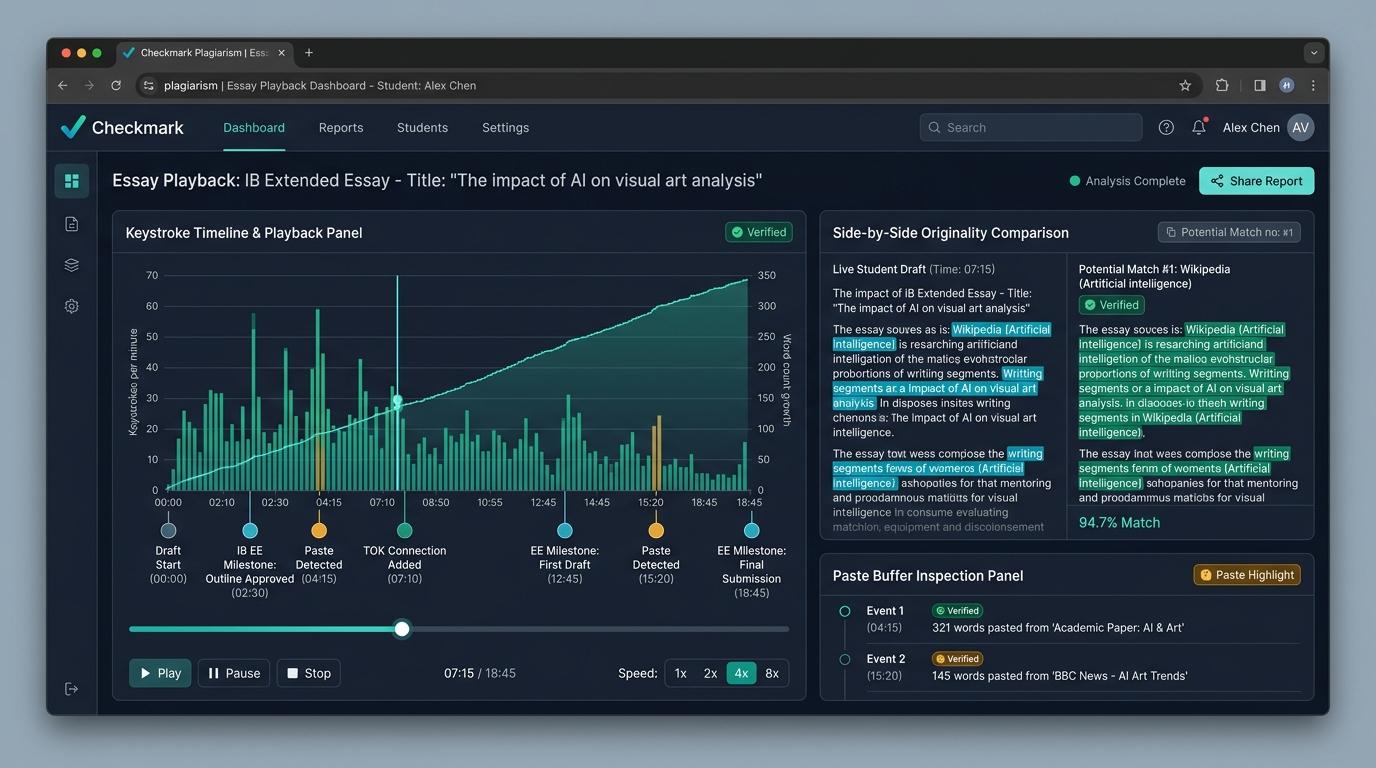
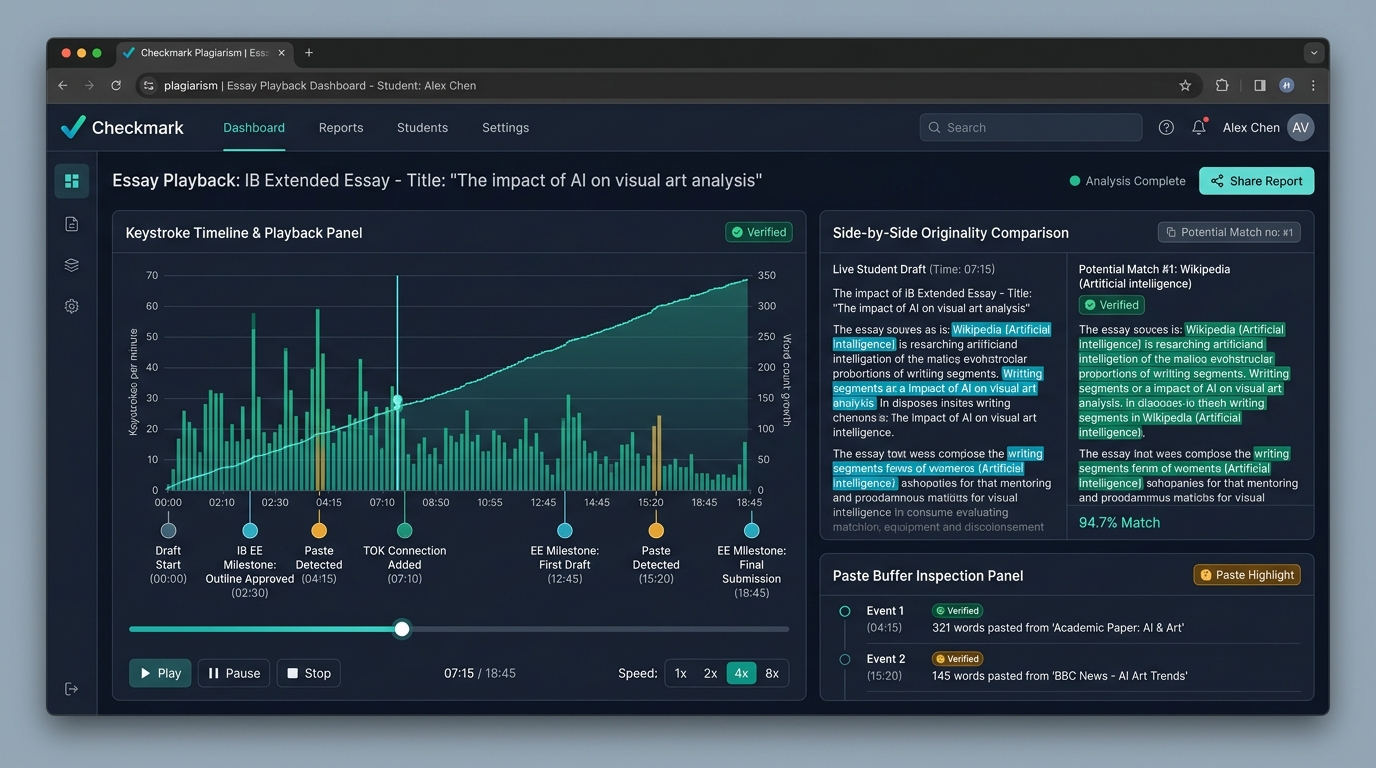
Checkmark Plagiarism solves this high-stakes dilemma through Writing Process Replay (patent-pending Essay Playback™). By combining scrubbable 1x–8x keystroke video replay, 100% immutable external paste buffer tracking, passage-level linguistic distributions with calibrated confidence sliders, synchronized side-by-side plagiarism matching, and quote-anchored rubric autograding, Checkmark provides educators with undeniable forensic “receipts.” This guide delivers an exhaustive technical and pedagogical roadmap, real-world IB case studies, and a 4-Phase IB Coordinator Integrity Protocol to transform authentication from an adversarial guessing game into a transparent, developmental, and defensible inquiry.
Checkmark Plagiarism equips IB Coordinators, DP Core leaders, department chairs, and Extended Essay supervisors with forensic writing telemetry and enterprise LMS integrations across Canvas LMS, Agilix Buzz, and Google Classroom.
1. The High-Stakes IB Diploma Integrity Dilemma: Authentication, Accountability, and the RPPF
The International Baccalaureate (IB) Diploma Programme (DP) represents one of the most rigorous, internationally celebrated secondary academic frameworks in the world. At the beating heart of the DP Core lie two compulsory, high-stakes capstone writing requirements:
- The Extended Essay (EE): An independent, deeply academic, 4,000-word research paper spanning up to twelve months of self-directed investigation in an academic discipline of the student's choosing.
- The Theory of Knowledge (TOK) Essay: A 1,600-word philosophical and epistemological inquiry written in response to one of six prescribed titles issued directly by the IB for each examination session.
Both tasks serve as non-negotiable matriculation benchmarks. Under IB Diploma regulations, a student who earns an “E” grade (elementary) in either the Extended Essay or Theory of Knowledge is automatically disqualified from receiving the IB Diploma—regardless of whether they achieve perfect scores in their six higher- and standard-level subjects.
- 6 to 12 months longitudinal writing process
- Primary and secondary scholarly sources
- 3 Mandatory RPPF Check-in Sessions
- Assessment Criteria A through E (34 marks)
- High-stakes prescribed titles issued by IBO
- Complex epistemological analysis across Areas of Knowledge
- 3 Documented TK/PPF Interactions
- Holistic global-impression assessment rubric
The submission is confirmed, to the best of the signatory’s knowledge, as the authentic work of the candidate.
- Plagiarism or GenAI flagged by external IB Examiner
- Award of Grade “N” (Diploma automatically withheld)
- Formal IB academic misconduct investigation
- Threat to IB World School institutional authorization
- False AI flag on honest multilingual (English B) student
- Adversarial student-supervisor conference & trauma
- University conditional offers delayed or forfeited
- Broken student-teacher trust & institutional legal escalation
The Institutional Burden of the Authentication Declaration
Before an Extended Essay or TOK paper can be transmitted to the IB e-Coursework portal for external moderation and marking, the student's designated supervisor and the school's IB Coordinator must formally confirm, to the best of their knowledge, that the work being submitted is the authentic work of the candidate.
This declaration is not a formality; it is a legally and institutionally binding warranty. If an external IB examiner or automated IBO monitoring system identifies uncredited source material, paraphrased academic journals, or unauthorized artificial intelligence generation in a submitted paper, the case is referred for a formal academic misconduct review by the IB Final Award Committee.
The consequences of an unresolved integrity investigation are severe:
- Award of “N” Grade (No Grade): The candidate receives an automatic “N” for the component, preventing the award of the full IB Diploma.
- Final Award Committee Penalties: In cases of deliberate intellectual property fraud or generative AI outsourcing, the IB Final Award Committee decides the penalty applied to the candidate, and a penalty for academic misconduct can prevent the award of the Diploma.
- Threat to IB World School Authorization: When an authorized IB World School demonstrates a pattern of submitting unvetted, plagiarized, or AI-generated coursework, the IBO can place the school on administrative probation or revoke its authorization entirely.
The Problem of the Static Document Snapshot
The fundamental challenge facing IB supervisors is that traditional review methods rely exclusively on static document snapshots. A supervisor who reads a completed 4,000-word History Extended Essay or a 1,600-word TOK draft only sees the final state of the prose.
They cannot see:
- Whether an elegant thesis statement was developed over five weeks of iterative brainstorming or dropped in as a 300-word block from Claude or ChatGPT at 2:00 AM.
- Whether extensive primary source citations were gathered across months of archival research in JSTOR or extracted from an automated prompt-engineering workflow.
- Whether a non-native English speaker received legitimate structural guidance or outsourced the entire paper to a private essay mill or AI rewriter.
To bridge this verification gap, the International Baccalaureate established the Reflections on Planning and Progress Form (RPPF) for the Extended Essay and the TK/PPF form (Theory of knowledge – Planning and progress form) for TOK. These frameworks mandate three structured reflection sessions:
- The First Formal Reflection Session: Formulation of the research question, search methodology, and preliminary theoretical framework.
- The Interim Reflection Session: Evaluation of initial findings, synthesis obstacles, restructuring of arguments, and critical source engagement.
- The Concluding Viva Voce (Final Reflection): A structured interview (the IB recommends that each reflection session last 20 to 30 minutes) where the candidate defends their conclusions, reflects on the research journey, and demonstrates authentic intellectual ownership.
However, without objective temporal writing process evidence, the RPPF process becomes vulnerable to retroactive fabrication. A student who generates an essay with AI can easily invent plausible-sounding reflection logs after the fact. To achieve true pedagogical integrity, IB educators need continuous writing process telemetry that directly maps the student's physical drafting history to their documented RPPF milestones.
2. The Failure of Black-Box AI & Similarity Detectors in the IB DP Ecosystem
When generative AI models emerged, many institutions responded by turning to legacy plagiarism checkers and first-generation AI writing classifiers. In the context of the International Baccalaureate Diploma Programme, however, these tools have created unprecedented chaos, false accusations, and investigative paralysis.
Multilingual candidates use formal, structured academic connectors (“In order to understand,” “Furthermore,” “Therefore”). Statistical classifiers flag low lexical perplexity as synthetic machine style.
4,000-word research papers require dense disciplinary citations, official treaty names, and chemical formulas. Generic scanners mark standard academic syntax as uncited similarity.
The score provides zero temporal evidence: Did the candidate draft for 40 hours or 4 seconds? Completely disconnected from the multi-month RPPF reflection log.
The supervisor cannot prove cheating; the student cannot prove innocence. The resulting standoff threatens diploma award and damages student dignity.
1. The Global Multilingual Dilemma: The False-Positive Bias Against ESL/ELL Writers
The IB Diploma is inherently international. Candidates around the world complete their Extended Essays and TOK papers in English as a second or third language (English B candidates, bilingual diploma candidates, and international school students in non-Anglophone regions).
Empirical computer science literature (most notably the 2023 Stanford University study by Liang et al., published in Patterns) has shown that probabilistic AI detectors exhibit severe, systemic bias against non-native English writers:
- Low Lexical Perplexity: Non-native writers rely on standard, well-mastered vocabulary and predictable syntactic constructions. AI classifiers, which equate predictability with machine generation, misclassify authentic non-native writing at high rates: in the Liang et al. study, seven widely used detectors incorrectly labeled TOEFL essays written by non-native English speakers as AI-generated at an average false-positive rate of 61.3%.
- Formulaic Academic Register: In teaching English for Academic Purposes (EAP), educators instruct students to use explicit discourse markers (“In conclusion,” “It is evident that,” “On the other hand”). These exact markers trigger high confidence in generative AI classifiers.
- Destructive Impact: When an IB supervisor receives an unverified “82% AI” alert on a multilingual student's paper, an accusatory confrontation often follows, destroying student-teacher rapport and penalizing the student precisely for following academic writing instruction.
2. The Citation Density and Disciplinary Lexicon Trap
An exemplary Extended Essay in History, Economics, Psychology, or Biology requires rigorous academic sourcing, containing between 30 and 70 formal scholarly citations, specialized technical jargon, and direct primary source quotations.
Legacy similarity detectors measure string overlaps across indexed web pages and student paper databases:
- In a History EE analyzing the 1962 Cuban Missile Crisis, standard terminology such as “the naval quarantine of Cuba instituted by the Executive Committee of the National Security Council (EXCOMM)” will trigger massive similarity overlaps.
- In a TOK Essay addressing Prescribed Title 1, repeated references to standard epistemology concepts (“Areas of Knowledge,” “Ways of Knowing,” “indigenous knowledge systems,” “peer-review consensus in the Natural Sciences”) result in inflated similarity scores of 35% to 50%.
- Supervisors are forced to manually sift through hundreds of false-positive source matches, wasting valuable instructional hours attempting to determine whether a 40% similarity index represents scholarly thoroughness or blatant intellectual theft.
3. The Lack of Temporal Telemetry and Evidentiary Due Process
A monolithic percentage—whether a 75% AI score or a 38% similarity index—is a mathematical inference, not evidentiary proof.
When a student vigorously denies an AI cheating allegation, an IB Coordinator who relies solely on a black-box percentage is left completely defenseless:
- The Software Cannot Answer: When was the paragraph written? Was it typed fluidly or pasted in bulk? Was it revised over five separate sessions?
- The Student Cannot Defend Themselves: A student who typed their own essay on a personal laptop has no way to prove their innocence against an algorithmic assertion without forensic writing telemetry.
- The IB Disqualification Risk: If the school submits the essay with lingering doubts, an external examiner flag can result in an official inquiry. If the school refuses to sign the authentication declaration without concrete proof, the student may miss the submission deadline and forfeit their diploma.
Comparative Evaluation Matrix: Static Scanners vs. Checkmark Multi-Evidence Replay
To illustrate why modern IB World Schools are moving away from legacy static checkers, the following matrix compares traditional detection mechanisms with Checkmark’s multi-evidence writing process suite across key IB DP requirements:
| Evaluation Dimension | Legacy Similarity Checkers | Monolithic AI Detectors | Checkmark Plagiarism Suite |
|---|---|---|---|
| Primary Forensic Evidence | Static string matching against indexed databases | Document-level probability score (e.g. “78% AI”) | Keystroke-by-keystroke temporal video replay (1x to 8x speed) |
| Writing Process Telemetry | ❌ None (inspects final file only) | ❌ None (statically evaluates tokens) | ✅ Full session duration, IKI intervals, typing velocity, & pauses |
| Paste Buffer Forensics | ❌ None (cannot identify origin) | ❌ None (treats pasted text as typed) | ✅ 100% immutable text capture of clipboard with jump-to-timeline |
| Multilingual / ELL Fairness | ⚠️ Moderate (flags common idioms) | ❌ Severe bias (high false-positive rates) | ✅ Exonerates authentic writing through physical keystroke telemetry |
| RPPF Milestone Mapping | ❌ Zero alignment | ❌ Zero alignment | ✅ Maps bursts, macro-revisions, & pauses directly to 3 RPPF check-ins |
| AI Granularity & Guardrails | ❌ N/A | ❌ Opaque whole-paper percentage | ✅ Passage-level confidence sliders with strict <150w honest guardrails |
| Plagiarism Source Alignment | ⚠️ Text wall with overlaps | ❌ N/A | ✅ Synchronized dual-pane view with live clickable links & source quotes |
| Rubric & Assessment Sync | ❌ Disconnected from IB criteria | ❌ Disconnected from rubrics | ✅ AI Rubric Autograder aligned to IB Criteria (A–E) with quote evidence |
| Data Privacy & Model Training | ⚠️ Often stores student papers in repos | ⚠️ Some vendors retain text for LLM training | ✅ 100% FERPA/GDPR zero-training guarantee; student IP never trained on |
3. Checkmark Essay Playback™: The Forensic Engine for Extended Essays & TOK Papers
Checkmark Plagiarism resolves the IB authentication crisis by shifting the paradigm from punitive suspicion to transparent, developmental writing forensics.
Instead of guessing whether a finished document “looks like AI,” Checkmark captures the authentic cognitive and mechanical drafting history of the student through patent-pending Essay Playback™.
Visual, video-like reconstruction of every keystroke, deletion, backspace, and cursor navigation across the entire multi-month writing lifespan.
100% preservation of all clipboard text insertions with jump-to-timeline synchronization.
- Raw clipboard text stored
- Insertion timestamp & index
- Permanent encryption audit
Sentence-level perplexity & burstiness metrics with calibrated confidence spectrums.
- Perplexity & burstiness cards
- Typical Human vs AI scale
- <150w honest “N/A” guardrail
Two-pane side-by-side alignment with live verified links and quad-badge categorization.
- Dual-pane synchronized scroll
- Live clickable DOI/web URLs
- Uncited vs quoted tags
Pre-configured criterion rubrics for EE (Criteria A–E) and TOK with quote-anchored written justifications synced to Canvas LMS, Buzz LMS, and Google Classroom.
1. The 1x to 8x Scrubbable Keystroke Timeline Player
For an Extended Essay or TOK paper, authentic scholarship is never a linear, single-sitting event. It is a multi-month intellectual journey characterized by drafting bursts, long pauses for reflection, sentence reorganization, thesis modifications, and extensive vocabulary fine-tuning.
Checkmark's Essay Playback™ reconstructs every character insertion, deletion, backspace, and cursor navigation into an interactive, video-like interface:
- Variable Scrubbing Speed (1x to 8x): Supervisors can scrub through a 40-hour drafting history in minutes, observing how the paper emerged from initial outlines to finalized drafts.
- Inter-Key Interval (IKI) Telemetry: Authentic human typing displays natural rhythmic variance (IKIs ranging dynamically from 80ms during familiar phrases to 2,000ms+ during conceptual synthesis). In contrast, synthetic bots or transcription tasks display unnatural, mechanical uniformity.
- Composing Pauses and Cognitive Friction: The timeline visually highlights long pauses (30 seconds to several minutes) where the student stopped typing to read sources, evaluate arguments, or plan subsequent paragraphs—providing visual proof of authentic cognitive labor.
2. Direct Alignment with the 3 Mandatory RPPF Milestones
Checkmark enables IB Coordinators to map drafting telemetry directly against the three formal RPPF reflection stages:
Documented Goal: Refining Research Question, search methodology, and preliminary bibliography.
Documented Goal: Mid-point synthesis, restructuring Section 3, overcoming analytical obstacles.
Documented Goal: Final defense, evaluating methodology, reflecting on personal academic growth.
When an Extended Essay supervisor conducts the Viva Voce interview, they no longer have to guess whether the student's verbal explanations match reality. They can open the Checkmark timeline during the interview, jump to the exact drafting session where a critical breakthrough occurred, and ask targeted questions:
“I see that during Session 14 on November 12th, you spent two hours restructuring your analysis of the Treaty of Versailles and deleted nearly 500 words. Walk me through the conceptual realization that led to that major pivot.”
A student who genuinely wrote the paper will light up and describe their thinking immediately; a student who outsourced the paper or copied an AI-generated draft will be unable to explain the structural telemetry.
3. Immutable External Paste Buffer Tracking with 100% Preservation
One of the most common dilemmas in academic integrity investigations occurs when a student claims: “I drafted my essay in another program, or I pasted my own research notes from a Google Doc.”
Legacy tools only see that a block of text was inserted. Checkmark’s Immutable External Paste Buffer Engine captures and permanently stores every external paste event:
| Event | Timestamp | Length | Character / Word Count | Preserved Clipboard Content | Verification |
|---|---|---|---|---|---|
| #P-01 | Month 2 • 14:10 | 385 chars | 54 words | “The Berlin Ultimatum of November 1958 precipitated...” | Verified Primary Source |
| #P-02 | Month 5 • 19:42 | 1,240 chars | 186 words | “FRUS 1961-1963, Vol. XIV, Berlin Crisis, 1961-1962, Document 112...” | Verified Archival Document |
| #P-03 | Month 8 • 23:15 | 2,410 chars | 370 words | “In evaluating whether historical perspectives require...” | Flagged for Viva Voce |
- 100% Text Preservation: Checkmark stores the exact string of text that entered the document through the clipboard, preserving it forever in an encrypted forensic log—even if the student subsequently rewrites, edits, or deletes every word.
- Source Differentiation: An Extended Essay student should paste research quotes, statistical figures, and bibliographic entries from academic databases. Checkmark allows supervisors to inspect pasted text instantly to confirm whether it represents a legitimate JSTOR quote or an illicit 800-word response from an AI chatbot.
- Jump-to-Playback Synchronization: Clicking any paste card in the Checkmark sidebar immediately scrubs the video player to the exact second the paste occurred, displaying the surrounding document context before and after the insertion.
4. Granular Passage-Level AI Detection with Honest Guardrails
Rather than generating an unhelpful, whole-essay score like “65% AI”, Checkmark analyzes text at the individual sentence and paragraph level through our AI writing detection system:
- Calibrated Confidence Sliders: Highlighting appears on specific sentences, linked to an evidence card in the sidebar showing a calibrated scale (Typical Human Writing Style vs. Typical AI Pattern) based on perplexity and burstiness distributions.
- Strict
<150-WordHonest Guardrail: Checkmark recognizes that statistical classifiers cannot reliably analyze short text fragments. Any passage under ~150 words displays an honestN/Astatus with a clear educational disclaimer, preventing false-positive flags on short thesis statements, epigraphs, or abstract summaries. - Educator-Only Flag Statuses: Flags (Flagged, Resolved, Not Flagged) remain private to educators, ensuring that preliminary algorithmic signals are never used to make automated or premature accusations against students.
5. Synchronized Side-by-Side Plagiarism Matching
When text matches external literature or web sources, Checkmark displays a synchronized Two-Pane Side-by-Side Viewer:
- Direct Source Links: Clicking a highlighted passage scrolls the right-hand panel directly to the matching source text, complete with live, verified URLs to published articles, encyclopedias, and academic journals.
- Uncited Source Differentiation: Checkmark uses a distinct visual badge for uncited source usage versus properly quoted text, allowing teachers to treat missing citation marks as a formative teaching moment rather than intentional academic fraud.
- School-to-School & Peer Repositories: Scans against historical submissions across the school district without exposing student intellectual property or violating student privacy.
4. Architectural Comparison: Standard Revision History vs. Checkmark Essay Playback™
Many educators ask: “Can't we just use Google Docs Version History or Microsoft Word Track Changes to verify authentic writing?”
While native word processor histories are useful for basic document recovery, they are fundamentally inadequate for forensic academic integrity verification. The table below outlines the critical architectural differences:
| Feature / Capability | Google Docs / Word Version History | Checkmark Essay Playback™ |
|---|---|---|
| Sampling Frequency | Periodic snapshots (every few minutes or on document save) | Continuous keystroke-by-keystroke event stream (millisecond accuracy) |
| Paste Buffer Analysis | Shows text appeared suddenly; zero source provenance | Preserves 100% of clipboard text; tracks character count & edits |
| Typing Dynamics (IKI) | ❌ No keystroke interval data or typing velocity metrics | ✅ Inter-Key Interval distribution (detects robotic transcription) |
| Macro-Revision Tracking | Displays rough text blocks; difficult to trace edits | Visualizes exact restructuring, rephrasing, and formulation pauses |
| RPPF Milestone Mapping | ❌ Manual, cumbersome file comparison across versions | ✅ Direct milestone integration with exportable supervisor PDF |
| Cross-LMS Synchronization | ❌ Lost if copied from external editor | ✅ Native capture across Canvas, Buzz, Google Docs, and Word |
The “Manual Transcription” Evasion Technique
A major vulnerability of standard version history is the manual transcription technique. When sophisticated students realize that large paste blocks are easily spotted in Google Docs version history, they open ChatGPT or an essay mill paper on a second screen (or smartphone) and manually retype the synthetic text word-for-word.
To standard revision history, this appears as normal typing. To Checkmark Essay Playback™, however, the deception is immediately obvious:
- Zero Formulation Pauses: The student types continuously without pausing to formulate ideas or search for vocabulary.
- Absence of Organic Backspacing: Natural writing exhibits frequent corrections (typos, backspacing, clause rearrangements). Retyping from a second screen shows steady, mechanical forward typing with almost zero structural revisions.
- Uniform Velocity: The typing cadence lacks the natural burstiness of human thought, generating a flat Inter-Key Interval graph that Checkmark’s telemetry engine flags as “Suspected Manual Transcription.”
5. Three Real-World IB Case Studies in Authenticity Verification
The following case studies demonstrate how IB Coordinators, Extended Essay supervisors, and TOK teachers use Checkmark’s multi-evidence suite to navigate complex integrity dilemmas.
- Alert: 42% Similarity Index
- Reality: 18 legitimate primary source quotes & treaty titles
- Resolution: Playback proves 46h organic research & Grade A
- Alert: 81% AI Probability Score
- Reality: Bilingual ELL student using EAP discourse connectors
- Resolution: Playback proves 16h drafting & 3,140 backspaces
- Alert: 1,200-char paste block
- Reality: Raw LoggerPro photogate sensor CSV export
- Resolution: Paste buffer proves raw data; full marks for Criterion C
Case Study 1: The 4,000-Word History Extended Essay (Cold War Archival Synthesis)
The Context & Scenario
A candidate submitted a 3,980-word History Extended Essay entitled: “To what extent did ideological misperceptions between the United States and the Soviet Union escalate the 1961 Berlin Crisis?”
When the essay was submitted through the school’s legacy portal, it returned a 42% Similarity Index. The supervisor was alarmed, suspecting that the student had copied extensive sections of published historical monographs.
- Session Distribution: 31 separate drafting sessions from October to February.
- Paste Buffer Breakdown: 18 distinct events (14 primary source documents from FRUS archives, 4 JSTOR bibliographic entries).
- Macro-Revision Telemetry: Heavy structural reorganizations in Sessions 12–15; student spent 6 hours restructuring Khrushchev counterarguments.
- Passage-Level AI Analysis: 0% AI confidence across all analytical body paragraphs.
Checkmark Investigation & Resolution
- Side-by-Side Source Inspection: The supervisor opened Checkmark’s synchronized dual-pane viewer. Checkmark instantly revealed that 38% of the 42% similarity consisted of legitimate, properly attributed direct quotes from the Foreign Relations of the United States (FRUS) archives, official treaty names, and standard Chicago-style bibliographic entries.
- Paste Buffer Verification: The supervisor reviewed the 18 external paste events. Each paste card showed the exact primary source excerpt captured from the clipboard, matching the quoted text in the essay.
- Essay Playback™ Authentication: Scrubbing through the 46 hours of drafting revealed authentic, organic writing: the student drafted analytical commentary around the quotes, paused frequently to re-read sources, and executed extensive structural rewrites during Month 5.
- Outcome: The supervisor signed the RPPF authentication declaration with complete confidence. The essay was submitted to IB e-Coursework and subsequently awarded an “A” Grade (32/34) by the external IB examiner.
Case Study 2: The 1,600-Word Theory of Knowledge (TOK) Prescribed Title Essay
The Context & Scenario
A bilingual IB Diploma candidate whose native language is Mandarin submitted a 1,585-word TOK Essay responding to a prescribed title (an illustrative title, not an actual IB prescribed title): “Does the pursuit of knowledge in the Arts require the same standard of proof as in the Natural Sciences?”
The school’s initial automated classifier flagged the submission with an 81% AI Probability Score. The TOK teacher, worried about potential diploma disqualification, scheduled an emergency conference.
- Initial Black-Box Flag: 81% AI Generated (Triggered by formal academic connectors & EAP syntax).
- Passage-Level Diagnostic: High sentence-level predictability on standard epistemology phrases (“In the context of the Natural Sciences,” “A fundamental criterion of verification”).
- Keystroke Telemetry: 18,420 keystrokes with 3,140 backspaces (17% correction ratio) and variable 110ms–1,800ms IKI cadence.
- Macro-Revisions: Session 7 (Hour 9) shows the candidate deleting Picasso's Guernica example and spending 90 minutes drafting an algorithmic music composition analysis.
Checkmark Investigation & Resolution
- Linguistic Diagnostic: Checkmark’s passage-level analysis revealed that the high AI score was driven entirely by low-perplexity discourse markers taught in the school's English B and EAP curriculum. The underlying arguments, real-world examples, and personal reflections were entirely unique.
- Keystroke Dynamic Verification: Opening Essay Playback™ immediately debunked the AI accusation. The student had spent over 16 hours actively typing, displaying a high correction ratio (over 3,000 backspaces) and variable typing velocity.
- Viva Voce Dialogue: During the conference, the teacher shared the screen and played back Session 7, where the student had struggled with framing the artistic example. The student explained: “I realized Guernica didn't fit my knowledge claim about quantitative verification, so I switched to algorithmic music composition.”
- Outcome: The teacher cleared the flag as a false positive, resolved the internal status to “Resolved: Authentic Multilingual Writing,” and submitted the TK/PPF form with verified confidence.
Case Study 3: The Physics Extended Essay (Rotational Dynamics & Experimental Modeling)
The Context & Scenario
A Physics Higher Level student submitted a 3,850-word Extended Essay investigating the moment of inertia of non-uniform rotational bodies.
The integrity scan alerted the supervisor to a massive 1,200-character paste event in Section 4 (Data Processing and Uncertainty Analysis). The supervisor was concerned that the student had pasted an AI-generated derivation or copied someone else’s lab calculations.
- Paste Buffer Inspection: Multi-column CSV data table containing raw photogate timing measurements (Trial 1–5, angular velocities, calculated uncertainties from LoggerPro export).
- Post-Paste Telemetry: Student spent the next 45 minutes manually typing LaTeX mathematical equations and formatting column headers directly within the document editor.
- Rubric Autograder Sync: Mapped to IB Physics EE Criterion C (Critical Thinking), confirming rigorous uncertainty propagation and authentic calculation methodologies.
Checkmark Investigation & Resolution
- Immediate Clipboard Inspection: Using Checkmark’s Immutable Paste Buffer viewer, the supervisor clicked on the paste card. The preserved text showed raw, tab-delimited numerical figures exported directly from the student's laboratory sensor software (LoggerPro).
- Temporal Context: Scrubbing through the timeline showed that after importing the data table, the student manually typed out every step of the propagation of uncertainties, showing realistic typographical errors, formula adjustments, and iterative LaTeX formatting.
- Outcome: The supervisor verified that the paste was a standard, authorized scientific workflow. The essay was approved with zero integrity concerns and earned full marks for experimental data presentation.
6. The 4-Phase IB Coordinator Integrity Protocol: From Inception to e-Coursework Upload
To institutionalize academic integrity across the entire Diploma Programme, IB Coordinators and department chairs can implement the 4-Phase Checkmark Integrity Protocol:
- Deploy Checkmark integrated writing environment across Canvas LMS, Buzz LMS, or Google Docs.
- Establish supervisor dashboards and train faculty on reading Essay Playback™ telemetry.
- Publish clear student guidelines on authorized AI assistance vs. unauthorized generative writing.
- RPPF Milestone 1 Check: Verify initial research question formulation & preliminary notes.
- RPPF Milestone 2 Check (Interim): Audit mid-point draft, review paste buffer provenance, and evaluate macro-revision dynamics before formal reflection submission.
- Conduct full multi-evidence audit: Synchronized Plagiarism matching + Passage-level AI sliders.
- Run Checkmark IB Rubric Autograder (Criteria A–E) for formative alignment.
- Ensure all external paste events are accounted for (citations, raw data, or quotes).
- Conduct concluding 20–30 min Viva Voce interview using Essay Playback™ scrubbable timeline.
- Resolve any ambiguous flags through supportive, evidence-based dialogue.
- Sign official IB Coordinator and Supervisor declaration with 100% evidentiary certainty.
Phase 1: Institutional Onboarding & Continuous Telemetry Configuration
- Seamless Ecosystem Deployment: Integrate Checkmark directly into the school’s learning environment (Canvas LMS, Buzz LMS, Google Classroom, or Google Docs/Word extensions).
- Transparent Student Onboarding: Explain the philosophy of Checkmark to all incoming DP candidates: “We are not using software to spy on you; we are using writing playback to protect your hard work, prove your authentic authorship, and celebrate your intellectual growth.”
- Baseline Diagnostic Calibration: Configure assignment parameters to reflect subject-specific requirements (e.g., enabling raw data paste allowances for Group 4 Sciences, or Chicago-style citation matching for History and Group 3 subjects).
Phase 2: Formative Milestone Telemetry Sync with RPPF Checkpoints
- Synchronizing Reflection 1: When students complete their First Formal Reflection, supervisors open Checkmark to verify that initial brainstorming and bibliography gathering correspond to active drafting sessions.
- Synchronizing Reflection 2 (The Interim Milestone): Before conducting the Interim RPPF conference, the supervisor reviews the student's active writing hours, paste buffer records, and structural revisions. If the student claims they spent weeks restructuring their paper, the telemetry should reflect corresponding drafting bursts and macro-revisions.
Phase 3: Pre-Submission Multi-Evidence Dossier Audit
- Triangulating the Evidence Triad: Before the final Extended Essay or TOK draft is locked, the IB Coordinator runs a complete Multi-Evidence Dossier audit:
- Plagiarism Layer: Ensure all similarity matches are properly cited with quotation marks and bibliographic entries in the Two-Pane viewer.
- Paste Buffer Layer: Review all external clipboard insertions to confirm 100% legitimate research provenance.
- Passage-Level AI Layer: Inspect flagged sentences using confidence sliders; dismiss formulaic academic phrasing on multilingual papers.
- Formative Autograding Calibration: Utilize Checkmark’s AI Rubric Autograder to evaluate the draft against official IB Assessment Criteria (e.g., Criteria A–E for EE), providing students with targeted revision feedback prior to final upload.
Phase 4: Restorative Viva Voce & Candidate Authentication Adjudication
- The Telemetry-Powered Viva Voce: During the mandatory concluding reflection session, the supervisor uses Checkmark's 1x–8x playback player as an interactive dialogue tool.
- Restorative Inquiry Protocol: If an unverified passage or sudden paste block exists, the supervisor asks open-ended, restorative questions:
“I noticed this 400-word section entered the document in a single paste during Session 9. Can you show me your research notebook or walk me through the primary source notes where this was developed?”
- Confident Sign-Off: With the complete multi-evidence dossier archived in the school's records, the IB Coordinator and supervisor sign the candidate declaration on IB e-Coursework, fully protected against future academic malpractice inquiries.
7. Global Compliance, FERPA/GDPR Governance, and Student Data Ethics
International Baccalaureate World Schools operate under strict international, national, and regional data privacy mandates. Whether an IB school is located in the United States (subject to FERPA and COPPA), the European Union or United Kingdom (subject to GDPR), or other jurisdictions across Asia and the Americas, student data governance is paramount.
Student Extended Essays & TOK papers are never ingested to train commercial or open foundation AI models.
Full student right-of-inspection compliance (34 CFR § 99.10) and GDPR data sovereignty; zero third-party data monetization.
End-to-end data encryption in transit (TLS 1.3) and at rest (AES-256) across all school districts and international networks.
1. The Zero-Training Guarantee
Many commercial AI tools and legacy plagiarism databases monetize student submissions by caching them into global comparison repositories or utilizing student prose to train commercial large language models.
Checkmark Plagiarism maintains an absolute Zero-Training Policy:
- Student Extended Essays, TOK papers, and creative writing submissions are never ingested into training datasets for foundation models.
- Student intellectual property remains 100% the property of the student and the educational institution.
2. FERPA & GDPR Procedural Compliance
- FERPA (34 CFR Part 99 § 99.10) Right of Inspection: In the event of an academic integrity inquiry, Checkmark enables institutions to export the complete, unredacted multi-evidence dossier—including timestamped keystroke logs, paste records, and confidence distributions—fulfilling the student's legal right to inspect all educational records used in disciplinary decisions.
- GDPR Data Minimization & Sovereignty: Checkmark adheres to strict data minimization principles (Article 5(1)(c) GDPR), collecting only the telemetry required for authentication and providing automated data deletion workflows upon student graduation.
8. Frequently Asked Questions (FAQs) for IB Coordinators, Supervisors, and Examiners
1. How does Essay Playback™ handle students who draft offline or in multiple writing applications?
Checkmark captures writing telemetry seamlessly through multiple native ecosystem integrations, including embedded editors in Canvas LMS, Buzz LMS, Google Classroom, Google Docs, and Microsoft Word (via Checkmark editor extensions). If a student writes an initial outline offline and pastes it into the main document, Checkmark captures the paste event in the Immutable Paste Buffer, recording the exact text, timestamp, and character count. During the subsequent RPPF conference, the supervisor can review the preserved paste block and confirm its authentic origin by reviewing the student’s offline notes, outlines, or research journals.
2. What happens if a student writes their entire 4,000-word Extended Essay in a single 12-hour marathon session?
While last-minute drafting marathons are pedagogically discouraged in the IB Diploma Programme, they do occasionally occur. Checkmark’s keystroke telemetry clearly distinguishes an authentic 12-hour human drafting marathon from a 30-second generative AI paste: an authentic marathon session will display thousands of organic backspaces, natural typing speed variations, frequent pauses for thought (long IKIs), and evolutionary sentence restructuring. In contrast, an outsourced or AI-generated essay will display either bulk paste insertions or continuous, mechanical transcription typing with zero formulation pauses.
3. Can the Checkmark Multi-Evidence Dossier be shared directly with external IB Examiners during an academic malpractice investigation?
Yes. If an external IB examiner flags an Extended Essay or TOK paper and the IB Final Award Committee requests formal documentation from the school, the IB Coordinator can generate a comprehensive, tamper-evident Multi-Evidence Verification Dossier (PDF/Web Link). This dossier includes the complete session breakdown, total active drafting hours, paste buffer audits, side-by-side citation analyses, and a secure, time-limited link to the scrubbable Essay Playback™ timeline—providing the IBO with undeniable proof of authentic student authorship.
4. How does Checkmark protect non-native English (ESL/ELL) IB candidates from false AI accusations?
Checkmark protects multilingual writers through three distinct layers:
- Physical Keystroke Verification: Even if a static classifier flags a student's structured academic syntax as “AI-like,” the underlying Essay Playback™ video proves that the student manually and organically drafted every word over dozens of hours.
- Passage-Level Granularity: Instead of assigning an arbitrary whole-paper score, Checkmark isolates specific sentences, allowing supervisors to see that flags are merely reacting to formal discourse connectors (“Furthermore,” “In order to analyze”).
- Honest
<150-WordGuardrails: Short sentences and structured thesis statements automatically displayN/A, eliminating misleading flags on concise grammatical structures.
5. How does Checkmark differentiate legitimate academic research citations from deliberate plagiarism?
Checkmark’s Synchronized Two-Pane Viewer utilizes a dedicated quad-badge taxonomy:
- Quoted & Cited (Green): Text enclosed in quotation marks with adjacent citations is acknowledged as proper scholarship.
- Uncited Source Usage (Orange/Amber): Text matching external literature without quotation marks is highlighted with a dedicated visual badge, allowing teachers to provide targeted citation coaching rather than treating formatting mistakes as intentional cheating.
- Live Side-by-Side Comparison: Clicking any highlighted passage aligns the essay side-by-side with the original online publication, academic journal, or encyclopedia, complete with clickable URLs.
6. Does Checkmark integrate with Canvas LMS, Buzz LMS, and Google Classroom gradebooks?
Yes. Checkmark provides enterprise-level integrations with major educational platforms: direct integration with Canvas LMS (including SpeedGrader), Agilix Buzz LMS, Google Classroom, and Moodle. Supervisors can grade Extended Essays and TOK papers against pre-loaded IB rubrics within Checkmark, generate quote-anchored written justifications, and publish finalized marks directly back into the Canvas or Buzz gradebook with one click.
7. What is the main difference between Google Docs Version History and Checkmark Essay Playback™?
Google Docs Version History captures periodic, coarse-grained document snapshots (every few minutes). It does not capture detailed typing speed, cannot measure Inter-Key Intervals, and cannot preserve the original contents of external paste buffers once the text has been edited. Checkmark Essay Playback™ is a continuous forensic telemetry engine that records every millisecond event stream, provides 1x–8x video scrubbing, permanently preserves 100% of clipboard text, detects mechanical transcription from second screens, and maps drafting milestones directly to official IB RPPF requirements.
Conclusion: Stop Guessing, Start Trusting in the IB Diploma Programme
The International Baccalaureate Diploma Programme was founded on the ideals of intellectual curiosity, critical inquiry, and academic integrity. In the era of generative artificial intelligence, preserving these ideals does not require turning classrooms into hostile surveillance zones or relying on unexplainable black-box detectors.
By adopting Checkmark Plagiarism and patent-pending Essay Playback™, IB Coordinators, Extended Essay supervisors, and TOK teachers can:
- Exonerate honest students falsely accused by generic AI classifiers.
- Verify authentic intellectual journeys across the 6-to-12-month RPPF and TK/PPF lifecycle.
- Transform high-stakes authentication into transparent, supportive, and restorative academic dialogue.
Stop guessing, start trusting. Equip your IB World School with the multi-evidence writing forensics needed to protect student dignity, ensure institutional compliance, and uphold the global gold standard of the IB Diploma.
Ready to Authenticate IB Coursework with Defensible Writing Telemetry?
Discover how Checkmark Plagiarism equips IB World Schools and district writing programs with patent-pending Essay Playback™, immutable paste tracking, and quote-anchored rubric autograding.