
Executive Summary
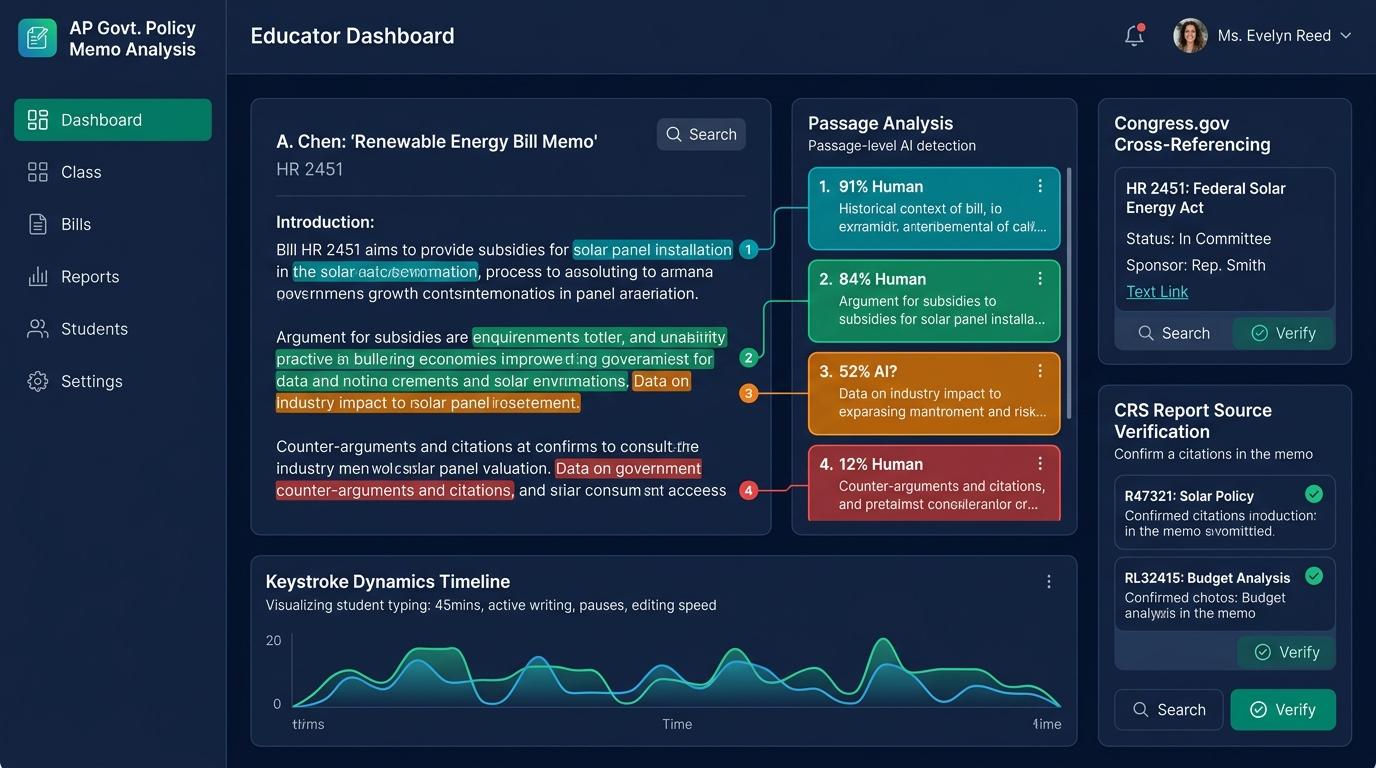
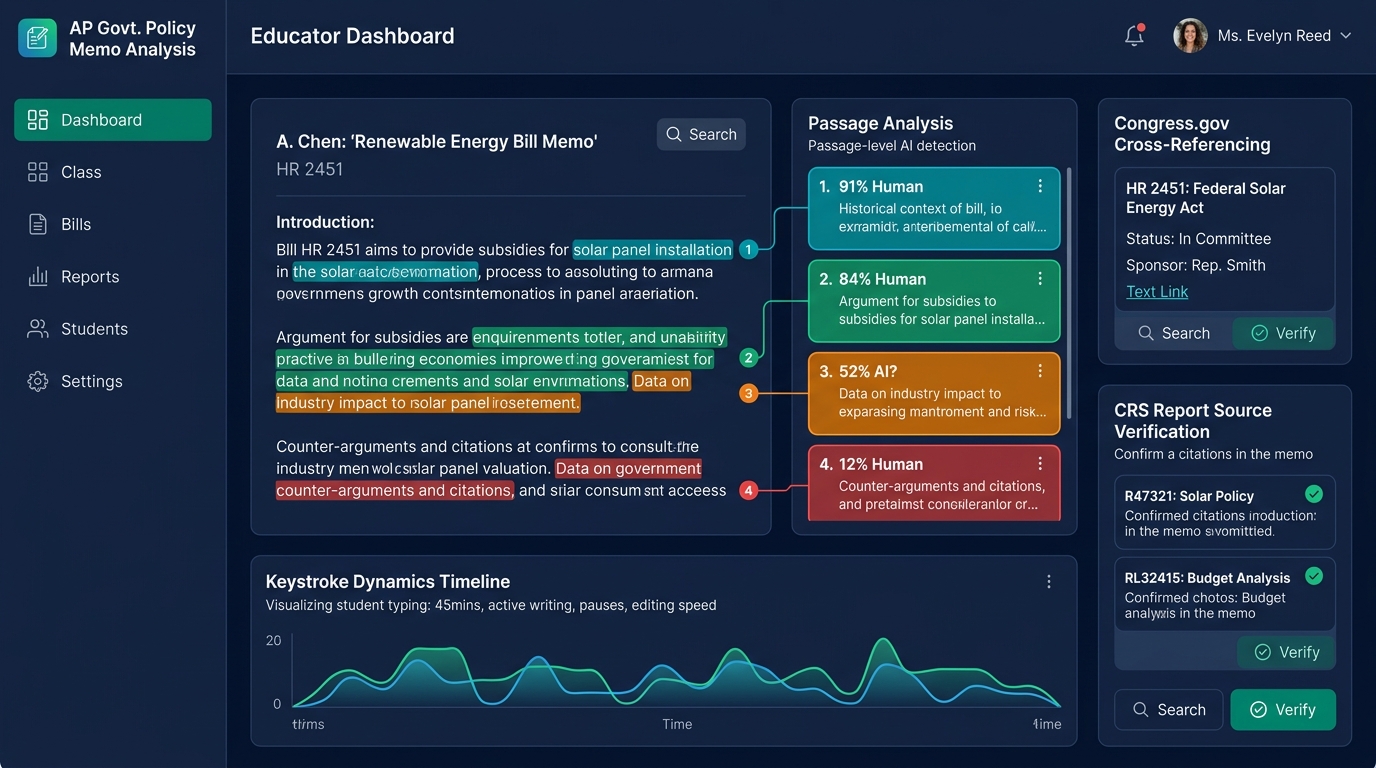
In Advanced Placement U.S. Government & Politics (AP Gov) and secondary civics classrooms, the policy memo is the gold standard for assessing higher-order analytical thinking. Authentic legislative synthesis requires students to evaluate statutory language, interpret Congressional Budget Office (CBO) scoring, navigate complex committee jurisdictions, and balance competing stakeholder interests. However, large language models (LLMs) have fundamentally disrupted this assessment modality. When prompted, generative AI produces superficially eloquent, highly bureaucratic policy briefs that frequently invent non-existent congressional bill numbers (H.R./S. designations), confabulate Congressional Research Service (CRS) reports, fabricate committee amendments, and misrepresent statutory mechanisms. Compounding this challenge, traditional black-box AI detectors regularly misclassify legitimate student policy memos as AI-generated due to the low-perplexity, highly structured legalistic diction inherent to formal government writing. To resolve this dilemma, civics educators must move beyond static text analysis and adopt an evidentiary approach combining primary legislative cross-referencing (via Congress.gov and GovInfo) with writing process telemetry and patent-pending Essay Playback™ (1x–8x scrubbable keystroke replay) through Checkmark Plagiarism. This transparent workflow allows teachers to verify research pauses, inspect external paste buffers, eliminate false accusations, and conduct restorative, mock-legislative defenses grounded in objective data.
As generative artificial intelligence transforms secondary and collegiate humanities education, public policy instructors face a double-edged sword: AI models can instantly generate polished policy memos mimicking professional legislative staffers, while standard AI detection algorithms punish the most disciplined students whose precise, legalistic writing triggers false alarms. Checkmark Plagiarism solves this crisis by combining patent-pending Essay Playback™, passage-level AI detection, source citation matching, and rubric autograding for Canvas LMS and Google Classroom.
1. The Policy Memo in Modern Civics & AP Government
In the College Board’s AP U.S. Government and Politics curriculum, students are tasked with mastering five foundational Disciplinary Practices:
Concept Application
Apply political concepts and institutional processes to authentic scenarios.
SCOTUS Comparison
Compare non-required Supreme Court cases to foundational precedents.
Data Analysis
Analyze quantitative political data, CBO forecasts, and budgetary trends.
Source Analysis
Read, analyze, and interpret foundational statutes, CRS briefs, and rules.
Argumentation
Develop defensible, evidence-based arguments with statutory synthesis.
To synthesize these practices into a single authentic assessment, AP Gov teachers, dual-enrollment political science instructors, and civics department chairs frequently assign Legislative Policy Memos. Modeled on professional briefs prepared by congressional staffers, legislative directors, and executive agency policy analysts, these assignments require students to analyze an active public policy problem—such as clean energy subsidies under the Inflation Reduction Act, federal grant requirements under Title I, or statutory authorities under the War Powers Resolution—and deliver actionable recommendations to a specific policymaker.
- Actual Public Laws & Statutes at Large
- U.S. Code Provisions & Code of Federal Regs
- Federal Register Notices & Executive Orders
- House Rule X / Senate Rule XXV Referral
- Senate Rule XXII Cloture & Filibuster
- Reconciliation Instructions & Byrd Rule
- Official CBO 10-Year Deficit Scoring
- Interest Group Coalition Alignment
- Federalism & State Preemption Trade-offs
Actionable legislative recommendation • Nuanced constitutional justification • Defensible stakeholder compromise
The Pedagogical Value of Authentic Synthesis
A rigorous policy memo forces students to grapple with the messy realities of American governance:
- Statutory Interpretation: Differentiating between broad legislative intent and precise statutory text (e.g., how an authorization bill differs from an appropriations measure).
- Federalism & Constitutional Restraints: Evaluating whether a proposed federal mandate withstands scrutiny under the Commerce Clause, Tenth Amendment, or Spending Clause (South Dakota v. Dole, United States v. Lopez).
- Institutional Friction: Analyzing how committee referrals in the House (e.g., Ways and Means vs. Energy and Commerce) and procedural hurdles in the Senate (the 60-vote cloture threshold under Rule XXII) constrain legislative ambition.
- Fiscal Realism: Assessing official scores from the Congressional Budget Office (CBO) or Joint Committee on Taxation (JCT) rather than assuming costless policy implementation.
When executed honestly, drafting a policy memo develops critical civic competencies that students carry into collegiate political science coursework, pre-law tracks, and public service careers.
2. Anatomy of AI Bureaucratic Hallucinations vs. Authentic Synthesis
When students face time constraints or struggle to parse dense 300-page congressional bills, many turn to generative artificial intelligence. By feeding prompts into ChatGPT, Claude, Microsoft Copilot, or specialized "essay bots" (e.g., "Write an AP Gov policy memo for Senator Tammy Baldwin on reforming the Farm Bill to support Midwestern dairy farmers, including specific bill citations and committee strategies"), students receive comprehensive, 1,200-word policy briefs in less than twenty seconds.
To an untrained eye, these AI-generated submissions appear exceptional. They utilize crisp executive formatting, authoritative bureaucratic rhetoric, and confident policy prescriptions. However, beneath the polished prose lies a pervasive structural failure: LLMs do not comprehend statutory law or live legislative dockets; they generate statistical token sequences based on web training data.
AI generates: "H.R. 4921 - The FISA Reform and Oversight Act of 2024"
Forensic Reality: On Congress.gov, H.R. 4921 in the 118th Congress is an unrelated post office designation bill.
AI generates: "CRS Report R47892 (2024): Warrant Requirements under Title VII"
Forensic Reality: R47892 does not exist in the Congressional Research Service digital archives.
AI generates: "The Senate Commerce Committee marked up the Section 702 amendment..."
Forensic Reality: FISA jurisdiction lies exclusively within Senate Judiciary and the Select Committee on Intelligence.
The Four Major Categories of AI Policy Hallucinations
LLMs routinely invent legislation out of whole cloth (e.g., "H.R. 6842: Clean Water Infrastructure Renewal Act"). When checked on Congress.gov, the number is either unassigned, belongs to the 109th Congress (2005), or addresses an unrelated topic. AI also commits temporal errors, attributing sponsorship to retired or deceased lawmakers.
Students prompt AI for footnotes, resulting in synthetic alphanumeric identifiers (e.g., CRS Report R47125) that produce 404 errors in the CRS digital repository. AI models also fabricate hyper-specific empirical claims (e.g., "GAO-23-1084 found 43.7% of Title I funds were delayed") where the report number is entirely invented.
Under House Rule X and Senate Rule XXV, committees have codified boundaries. AI models routinely route corporate tax bills to House Education, invent "cloture votes under Rule XXII in the House of Representatives" (where cloture does not exist), or claim presidential vetoes were overridden by simple majority votes.
Authentic policy synthesis requires students to model real interest group tensions. AI defaults to frictionless harmony, depicting antagonistic groups (e.g., Sierra Club and American Petroleum Institute) as co-authoring compromises, or inventing non-existent 501(c)(4) advocacy coalitions with fabricated quotes.
3. Deep Forensic Comparison: Authentic Student Memo vs. AI Hallucination
To demonstrate the stark contrast between authentic legislative research and synthetic AI confabulation, examine how both approaches handle an identical AP Government policy assignment:
| Forensic Indicator | Authentic Student Synthesis | AI-Fabricated Policy Memo |
|---|---|---|
| Statutory Precision | Cites specific codifications: 42 U.S.C. § 1320f (Drug Price Negotiation Program); references the 10-drug initial selection list published by CMS under IRA Section 1192. | Cites generic statutory labels: "The Prescription Drug Affordability and Equity Act of 2023" or vague placeholders like "Section 402(b) of the Health Care Act." |
| Congressional Docket Status | References active legislation: S. 1339 (PBM Reform Act) marked up by Senate HELP, noting cross-jurisdictional friction with Senate Finance. | Invents fictitious bill numbers: "S. 4928: The Medicare Part D Direct Relief Act," claiming Wyden introduced it with 30 bipartisan cosponsors (non-existent on Congress.gov). |
| Fiscal Scoring (CBO / JCT) | Cites real CBO baseline projections ($25 billion in direct Medicare savings through 2031); discusses non-linear dynamic scoring impacts on generic launch delays. | Synthesizes round, unverified numbers: "CBO estimates this policy will immediately save taxpayers exactly $40.5 billion annually with zero impact on innovation." |
| Judicial & Constitutional Analysis | Analyzes ongoing First and Fifth Amendment (Takings Clause) challenges in federal district courts (Merck & Co. v. Becerra, PhRMA v. Becerra). | Uses vague legal generalities: "This policy firmly aligns with constitutional interstate commerce powers and has faced minor administrative review." |
| Stakeholder Friction | Accurately models divergent stances: PhRMA lawsuit opposition vs. AARP lobbying; highlights internal pharmaceutical pushback on the 9-vs-13 year negotiation window. | Presents generic, friction-free bullet points: "Both health advocates and pharmaceutical leaders strongly support balanced transparency." |
| Writing Telemetry & Dynamics | Multi-hour drafting sessions across 3 days; prolonged pauses (2–6 mins) while reading primary PDF sources; iterative revision of statutory arguments in playback. | Instantaneous 600-word paste from external clipboard (0.2s duration) or steady, mechanical transcription (uniform typing speed with zero compositional pauses). |
4. The Pedagogical Dilemma: Why Policy Memos Trigger Black-Box AI False Positives
Faced with AI-generated submissions, many educators and high schools have turned to automated, black-box AI detection software. These tools analyze static text for statistical properties—primarily perplexity (word predictability) and burstiness (variation in sentence structure and length).
However, relying on standalone AI percentages to evaluate AP Government policy memos creates a severe institutional crisis: The formal conventions of professional policy writing inherently trigger false-positive AI flags.
- Standardized Headers: MEMORANDUM, TO, FROM, RE
- Passive Voice & Executive Diction
- Statutory Formulas: "Pursuant to 5 U.S.C. § 553..."
- Structured Bullet Points & Action Items
- High Word Predictability → Low Perplexity Flag
- Uniform Sentence Structure → Low Burstiness Flag
- Detector Output: "87% AI-Generated"
- Zero proof, no prompt history, false accusation risk
Why Legitimate Civics Writing Flags as "AI"
- Standardized Formatting Conventions: Professional policy briefs adhere to rigid organizational templates: Executive Summary, Background, Statutory Authority, Stakeholder Analysis, Policy Options, and Strategic Recommendation. Detectors trained on general essay prose interpret this structural uniformity as synthetic generation.
- Statutory and Legal Nomenclature: Phrases such as "pursuant to Section 402 of the Clean Air Act," "exercising delegated regulatory authority under the Chevron framework," and "subject to discretionary congressional appropriations" are low-perplexity, high-frequency word sequences in legal corpora. A human student using proper legal citations naturally produces text with low perplexity scores.
- Impersonal, Objective Tone: Civics and public policy teachers actively instruct students to eliminate first-person pronouns, rhetorical emotionalism, and colloquialisms. Because LLMs are also optimized for neutral, objective prose, highly disciplined student writing mimics the statistical signature of an LLM.
The Failure of Standalone Detectors
When a teacher relies solely on a black-box percentage score (e.g., "Turnitin reports 78% AI" or "GPTZero reports 92% Probability"), they face an unresolvable evidentiary dilemma:
- A percentage score provides zero proof. It cannot point to a specific prompt, cannot prove where a student obtained a fact, and cannot explain whether a phrase was generated by an LLM or copied from an authentic CRS report.
- It incentivizes dishonest students to deploy AI humanizers and text spinners (e.g., Undetectable AI, HideMyAI) that intentionally inject typographical quirks and low-probability synonyms to deceive detectors, while doing nothing to fix the underlying legislative hallucinations.
5. The AP Gov Evidentiary Matrix
To evaluate legislative policy memos fairly, educators need a multi-dimensional evidentiary framework that evaluates both the factual integrity of the final text and the authentic behavioral telemetry of the writing process.
- Cross-reference bill IDs on Congress.gov & GovInfo
- Verify live committee referrals (House Rule X / Senate Rule XXV)
- Check real CBO scoring baselines & CRS report archives
- Flag specific synthetic clauses, not whole papers
- Calibrated human vs. AI confidence sliders in sidebar
- Private educator-only flag statuses prevent student panic
- 1x–8x scrubbable keystroke video replay
- Track multi-minute research pauses while reading statutes
- Inspect external clipboard pastes and character counts
- Automated scoring against AP Gov CED Disciplinary Practices
- Direct evidence anchors tied to student statutory citations
- 100% teacher final authority before Gradebook sync
The table below contrasts traditional rubric evaluation, standalone AI detectors, and Checkmark Plagiarism’s integrated integrity suite across key civics assessment criteria:
| Assessment Dimension | Traditional Rubric | Black-Box AI Detectors | Checkmark Plagiarism Suite |
|---|---|---|---|
| Statutory Verification | Manual Google searches; slow and easily missed during high-volume grading. | Ignores factual veracity entirely; evaluates only token probability. | Defensible Web & Source Matching: Links citations against live government repositories, identifying uncredited text vs. authentic quotes. |
| Detection of AI Hallucinations | Often fooled by eloquent, authoritative prose and formatted executive summaries. | Flags the entire paper as "AI" due to formal diction, without explaining which facts are confabulated. | Passage-Level Granularity: Underlines exact confabulated claims and phantom bill summaries with calibrated confidence cards. |
| Writing Telemetry & Research | Completely blind to drafting history; evaluates only static final files. | Zero process visibility; cannot distinguish 4 days of drafting from a 30s AI paste. | Patent-Pending Essay Playback™: Reconstructs the complete writing session keystroke-by-keystroke at 1x–8x speed, revealing authentic research pauses. |
| Paste Forensics | Unknown whether text was typed manually or copied from an external LLM. | Cannot track paste origin; bypassed if student uses an AI humanizer or retypes. | External Paste Inspector: Captures raw timestamped clipboard text even if the student rewrites every word; jump-to-playback integration. |
| Rubric Grading Efficiency | Manual scoring of 150+ AP Gov essays takes 20–30 hours per assignment. | No grading or feedback capabilities. | AI Autograder with Teacher-in-the-Loop: Evaluates AP Gov Disciplinary Practices, generates quote-anchored justifications, and syncs to LMS. |
| Student Due Process | Subjective teacher impression vs. student denial; causes adversarial confrontations. | Opaque percentage creates unprovable accusations, damaging trust. | Transparent Evidentiary Receipts: Objective timeline data protects honest students from false accusations and provides proof during conferences. |
6. Step-by-Step AP Gov Teacher Audit Protocol
When evaluating AP Government policy memos, civics teachers and social studies departments should implement a standardized four-step audit protocol. This protocol balances rapid primary-source verification with forensic writing process telemetry, ensuring that academic integrity inquiries are fair, defensible, and restorative.
The 3-Minute Legislative Docket Check
Before reading full prose, run a rapid primary-source check on cited legislative identifiers:
1. Congress.gov Query
Paste bill numbers (e.g. H.R. 2814) into Congress.gov. Verify sponsor, title, and congress session.
2. CRS Report Search
Query alphanumeric report numbers (e.g. R46211) at CRSReports.congress.gov or EveryCRSReport.com.
3. Federal Register & CFR
For administrative law memos, verify cited CFR Titles and Parts via federalregister.gov.
Committee Jurisdiction & Procedural Realism Check
- House vs. Senate Alignment: Did the student advocate for a "filibuster compromise" in the House or refer tax legislation outside House Ways and Means or Senate Finance?
- Mandatory vs. Discretionary Spending: Does the memo confuse entitlement authorizations with annual discretionary appropriations?
- Constitutional Precedent: Does the memo apply the Nondelegation Doctrine correctly to administrative rules or cite relevant SCOTUS precedent (South Dakota v. Dole)?
Writing Telemetry & Essay Playback™ Analysis
Scrub the Checkmark timeline at 2x–8x speed to evaluate behavioral signals:
Multi-hour drafting across days; 2–6 min cognitive pauses while reading statutes; frequent backspacing and paragraph rewrites.
Instantaneous 800-word paste (0.3s) at start; 1 minute of cosmetic header edits; raw clipboard text stored in Paste Inspector.
Continuous, metronome typing stream at 70 WPM; zero cognitive pauses; <2% backspace ratio; linear drafting from word 1 to 1,000.
The Restorative "Staffer Briefing" Conference
Conduct a supportive, evidence-based discussion structured as a legislative staff briefing:
"Our academic integrity system tracks the drafting process so we can celebrate your research. Let's open your Essay Playback™ timeline together."
"I noticed this section on H.R. 4921 appeared in an external paste event at 11:42 PM, and Congress.gov shows that bill is an unrelated naming act. Walk me through how you gathered that data."
"Explain the core trade-off in your recommendation. Why does Senate HELP have jurisdiction here instead of Senate Finance?"
If unauthorized AI is acknowledged, grant a 48-hour resubmission in Checkmark's embedded editor requiring live Congress.gov bill links.
7. How Checkmark Plagiarism Empowers Civics & AP Gov Faculty
Checkmark Plagiarism is engineered specifically to meet the high-stakes analytical and evidentiary demands of secondary and higher education humanities departments:
Passage-Level AI Analysis with Calibrated Sliders
Unlike legacy tools that brandish an opaque "84% AI" badge, Checkmark evaluates essays at the passage level. It highlights specific sentences exhibiting statistical signatures of synthetic generation while leaving authentically drafted sections clear. In the sidebar, educators inspect calibrated confidence sliders (typical human writing style vs. typical AI pattern) to understand underlying perplexity metrics without jumping to punitive conclusions.
Short-Text Disclaimers & Ethical Guardrails
Checkmark enforces strict ethical guardrails: for text segments under ~150 words, the AI report displays N/A rather than guessing on insufficient sample sizes. This prevents false accusations on brief executive summaries, memo headers, or short definition sections.
Immune to "AI Humanizers" & Text Spinners
While commercial paraphrasing tools (e.g., QuillBot, Undetectable AI) alter surface vocabulary to bypass static detectors, they cannot fake authentic temporal writing history. Checkmark’s Essay Playback™ immediately exposes text spinners: either the spun text is pasted into the document in a single burst, or it is retyped mechanically without the organic hesitation patterns that accompany genuine human drafting.
Quote-Anchored Rubric Autograding for AP Gov
Grading 150 multi-page policy briefs is a massive instructional burden. Checkmark’s AI Autograder evaluates essays against custom rubrics or standardized AP Gov criteria (Constitutional Reasoning, Evidence Synthesis, Counterargument Evaluation). Every score is tethered directly to student prose with clickable evidence cards, maintaining 100% teacher final authority before syncing to Canvas or Google Classroom.
Checkmark is strictly compliant with FERPA and COPPA. Unlike commercial AI tools that ingest user inputs to train public language models, Checkmark maintains a strict Zero Data Retention for AI Training policy. Student submissions, keystroke telemetry, and grading data remain completely confidential, encrypted at rest and in transit.
8. Frequently Asked Questions (FAQ)
Why do AP Government policy memos trigger higher false-positive rates on generic AI detectors than standard English essays?
Policy memos inherently require formal, objective, and structured language. Standard elements like executive memo headers (TO/FROM/DATE/SUBJECT), passive-voice administrative phrasing ("it is recommended that regulatory standards be implemented"), statutory citations ("pursuant to 42 U.S.C. § 1983"), and standardized bullet points have low linguistic perplexity and uniform burstiness. Generic AI detectors mistakenly interpret this high structural predictability and professional diction as machine-generated text.
How does Checkmark Plagiarism distinguish between a student reading an authentic CRS report in another tab versus copying from ChatGPT?
Checkmark’s Essay Playback™ captures the temporal rhythm of the writing process. When a student reads a primary source (like a 30-page CRS report or a Supreme Court syllabus) on a second screen or tab, the telemetry displays a 2–6 minute cognitive pause followed by incremental drafting, backspacing, exploratory rephrasing, and gradual synthesis. In contrast, when copying from ChatGPT, the telemetry records an external paste event of hundreds of finished words in milliseconds, or a continuous, mechanical typing stream lacking cognitive pauses.
What if a student claims they drafted their policy memo in Microsoft Word or Apple Pages and pasted the final text into the LMS editor?
Pasting a finished essay in a single block eliminates the continuous telemetry needed to verify independent authorship. To protect students and ensure transparency, teachers should establish a clear syllabus policy requiring all drafting to take place within Checkmark-integrated environments (such as the Checkmark Google Docs add-on, Canvas LMS SpeedGrader integration, or Checkmark web editor). If an external paste occurs, Checkmark’s External Paste Inspector preserves the exact timestamp and clipboard content, allowing the teacher to ask the student to provide the incremental version history of the external file during a restorative conference.
How can civics teachers quickly verify if a cited congressional bill number or CRS report is real?
Educators can use the 3-Minute Legislative Docket Check: 1) Search the bill number (e.g., H.R. 3491) at Congress.gov and verify that the title, sponsor, and legislative text match the student's topic in the correct congressional session; 2) Search cited CRS reports at CRSReports.congress.gov or EveryCRSReport.com; 3) Check executive agency rules via the Federal Register search portal at federalregister.gov.
Can students use AI ethically during an AP Gov policy memo assignment?
Yes, when explicitly permitted under classroom policy. Ethical AI use in civics might include asking an LLM to explain complex regulatory jargon, brainstorm potential stakeholder counterarguments, or check citation formatting. However, authorized AI assistance must be clearly distinguished from unauthorized authorship fraud (having an LLM draft sections of the memo or fabricate empirical evidence). Checkmark's passage-level detection and Playback telemetry allow teachers to see exactly where AI assistance ended and independent student synthesis began.
How does Checkmark Plagiarism protect student privacy and adhere to federal educational data laws?
Checkmark is strictly compliant with FERPA and COPPA. Unlike commercial AI tools that ingest user inputs to train public language models, Checkmark maintains a strict Zero Data Retention for AI Training policy. Student essays, keystroke telemetry, and grading data remain completely private to the school and district, encrypted both in transit and at rest.
How does Checkmark integrate with Canvas LMS SpeedGrader for AP Gov grading?
Checkmark integrates seamlessly with Canvas LMS via LTI 1.3 standards. When an AP Gov teacher opens a student submission in SpeedGrader, Checkmark embeds side-by-side plagiarism source matches, passage-level AI confidence cards, Essay Playback™ controls, and quote-anchored rubric scoring directly within the SpeedGrader interface. Once the teacher reviews and approves the feedback, finalized rubric scores and comments sync immediately to the Canvas Gradebook.
9. Conclusion: Restoring Trust in Civics & Public Policy Education
The goal of public policy and AP Government education is not merely to produce students who can generate clean, compliant prose—it is to develop thoughtful, discerning citizens who can evaluate empirical evidence, navigate constitutional complexities, and participate constructively in democratic self-governance.
When artificial intelligence automates the appearance of civic analysis through bureaucratic hallucinations, and when crude detection algorithms falsely penalize our most disciplined student writers, the foundational trust between educator and student is broken.
By replacing opaque percentage scores with Checkmark Plagiarism’s multi-dimensional integrity platform—combining primary source verification, passage-level AI analysis, quote-anchored rubric autograding, and the transparent forensic proof of Essay Playback™—civics educators can stop guessing and start trusting. We can protect our students’ authentic voices, uphold rigorous academic standards, and ensure that the next generation of public leaders learns to govern with integrity.
Transform Civics & AP Gov Assessment Today
Equip your social studies department with patent-pending Essay Playback™, passage-level AI analysis, and quote-anchored autograding for Canvas LMS and Google Classroom.