
Executive Summary & Pedagogical Mandate
In Advanced Placement (AP) U.S. Government and Politics, Question 3 of Section II (The SCOTUS Comparison Free-Response Question, 4 Points) represents the pinnacle of high school legal analysis, constitutional literacy, and jurisprudential reasoning. Administered as part of a 100-minute free-response section, Question 3 presents students with a factual summary from an unstudied, non-required Supreme Court case. Students must execute a multi-tiered legal synthesis against one of the fifteen mandatory foundational SCOTUS precedents identified in the College Board Course and Exam Description (CED).
High school AP Gov educators managing 120 to 160 students across five or six class sections face an acute grading bottleneck: evaluating 150 multi-part legal essays takes 15 to 25 hours per assessment cycle. However, attempting to offload this grading burden to generic, zero-shot Large Language Models (LLMs) creates severe pedagogical and diagnostic hazards. Generic LLMs suffer from surface plausibility bias—they hallucinate points by crediting vague amendment numbers (e.g., granting credit for writing “the 14th Amendment” when the College Board rubric strictly demands the “Equal Protection Clause of the Fourteenth Amendment”), conflate majority holdings with obiter dicta or dissenting opinions, and fail to verify the multi-step causal bridge connecting case facts → constitutional provisions → judicial holding → institutional impact. Conversely, rigid keyword regex pattern matchers unfairly penalize English Language Learners (ELL) and neurodivergent students who explain constitutional mechanics using valid paraphrased language.
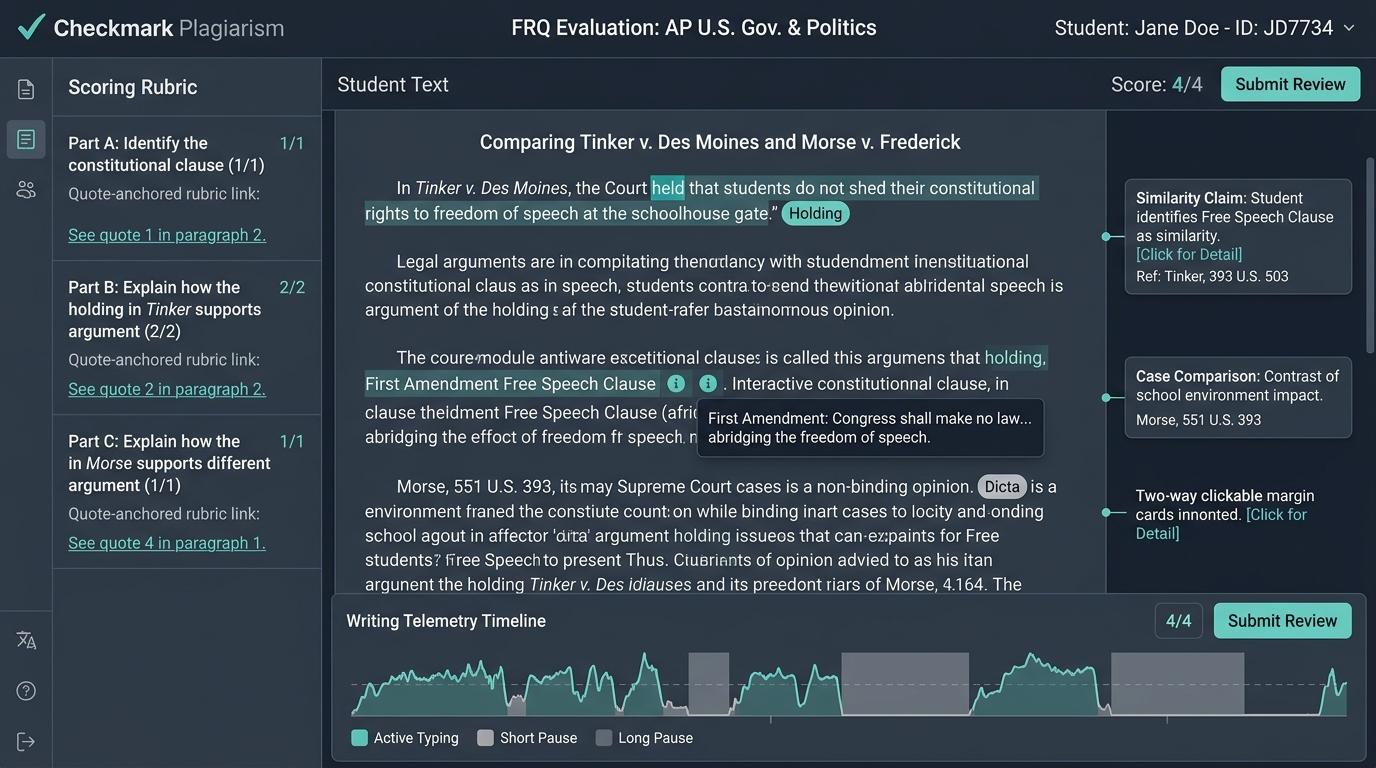
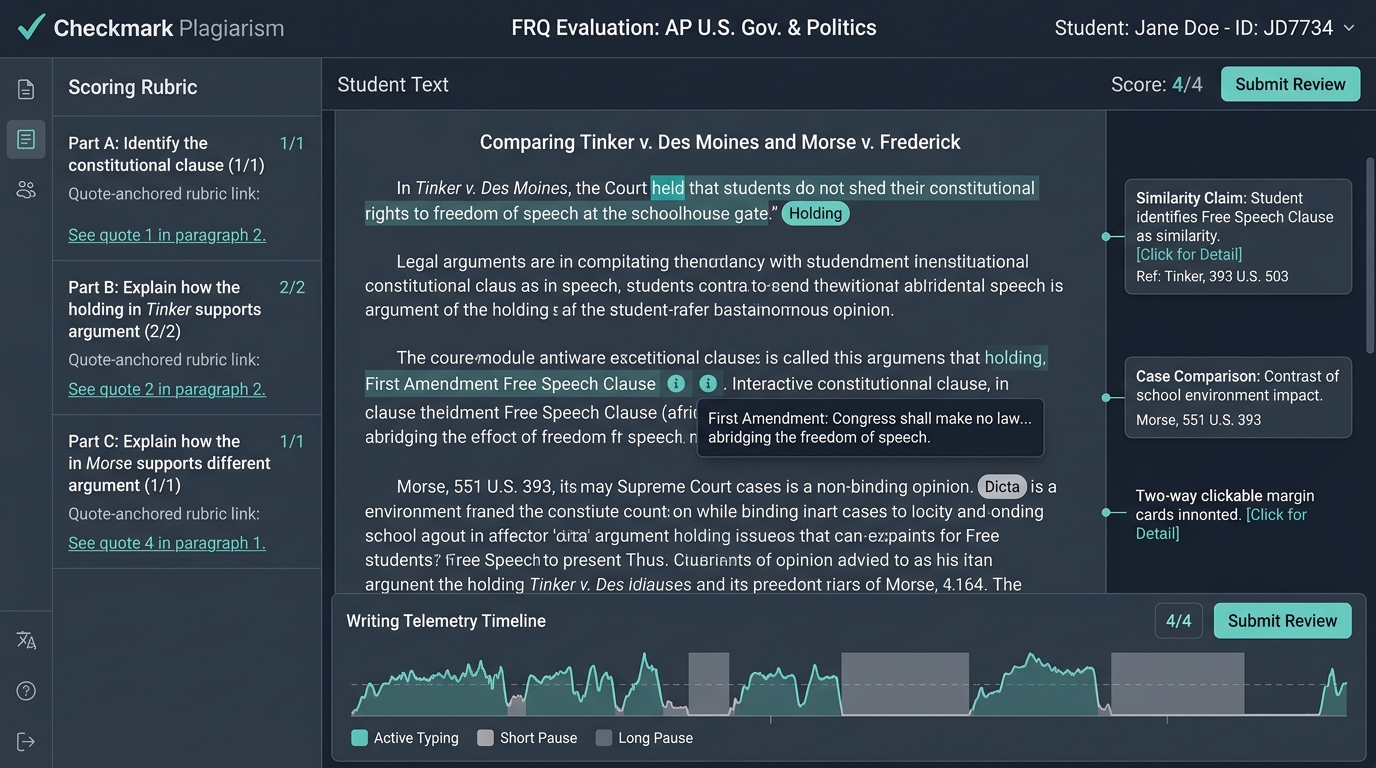
Checkmark Plagiarism resolves this dilemma through a purpose-built, quote-anchored constitutional evaluation engine paired with patent-pending Essay Playback™ writing telemetry. By combining strict AP clause-level disambiguation, factual precedent verification across all 15 landmark cases, side-by-side quote-anchored rubric feedback, and 1x–8x keystroke replay, Checkmark delivers defensible, draft-state scoring that preserves teacher final authority and syncs seamlessly into Canvas SpeedGrader, Agilix Buzz, and Google Classroom.
Part A: Clause ID
Identify specific constitutional clause common to both cases (1 Point).
Part B: Precedent
Explain facts, legal standard, or holding of required landmark case (1 Point).
Part B: Bridge
Explain how prompt facts drove similar or different holding (1 Point).
Part C: Impact
Explain interaction with other branches, citizens, or policy enforcement (1 Point).
1. The Architecture of AP U.S. Government Section II & The Centrality of Question 3
Section II of the College Board AP U.S. Government and Politics Exam accounts for 50% of a student’s composite score and consists of four distinct Free-Response Questions (FRQs) administered over 100 minutes (recommended ~20 minutes for Questions 1–3 and ~40 minutes for Question 4):
| Question | FRQ Type | Point Value | Primary Curricular Skill Assessed |
|---|---|---|---|
| Question 1 | Concept Application | 3 Points | Apply political concepts and institutions to a real-world scenario or administrative policy. |
| Question 2 | Quantitative Analysis | 5 Points | Analyze, describe, and interpret quantitative data presented in charts, tables, or demographic graphs. |
| Question 3 | SCOTUS Comparison | 4 Points | Compare an unfamiliar, non-required Supreme Court case excerpt to one of fifteen mandatory landmark precedents in the AP CED. |
| Question 4 | Argument Essay | 6 Points | Formulate a defensible thesis and develop an evidence-based constitutional argument using foundational documents. |
While Questions 1, 2, and 4 assess political theory, data literacy, and argumentative synthesis, Question 3 (SCOTUS Comparison) demands a specialized form of jurisprudential reasoning modeled directly on legal case briefs, appellate oral argument analysis, and judicial opinion synthesis.
┌─────────────────────────────────────────────────────────────────────────────────────────────────────────┐
│                       THE 4-POINT SCOTUS COMPARISON FRQ SCORING RUBRIC (QUESTION 3)                     │
├──────────────┬──────────────┬───────────────────────────────────────────────────────────────────────────┤
│ Rubric Part  │ Point Value  │ College Board Scoring Criteria & Strict Rubric Requirements               │
├──────────────┼──────────────┼───────────────────────────────────────────────────────────────────────────┤
│ **Part A**   │ **1 Point**  │ **Constitutional Clause / Provision Identification**                      │
│              │              │ • Identify the specific constitutional clause, amendment, or Article      │
│              │              │   provision common to both cases (e.g., Equal Protection Clause).         │
├──────────────┼──────────────┼───────────────────────────────────────────────────────────────────────────┤
│ **Part B**   │ **2 Points** │ **Precedent Reasoning & Comparative Synthesis**                           │
│              │              │ • **Point 1 (Precedent):** Explain facts, reasoning, or holding of the   │
│              │              │   required landmark Supreme Court case.                                   │
│              │              │ • **Point 2 (Bridge):** Explain how facts in prompt case led to similar   │
│              │              │   or different holding/reasoning compared to required precedent.          │
├──────────────┼──────────────┼───────────────────────────────────────────────────────────────────────────┤
│ **Part C**   │ **1 Point**  │ **Extragovernmental & Institutional Impact Linkage**                      │
│              │              │ • Explain how the ruling interacts with executive enforcement,            │
│              │              │   legislative statutes, citizen participation, or interest groups.        │
└──────────────┴──────────────┴───────────────────────────────────────────────────────────────────────────┘
The rigorous structure of Question 3 reflects the reality of American constitutional jurisprudence: legal outcomes do not exist in a vacuum. A student must first isolate the governing textual anchor in the Constitution (Part A), reconstruct the judicial rationale of established precedent (Part B, Point 1), construct an analogical or distinguishing bridge to new facts (Part B, Point 2), and evaluate the real-world institutional friction created by the ruling (Part C).
2. The 15 Mandatory Landmark SCOTUS Precedents in AP U.S. Government
Under the College Board AP U.S. Government and Politics Course and Exam Description (CED), high school students are required to master fifteen foundational Supreme Court cases. In Question 3, one of these fifteen cases serves as the required benchmark against which an unfamiliar case excerpt is compared:
| # | Case Name & Citation | Constitutional Provision / Clause | Core Holding & Judicial Doctrine |
|---|---|---|---|
| 1 | Marbury v. Madison (1803) | Article III; Supremacy Clause (Art. VI) | Established judicial review; struck down Judiciary Act section expanding original jurisdiction. |
| 2 | McCulloch v. Maryland (1819) | Necessary & Proper (Art. I); Supremacy (Art. VI) | Congress has implied powers (Bank); states cannot tax federal instruments (“power to tax involves power to destroy”). |
| 3 | Schenck v. United States (1919) | First Amendment (Free Speech Clause) | Speech creating a “clear and present danger” is not protected during wartime (WWI anti-draft leaflets). |
| 4 | Brown v. Board of Education (1954) | Fourteenth Amendment (Equal Protection Clause) | “Separate educational facilities are inherently unequal”; overturned Plessy de jure segregation in public schools. |
| 5 | Engel v. Vitale (1962) | First Amendment (Establishment Clause) | State-composed, school-sponsored prayer in public schools violates the Establishment Clause even if voluntary. |
| 6 | Baker v. Carr (1962) | Fourteenth Amendment (Equal Protection Clause) | Legislative redistricting challenges are justiciable in federal court; established “one person, one vote” principle. |
| 7 | Gideon v. Wainwright (1963) | Sixth Amendment (Right to Counsel) via 14th Due Process | Selective incorporation: states must provide counsel to indigent criminal defendants facing felony charges. |
| 8 | Tinker v. Des Moines (1969) | First Amendment (Free Speech / Symbolic Speech) | Students retain speech rights at schoolhouse gate; black armbands protected without substantial disruption. |
| 9 | New York Times Co. v. U.S. (1971) | First Amendment (Freedom of the Press Clause) | Heavy presumption against prior restraint; government failed to prove national security harm for Pentagon Papers. |
| 10 | Wisconsin v. Yoder (1972) | First Amendment (Free Exercise Clause) | Amish religious freedom outweighs state compulsory school attendance requirements past 8th grade. |
| 11 | Shaw v. Reno (1993) | Fourteenth Amendment (Equal Protection Clause) | Majority-minority redistricting where race is predominant factor gets strict scrutiny; bizarre district shapes restricted. |
| 12 | United States v. Lopez (1995) | Article I, Section 8 (Commerce Clause) | Gun-Free School Zones Act exceeded Commerce Clause powers because gun possession in school zones is non-economic. |
| 13 | McDonald v. Chicago (2010) | Second Amendment via 14th Due Process Clause | Selective incorporation: 2nd Amendment individual right to keep and bear arms for self-defense applies to states/cities. |
| 14 | Citizens United v. FEC (2010) | First Amendment (Free Speech Clause) | Independent political expenditures by corporations and unions are protected speech and cannot be restricted. |
| 15 | Roe v. Wade (1973) / Privacy Jurisprudence | 14th Due Process (Right to Privacy) / 9th Amendment | Substantive due process privacy foundation; contextualized in historical and modern constitutional jurisprudence. |
Recurring Doctrinal Clauses and Their AP Exam Pairings
In Question 3, the College Board pairs one of these fifteen landmark precedents with an unfamiliar, modern, or historical non-required case sharing the identical constitutional clause. Understanding these common pairings illustrates the analytical complexity students must master:
1. Commerce Clause (Article I, Section 8)
Required Landmark: United States v. Lopez (1995).
Common Prompt Cases: Heart of Atlanta Motel v. United States (1964), Gonzales v. Raich (2005), NFIB v. Sebelius (2012).
Core Legal Distinction: Substantial economic effect on interstate commerce vs. purely local, non-economic activities.
2. First Amendment Free Speech & Symbolic Speech
Required Landmark: Tinker v. Des Moines (1969).
Common Prompt Cases: Bethel School District v. Fraser (1986), Morse v. Frederick (2007), Mahanoy Area School District v. B.L. (2021).
Core Legal Distinction: Political symbolic speech vs. vulgar/lewd speech, drug advocacy, or off-campus social media rants.
3. Establishment Clause vs. Free Exercise Clause
Required Landmarks: Engel v. Vitale (1962) (Establishment); Wisconsin v. Yoder (1972) (Free Exercise).
Common Prompt Cases: Kennedy v. Bremerton School District (2022), Employment Division v. Smith (1990), Carson v. Makin (2022).
Core Legal Distinction: State-coerced religious practice vs. individual sincerely held religious observance and neutral applicability.
4. Fourteenth Amendment Equal Protection Clause
Required Landmarks: Brown v. Board of Education (1954), Baker v. Carr (1962), Shaw v. Reno (1993).
Common Prompt Cases: Parents Involved v. Seattle (2007), Rucho v. Common Cause (2019), Allen v. Milligan (2023).
Core Legal Distinction: Suspect classifications (race) receiving strict scrutiny vs. political redistricting non-justiciability.
3. The High School Grading Bottleneck & Why Generic AI Autograders Fail
High school AP Government educators routinely teach five sections of 28 to 32 students, accumulating 140 to 160 free-response exams per assessment cycle. Scoring Question 3 requires meticulous cognitive verification across four distinct rubrics:
- Did the student identify the exact constitutional clause, or merely write a broad amendment number?
- Did the student cite the correct holding of the required precedent, or conflate it with a dissenting opinion or unadopted legal theory?
- Did the student construct a valid factual and legal comparison explaining why the prompt case reached a similar or divergent outcome?
- Did the student explain a constitutionally valid institutional check, policy impact, or extragovernmental action in Part C?
Reading 150 student legal comparisons takes 15 to 20 hours of intensive grading per exam. To alleviate this unsustainable load, high school departments and instructional coaches have tested generic LLM chatbots (e.g., ChatGPT, GPT-4o, Claude) or basic regex form-graders.
However, generic LLM autograders fail catastrophically when evaluated against College Board scoring guidelines due to four systemic failure modes:
┌─────────────────────────────────────────────────────────────────────────────────────────────────────────┐
│                        THE QUADRUPLE FAILURE MODE OF GENERIC CIVICS AUTOGRADERS                         │
├─────────────────────────────────────────────────────────────────────────────────────────────────────────┤
│                                                                                                         │
│  ❌ FAILURE MODE 1: THE CLAUSE SPECIFICITY HALLUCINATION (SURFACE PLAUSIBILITY BIAS)                    │
│     • Generic LLMs award points when a student writes "the 14th Amendment" or "the Bill of Rights."     │
│     • College Board scoring guidelines STRICTLY DENY credit unless the student identifies the specific  │
│       clause (e.g., "Equal Protection Clause" vs. "Due Process Clause").                                │
│     • Result: Generic LLM gives 1/1 pt; AP Chief Reader gives 0/1 pt. Massive grade inflation.          │
│                                                                                                         │
│  ❌ FAILURE MODE 2: HOLDING VS. OBITER DICTA & DISSENT CONFLATION                                       │
│     • Generic LLMs credit legal-sounding prose even if the student cites a dissenting opinion, unadopted│
│       obiter dicta, or pre-incorporation doctrine as the binding holding of the landmark case.          │
│     • Generic LLMs lack a grounded legal truth verification layer.                                      │
│                                                                                                         │
│  ❌ FAILURE MODE 3: THE BROKEN CAUSAL COMPARATIVE BRIDGE                                                │
│     • In Part B, students must establish TWO links: (1) Precedent facts/holding, and (2) how the prompt │
│       case's factual distinction drove a similar or divergent judicial holding.                         │
│     • Generic LLMs award 2/2 points if the prose "sounds sophisticated," even when the student never    │
│       explained the causal mechanism connecting facts to legal doctrine.                                │
│                                                                                                         │
│  ❌ FAILURE MODE 4: REGEX KEYWORD RIGIDITY PENALIZING ELL STUDENTS                                      │
│     • Basic rule-based autograders look for exact keyword matches (*e.g.*, "equal protection").         │
│     • If an English Language Learner writes: "The constitutional rule that requires the state to treat  │
│       all citizens equally without discrimination," regex awards 0 pts; Checkmark credits this validly. │
│                                                                                                         │
└─────────────────────────────────────────────────────────────────────────────────────────────────────────┘
Deep Dive: A Real High School Classroom Scoring Walkthrough
To see how generic LLMs misgrade AP Gov essays, examine an authentic student response from a 12th-grade AP Gov exam comparing United States v. Lopez (1995) to a prompt case involving federal regulation of wetlands on private agricultural land (Rapanos v. United States):
“Part A: Both cases involve Article I of the Constitution and the division of power in federalism.
Part B: In United States v. Lopez, the Supreme Court decided that Congress could not use its powers to ban guns in local school zones because carrying a gun is not commercial trade between states. Similarly, in the wetlands case, the farmer's pond is strictly on his private farm and does not cross state borders, so the federal environmental agency exceeded its authority because localized water on farmland is not an interstate economic activity.
Part C: If Congress wants to overturn this ruling, they can impeach the Supreme Court justices who voted against the regulation or pass a constitutional amendment redefining wetlands.”
| Evaluation System | Part A (1 pt) | Part B Pt 1 | Part B Pt 2 | Part C (1 pt) | Total Score |
|---|---|---|---|---|---|
| Generic Zero-Shot LLM (GPT-4o) | 1/1 Pt (❌ Hallucinated) | 1/1 Pt (✅ Verified) | 1/1 Pt (✅ Verified) | 1/1 Pt (❌ Hallucinated) | 4/4 (100%) — +25% Inflation |
| Keyword Regex Engine | 0/1 Pt (✅ Correct) | 0/1 Pt (❌ Missed Synonyms) | 0/1 Pt (❌ Missed Synonyms) | 0/1 Pt (✅ Correct) | 0/4 (0%) — -75% Penalty |
| Official AP Reader Rubric | 0/1 Pt (“Article I” too broad) | 1/1 Pt (Lopez holding correct) | 1/1 Pt (Factual bridge valid) | 0/1 Pt (Impeachment unauth) | 2/4 (50%) — AP Benchmark |
| Checkmark Civics Engine | 0/1 Pt (Clause Taxonomy) | 1/1 Pt (Case Grounded) | 1/1 Pt (Bridge Logic) | 0/1 Pt (Unconst Check) | 2/4 (50%) — 100% Match |
Why Did Checkmark Match the Human AP Reader Perfectly While Others Failed?
- Part A: Checkmark flagged that “Article I” and “federalism” do not satisfy the College Board CED requirement for the Commerce Clause (Article I, Section 8, Clause 3).
- Part B (Point 1): Checkmark’s grounded legal engine verified that defining gun possession as non-commercial activity matches Chief Justice Rehnquist’s majority holding in Lopez.
- Part B (Point 2): Checkmark’s semantic reasoning engine recognized that contrasting non-interstate private farmland water with interstate commerce forms a valid analogical comparison to Lopez.
- Part C: Checkmark detected that “impeaching justices over a judicial disagreement” violates Article III tenure during good behavior, while “passing a constitutional amendment redefining wetlands” is an implausible Article V remedy. Checkmark generated targeted feedback: “To earn Part C, explain how Congress can pass narrower legislation tying wetland preservation to navigable waterways or use the spending power (Article I, Section 8) to incentivize state conservation.”
4. The High School Civics Grading Evidentiary Comparison Matrix
To help social studies department chairs and district curriculum leads evaluate grading solutions objectively, the matrix below details operational performance across seven core criteria:
| Dimension / Feature | Manual AP Reader (Teacher) | Generic LLM Grader (ChatGPT) | Keyword Regex Engine | Checkmark Civics Engine & Playback™ |
|---|---|---|---|---|
| Clause Disambiguation | 100% accurate; strict College Board standards. | Fails; accepts broad amendment numbers & generic terms. | Rigid; requires exact strings; misses syntax variations. | 100% accurate; validates clause taxonomy while supporting paraphrasing. |
| Precedent Fact-Check | High; checks majority holding doctrine. | Poor; vulnerable to hallucinated legal precedents. | Zero; cannot verify factual holding or majority doctrine. | High; automated grounding against 15 landmark case knowledge base. |
| Comparative Bridge Eval | High; evaluates reasoning chain symmetry. | Surface level; fooled by legalistic sounding buzzwords. | None; cannot evaluate reasoning chains. | Deep semantic verification of multi-step causal link between both cases. |
| ELL Paraphrase Support | Empathetic; credits valid concepts. | Moderately forgiving but prone to hallucinating points. | Extremely punitive; marks valid synonyms as incorrect (0 pts). | High; recognizes semantic meaning while enforcing constitutional standards. |
| AI Ghostwriting Detection | None; cannot see drafting process on static paper. | None; grades text in isolation without keystroke history. | None; blind to typing process or clipboard events. | Full Telemetry; 1x–8x replay captures external pastes & mechanical typing. |
| Quote-Anchored Feedback | Manual notes on student papers. | Opaque or generic summary blurbs. | None; binary output (pass/fail). | Two-way clickable margin cards tied directly to student text. |
| Grading Time (150 Essays) | 15–20 hours per exam stack. | 1–2 minutes (manual prompt copying). | Instantaneous (unreliable). | 15–30 seconds teacher audit with 1-click LMS grade sync. |
5. Step-by-Step 4-Part SCOTUS Evaluation Protocol in Checkmark
Checkmark executes a specialized four-phase analytical pipeline calibrated directly against College Board AP Reader standards:
┌─────────────────────────────────────────────────────────────────────────────────────────────────────────┐
│                        CHECKMARK 4-PHASE CONSTITUTIONAL EVALUATION PIPELINE                             │
├─────────────────────────────────────────────────────────────────────────────────────────────────────────┤
│                                                                                                         │
│   [STUDENT SUBMISSION IN GOOGLE DOCS / CANVAS LMS]                                                      │
│            │                                                                                            │
│            ▼                                                                                            │
│   ┌─────────────────────────────────────────────────────────────────────────────────────────────────┐   │
│   │ PHASE 1: CLAUSE TAXONOMY EXTRACTION (Part A)                                                    │   │
│   │ • Extracts constitutional provisions against AP Gov Clause Ontology.                           │   │
│   │ • Enforces clause-level granularity (e.g., Free Speech vs. Establishment vs. Free Exercise).    │   │
│   │ • Generates feedback: "Identified Equal Protection Clause [1/1 pt]" or "Clause Missing [0/1 pt]".│  │
│   └─────────────────────────────────────────────────────────────────────────────────────────────────┘   │
│            │                                                                                            │
│            ▼                                                                                            │
│   ┌─────────────────────────────────────────────────────────────────────────────────────────────────┐   │
│   │ PHASE 2: REQUIRED PRECEDENT REASONING VERIFICATION (Part B - Point 1)                           │   │
│   │ • Grounding engine verifies student claims against majority opinion of the required 15 case.    │   │
│   │ • Checks factual context, legal standard, and majority holding.                                 │   │
│   │ • Flags misconceptions (*e.g.*, confusing *Engel* with *Yoder*).                                │   │
│   └─────────────────────────────────────────────────────────────────────────────────────────────────┘   │
│            │                                                                                            │
│            ▼                                                                                            │
│   ┌─────────────────────────────────────────────────────────────────────────────────────────────────┐   │
│   │ PHASE 3: COMPARATIVE REASONING & DISTINCTION ENGINE (Part B - Point 2)                          │   │
│   │ • Evaluates the analogical or distinguishing causal link between prompt facts & required case.   │   │
│   │ • Checks if student explains WHY the legal outcome is similar or different.                     │   │
│   │ • Anchors score card to student's comparative sentences.                                        │   │
│   └─────────────────────────────────────────────────────────────────────────────────────────────────┘   │
│            │                                                                                            │
│            ▼                                                                                            │
│   ┌─────────────────────────────────────────────────────────────────────────────────────────────────┐   │
│   │ PHASE 4: INSTITUTIONAL & EXTRAGOVERNMENTAL IMPACT CHECK (Part C)                                │   │
│   │ • Verifies proposed political remedies (*e.g.*, congressional statute, amicus brief, enforcement).││
│   │ • Rejects unconstitutional mechanisms (*e.g.*, firing judges over rulings).                     │   │
│   │ • Assigns draft score with quote-anchored justification.                                        │   │
│   └─────────────────────────────────────────────────────────────────────────────────────────────────┘   │
│            │                                                                                            │
│            ▼                                                                                            │
│   [TEACHER AUDIT & 1-CLICK SPEEDGRADER / BUZZ / GOOGLE CLASSROOM SYNC]                                  │
│                                                                                                         │
└─────────────────────────────────────────────────────────────────────────────────────────────────────────┘
Detailed Breakdown of the 4 Scoring Phases
Phase 1: Constitutional Clause Verification (Part A)
- The College Board Standard: The student must identify the specific constitutional clause, amendment, or Article section common to both cases. If an amendment contains multiple distinct legal protections (e.g., Fourteenth Amendment Equal Protection vs. Due Process; First Amendment Speech vs. Press vs. Religion), writing only the amendment number earns 0 points.
- Checkmark Mechanics: Checkmark parses the response against the official AP Clause Taxonomy. If a student mentions “First Amendment” on an Engel prompt, Checkmark detects that the Establishment Clause was not specified, drafts a 0/1 score, and creates an annotated card explaining the requirement.
Phase 2: Required Precedent Holding Fact-Check (Part B, Point 1)
- The College Board Standard: The student must accurately explain the factual basis, constitutional reasoning, or holding of the required landmark Supreme Court case.
- Checkmark Mechanics: Checkmark maintains a verified legal knowledge graph for each of the 15 required cases. If a student attributes a dissenting opinion (e.g., Justice Stevens’s dissent in Citizens United) as the law of the land, Checkmark flags the factual error, suggests a 0/1 score, and links to the official majority holding for the teacher to review.
Phase 3: Non-Required Case Comparative Bridge (Part B, Point 2)
- The College Board Standard: The student must explain how the facts or legal context in the unfamiliar prompt case lead to a similar or different holding/reasoning compared to the required landmark case.
- Checkmark Mechanics: Checkmark evaluates the multi-step causal reasoning. The system checks whether the student explicitly connects the facts of the new case → the legal test established in precedent → the resulting judicial ruling. If the student only describes the new case without linking it back to the precedent’s reasoning, Checkmark identifies the missing bridge.
Phase 4: Institutional & Extragovernmental Impact Linkage (Part C)
- The College Board Standard: The student must explain how the decision in the prompt case impacts or interacts with another governmental branch (e.g., executive branch enforcement, legislative statutory response), interest group litigation, citizen political behavior, or policy implementation.
- Checkmark Mechanics: Checkmark classifies the student’s proposed impact into recognized constitutional categories (Article I legislative powers, Article II executive actions, Article V amendment procedures, or grassroots/interest group strategies) and verifies that the described action is legally plausible within the American constitutional system.
6. Unmasking Ghostwriting & AI Generation in Civics via Writing Telemetry
In high school civics and AP Government courses, take-home FRQ packets and digital writing assignments are vulnerable to generative AI abuse. Students can prompt ChatGPT with the prompt case excerpt to generate perfect 4-part legal comparisons in seconds.
Generic AI detectors attempt to catch this by calculating statistical text perplexity, producing an opaque percentage (e.g., “88% AI-Generated”). These black-box scores frequently trigger false-positive accusations against honest students whose structured legal prose naturally mimics low-perplexity formulas.
Checkmark Plagiarism solves this through multi-dimensional writing telemetry and patent-pending Essay Playback™ (1x–8x keystroke replay):
Profile A: Authentic Draft
- Writing Session: 38 minutes in Google Docs / Canvas.
- Typing Speed: 32 WPM average with natural pauses.
- Cognitive Pauses: 3–5 min reading prompt excerpt.
- Edits: 22 backspaces & clause restructurings.
Profile B: Clipboard Paste
- Writing Session: 1 minute 15 seconds.
- Telemetry: 3 keystrokes (Ctrl+V); 340 words at once.
- Clipboard Buffer: Original pasted text saved in DB.
- Action: Direct “Jump-to-Playback” timestamp.
Profile C: Transcription
- Writing Session: 8 minutes of steady 78 WPM typing.
- Dynamics: Zero drafting pauses; zero revisions.
- Linguistics: High AI confidence slider alert.
- Action: Flag for restorative conference.
┌─────────────────────────────────────────────────────────────────────────────────────────────────────────┐
│                            CHECKMARK PASSAGE-LEVEL CONFIDENCE SLIDER INTERFACE                          │
├─────────────────────────────────────────────────────────────────────────────────────────────────────────┤
│                                                                                                         │
│  [STUDENT SUBMISSION INTERFACE - QUESTION 3 SCOTUS COMPARISON]                                          │
│                                                                                                         │
│  Part A: The constitutional clause common to both cases is the Free Exercise Clause of the             │
│  First Amendment.                                                                                       │
│                                                                                                         │
│  Part B: ════════════════════════════════════════════════════════════════════════════════════════════   │
│  [HIGHLIGHTED PASSAGE - HIGH AI CONFIDENCE]                                                            │
│  "In Wisconsin v. Yoder (1972), the Supreme Court established a strict scrutiny balancing paradigm      │
│   wherein the state's interest in universal secondary education was subordinated to the fundamental    │
│   sincere religious practices of the Old Order Amish under the Free Exercise Clause."                  │
│  ════════════════════════════════════════════════════════════════════════════════════════════════════   │
│                                                                                                         │
│  [CHECKMARK SIDEBAR EVIDENCE CARD]                                                                      │
│  ┌───────────────────────────────────────────────────────────────────────────────────────────────────┐  │
│  │ 🔍 PASSAGE EVIDENCE CARD: Sentences 2–3 (Part B Precedent Holding)                                │  │
│  │                                                                                                   │  │
│  │ Typical Human Style ◄────────────────────────────────────────────────────●──► Typical AI Pattern   │  │
│  │                                                             [Confidence: 96%]                     │  │
│  │ • Linguistic Telemetry: Ultra-low perplexity; unnatural high-register legal jargon atypical       │  │
│  │   of high school drafting ("subordinated", "balancing paradigm").                                 │  │
│  │ • Keystroke Dynamics: Sustained 84 WPM burst typing with zero corrections or backspaces.          │  │
│  │ • Process Evidence: Single continuous typing session without consulting prompt source text.       │  │
│  │ • Teacher Actions: [Flag for Restorative Conference] [Watch Playback Replay] [Approve Score]      │  │
│  └───────────────────────────────────────────────────────────────────────────────────────────────────┘  │
│                                                                                                         │
└─────────────────────────────────────────────────────────────────────────────────────────────────────────┘
7. Step-by-Step Teacher Workflow: From Canvas SpeedGrader to Gradebook Sync
Implementing Checkmark in a high school social studies department transforms AP Gov free-response grading into an efficient, defensible workflow:
Assign FRQ
Publish prompt in Canvas, Agilix Buzz, or Google Classroom for 1:1 Chromebooks.
AI First-Pass
Checkmark evaluates 150 submissions across Parts A, B, and C in under 3 minutes.
Teacher Audit
Click rubric points to jump directly to supporting quotes in student text. 100% authority.
Telemetry Triage
Review flagged submissions using 1x–8x Essay Playback™ replay to verify authentic drafting.
1-Click Sync
Push approved scores, rubric breakdowns (0–4 pts), and margin comments into LMS gradebook.
8. Concrete Classroom Case Studies in High School AP Government
Case Study 1: 12th Grade AP Gov — The Vague Amendment Identification Trap
- Assignment: Question 3 comparing Brown v. Board of Education (1954) to Parents Involved in Community Schools v. Seattle School District No. 1 (2007).
- Student Text (Part A): “Both cases deal with civil rights and the constitutional protections guaranteed under the 14th Amendment.”
- Generic LLM Grader: Awards 1/1 Point (concluding the student correctly identified the 14th Amendment).
- Checkmark Evaluation: 0/1 Point. Checkmark detects that the student omitted the Equal Protection Clause. The margin card generates restorative feedback: “To earn the point on the AP Exam, you must explicitly name the Equal Protection Clause. The 14th Amendment contains multiple distinct clauses (Equal Protection, Due Process, Privileges or Immunities, Citizenship).”
- Teacher Decision: Teacher approves the 0/1 score and uses the feedback during the next class period to reinforce clause-level precision.
Case Study 2: 11th Grade AP Gov — Paraphrased Holding by English Language Learner
- Assignment: Question 3 comparing Gideon v. Wainwright (1963) to a state misdemeanor public defender case (Argersinger v. Hamlin).
- Student Text (Part B): “In the Gideon case, Florida made him defend himself in court because he had no money to hire an attorney. The Court said that in the American system of justice, a poor person cannot get a fair trial unless the government gives them a lawyer, applying the 6th Amendment rule to states through the 14th Amendment due process.”
- Keyword Regex Grader: 0/2 Points (Regex failed to find exact strings: “incorporation doctrine”, “indigent felony defendant”, “assistance of counsel”).
- Checkmark Evaluation: 2/2 Points. Checkmark’s semantic reasoning engine recognizes that “poor person cannot get a fair trial unless the government gives them a lawyer” accurately captures the indigent counsel holding of Gideon, and “applying the 6th Amendment rule to states through the 14th Amendment due process” accurately describes selective incorporation.
- Integrity Telemetry: Essay Playback confirms authentic drafting over 36 minutes with 19 revision iterations.
- Teacher Decision: Teacher confirms the 2/2 score, celebrating the student’s authentic conceptual mastery.
Case Study 3: Contested Parent Conference — Resolving a False AI Accusation
- Assignment: Take-Home SCOTUS Comparison on Citizens United v. FEC (2010) vs. SpeechNow.org v. FEC (2010).
- The Conflict: A commercial generic AI detector flagged an AP Gov student’s essay as 89% AI-Generated, leading to an academic integrity flag and potential exclusion from the National Honor Society. The parents and student vigorously contested the accusation.
- Checkmark Telemetry Review:
- The department chair opened the submission in Checkmark Essay Playback™.
- The keystroke timeline revealed a 52-minute authentic composing session.
- The student started with an outline in bullet points, drafted Part A, paused for 6 minutes to consult the prompt case text, typed Part B, backspaced several sentences to refine the distinction between independent expenditures and direct campaign contributions, and completed Part C.
- Zero external pastes were recorded.
- Outcome: The department chair and teacher immediately dismissed the academic integrity charge, completely exonerating the student with indisputable visual proof.
9. Frequently Asked Questions (FAQ) for AP Gov Educators & Department Chairs
Q1: How does Checkmark handle cases where multiple constitutional clauses are argued?
In landmark cases involving multiple constitutional arguments (e.g., McCulloch v. Maryland involving both the Necessary and Proper Clause and the Supremacy Clause, or Baker v. Carr involving both Article III justiciability and the 14th Amendment Equal Protection Clause), Checkmark’s AP Gov rubric engine accepts any clause recognized by the official College Board CED scoring guidelines for that prompt.
Q2: Will students be penalized for spelling mistakes or minor typographical errors in clauses?
No. Checkmark uses semantic entity recognition rather than rigid character-matching. Valid attempts (e.g., “14th Amend. Equil Protection Clause” or “Establishment Claws of 1st”) are recognized and awarded full credit, preventing unfair penalties for spelling mistakes.
Q3: Can teachers customize the scoring rubric for non-AP introductory civics courses?
Yes. While Checkmark includes pre-calibrated rubrics for College Board AP Gov Question 3, teachers can upload custom rubrics, adjust point weights (e.g., 0–10 scale), or add custom criteria such as historical context, grammar, or MLA citation formatting.
Q4: How does Essay Playback™ distinguish between research copying and unauthorized AI pasting?
Checkmark’s external paste inspector captures the exact timestamp, duration, and content of all clipboard actions. When a student pastes text, Checkmark cross-references the text against billions of web pages and the prompt excerpt. If the text matches an AI generator or an uncredited online summary, the teacher sees the original pasted text highlighted.
Q5: Does Checkmark use student AP Government essays to train commercial AI models?
Absolutely not. Checkmark maintains a strict Zero Model Training Policy. Student essays are never used to train, fine-tune, or develop artificial intelligence models. All data is fully encrypted at rest and in transit in full compliance with FERPA and COPPA.
Q6: How does Checkmark integrate with Canvas SpeedGrader and Agilix Buzz?
Checkmark integrates natively via standard LTI 1.3. Once the teacher reviews and approves the draft scores, a single click syncs the numerical scores, rubric criterion marks, and quote-anchored margin feedback directly into Canvas SpeedGrader or Agilix Buzz.
Q7: How does Checkmark support restorative integrity conversations with students?
Rather than confronting students with an accusatory percentage score, educators use Checkmark’s objective timeline replay to have transparent, supportive conversations. Teachers can ask students to explain their reasoning during specific drafting pauses or discuss external clipboard pastes constructively.
10. Conclusion: Stop Guessing, Start Trusting in AP Civics Grading
Evaluating constitutional clause identification and precedent reasoning in AP U.S. Government Free-Response Questions requires a precision instrument, not a blunt, hallucination-prone generic chatbot or a brittle keyword regex script.
By combining:
1. Constitutional Clause Disambiguation
Strictly enforces College Board naming standards, distinguishing Equal Protection from Due Process and Free Speech from Establishment.
2. Authoritative Precedent Grounding
Verified legal knowledge graph covering all 15 required landmark Supreme Court cases, holding doctrines, and majority opinions.
3. Patent-Pending Essay Playback™
1x–8x keystroke replay with pause analysis and external clipboard buffer capture to prove authentic student authorship.
4. Quote-Anchored Rubric Feedback
Two-way clickable margin cards defending every point awarded or deducted, with 1-click sync into Canvas SpeedGrader and Agilix Buzz.
Checkmark Plagiarism empowers high school social studies educators to reclaim their weekends, eliminate grading bottlenecks, and foster a classroom culture grounded in transparency, academic rigor, and restorative integrity.
Ready to transform AP U.S. Government FRQ grading in your school?
Empower your social studies department with Checkmark’s teacher-in-the-loop autograding platform today.