
Executive Summary
Timed writing assessments—such as 45-to-60-minute in-class bluebook essays, AP/IB Document-Based Questions (DBQs), and college midterms—are designed to evaluate a student's live cognitive synthesis, critical thinking, and spontaneous prose construction under working memory constraints. However, testing coordinators, humanities faculty, and academic integrity committees face an escalating evaluation dilemma: students circumventing the timed testing window by pasting pre-drafted scripts (prepared off-platform or generated via generative AI) or optically transcribing text from a hidden secondary device. Traditional static AI detectors and coarse LMS revision snapshots produce ambiguous, indefensible whole-paper percentages or miss manual retyping entirely. By contrast, writing telemetry provides an empirical, defensible biometric record of the live composing journey. Authentic real-time brainstorming leaves unmistakable psycholinguistic signatures: an initial formulation pause (3–8 minutes of outlining and cognitive framing), short Production Bursts (P-bursts) of 8–18 words punctuated by evaluative pauses (2–7 seconds), and high Keystroke Friction Ratios (15%–30% backspaces and structural revisions). Conversely, illicit script ingestion produces distinct telemetry anomalies: instantaneous monolithic paste drops (400–800 words in 0.0s), synthetic camouflage chunking, or metronomic optical transcription (flat 45–60 WPM with <3% backspaces and near-zero variance in Inter-Key Intervals). Checkmark Plagiarism's patent-pending Essay Playback™ suite, External Paste Buffer Inspector, and Transcription Cadence Detection give educators transparent, pedagogical evidence (“receipts”) to uphold assessment validity, protect neurodivergent writers, and transform disciplinary confrontations into supportive, restorative learning dialogues under the guiding principle: “Stop guessing, start trusting.”

1. The High-Stakes Assessment Dilemma: Live Synthesis vs. Script Injection
In high-stakes secondary and post-secondary education, timed writing examinations remain the gold standard for measuring authentic student mastery. Whether administered as an Advanced Placement (AP) European History Document-Based Question (DBQ), an International Baccalaureate (IB) Paper 2 comparative literature essay, a 50-minute college English midterm, or a state high school graduation benchmark, timed assessments isolate the writer's immediate cognitive competence from external collaborative aids.
45–60 Minute LMS / Digital Bluebook Testing Window
- • Document Prompt Reading: 3–8 min initial formulation incubation and scratchpad outlining.
- • Working Memory Lexical Retrieval: Dynamic clause assembly with high Inter-Key Interval (IKI) variance.
- • Syntactic Revision Bursts: 15%–30% Keystroke Friction Ratio (KFR) with active restructuring.
- • Live Primary Source Synthesis: Permissible prompt citation with referenced document integration.
500–800 words injected at 0.00s; pre-drafted external essay copied from off-platform AI or note document.
1–2 sentences pasted every 45 seconds to emulate human progression while bypassing basic total-time alerts.
Student reads off phone/tablet; flat 50 WPM cadence, <3% backspace, zero syntactic planning pauses.
The Shift from Raw In-Class Composition to Pre-Fabricated Ingestion
When digital bluebooks and Learning Management System (LMS) lock-down environments replaced physical paper bluebooks, the threat landscape evolved. Instead of entering the exam room to analyze unseen prompts and primary sources in real time, some students attempt to import pre-fabricated prose through three primary vectors:
- Monolithic Script Ingestion: Pasting a fully drafted essay—often generated off-platform using large language models (LLMs) prior to the exam or in an unproctored virtual tab—into the text editor in a single action (e.g., 650 words in 0.00 seconds).
- Camouflage Chunking: Incrementally pasting small chunks (1–3 sentences at a time) every 30 to 60 seconds to evade basic total-time monitoring and mimic the chronological progression of human composition.
- Optical Transcription (Second-Screen Evasion): Positioning a secondary device (a mobile phone propped against a pencil case, a smartwatch, or a secondary desktop monitor in unproctored remote exams) and manually retyping an unapproved script character-by-character into the exam editor.
Why Static AI Detectors and Basic LMS Logs Fail
Assessment coordinators, testing directors, and faculty committees facing disputed timed exam submissions frequently discover that standard investigative tools create significant pedagogical and legal liabilities:
| Diagnostic Approach | What It Measures | Fatal Flaw in Timed Exam Adjudication |
|---|---|---|
| Static AI Classifiers | Surface word predictability (perplexity) and sentence length variability (burstiness) on the final text. | Opaque & Unreliable: Generates black-box probability percentages (e.g., “78% Likely AI”) without audit trails. Falsely flags neurodivergent, highly structured, or non-native English writers who write with clean, uniform syntax. |
| Standard LMS Snapshot Logs | Coarse document state saves every 5 to 10 minutes (e.g., Canvas or Google Docs native version history). | Granularity Blindness: Aggregates keystrokes into broad snapshots. Cannot differentiate between a student typing 50 words across 5 minutes versus pasting 50 words at minute 4.9 and sitting idle. |
| Basic DOM Paste Listeners | Binary flags triggered on JavaScript onPaste events. |
Easily Bypassed: Blind to optical second-screen transcription. Fails to capture the actual clipboard text, leaving educators unable to prove whether a paste was an unapproved essay or a quote copied from the exam's own prompt. |
| Invasive Webcam Proctoring | Eye-tracking gaze detection, room panning, and AI facial movement algorithms. | High Anxiety & False Positives: Flags students looking at scratch paper or processing ideas visually. Creates severe privacy and accessibility friction while failing to capture the writing process itself. |
To resolve these vulnerabilities without resorting to punitive guesswork or invasive surveillance, institutions are adopting writing telemetry—the granular, millisecond-by-millisecond measurement of keystroke dynamics, pause topography, and editor interactions.
2. The Cognitive Science of Timed Composing: Real-Time Brainstorming Telemetry
Genuine human writing under timed conditions is not a continuous, steady transcription of pre-formed sentences. It is an intensely recursive, cognitively taxing struggle governed by working memory limits, lexical retrieval latency, and syntactic restructuring.
- Duration: 3–8 minutes initial window
- Keystrokes: 0–30 characters in main editor
- Reading prompts & evaluating sources
- Structuring scratchpad outline & thesis framing
- P-Bursts: 8–18 words at 45–75 WPM
- Formulation Pauses: 2–7s at syntactic boundaries
- Working memory translation into keystrokes
- High Inter-Key Interval (IKI) distribution variance
- Keystroke Friction: 15%–30% Backspaces (KFR)
- Word and clause deletions (R-bursts)
- Structural reordering & non-linear cursor jumps
- Final argumentation polish & evidence verification
The Three Biomechanical Pillars of Authentic Brainstorming
Decades of cognitive writing research—grounded in the foundational models of Hayes & Flower (1980) and Kellogg (1996), and validated through modern keystroke logging research (e.g., Leijten & Van Waes, 2013)—demonstrate that live human brainstorming exhibits three distinct telemetric signatures:
1. Formulation Latency & Brainstorming Topography
In a 45-to-60-minute timed exam, a student who is authentically engaging with the prompt does not immediately begin typing full prose at second 0:01.
- The Silent Incubation Window: Authentic writers typically display 3 to 8 minutes of low-keystroke formulation latency at the start of the session. During this window, telemetry records near-zero character production, intermittent cursor movements, or short bulleted scratchpad outlines (e.g., jotting down thesis ideas, document citations, or mnemonic frameworks).
- Cognitive Function: The working memory is actively parsing the prompt constraints, searching long-term memory schemas for historical facts or theoretical models, and establishing a global rhetorical goal.
2. Cognitive Burst Dynamics: P-Bursts and Syntactic Pauses
Once drafting commences, human motor execution occurs in discrete spurts termed Production Bursts (P-bursts) separated by cognitive planning pauses.
- P-Burst Length: In spontaneous timed writing, P-bursts average 8 to 18 words (approximately 40 to 100 characters) before pausing.
- Pause Topography: Pauses are non-randomly distributed. Telemetry reveals micro-pauses (200–800 ms) between words within a clause, but significant formulation pauses (2.0 to 7.0+ seconds) at major syntactic boundaries:
- Before starting a new subordinate clause (e.g., pausing before “although,” “whereas,” or “consequently”).
- At sentence boundaries (periods, semicolons).
- At paragraph transitions (where planning pauses often extend to 10–25 seconds as the writer shifts to a new line of argument).
3. Revision Friction & Backspace Churn
Real-time composition involves constant self-monitoring and immediate error recovery. Writers continuously adjust word choices, correct typos, and abandon dead-end syntactic structures.
- The Keystroke Friction Ratio (KFR): Defined as the ratio of deletion events (Backspace and Delete keys) to total keyboard interactions:
KFR = [ (Nbackspace + Ndelete) / Ntotal_keystrokes ] × 100%
- Authentic Baseline: Authentic real-time brainstorming exhibits a KFR of 15% to 30%. For every 1,000 characters in the final submission, an authentic writer typically executes 1,200 to 1,500 total keystrokes due to active revision, lexical trial-and-error, and spontaneous sentence restructuring.
Jagged velocity curve with dynamic peaks (P-bursts of 14 words), 4.8s syntactic boundary pauses, and red downward revision markers (-32 chars).
Invariant flat horizontal cadence hovering at 48–52 WPM from minute 0 to 50, with shallow 1.1s eye saccades and zero structural revisions.
3. Telemetry Signatures of Pre-Drafted Script Ingestion
When a student imports pre-drafted text into a timed testing environment, the psycholinguistic connection between working memory and motor execution is severed. The student is no longer generating syntax; they are merely executing a data transfer operation. This structural decoupling leaves unmistakable mathematical anomalies in document telemetry.
- Duration: 0.00 seconds
- Volume: 400–800+ words in single event
- Keystrokes: 1 single paste event
- Raw external clipboard text preserved in buffer
- Cadence: 25–50 words every 45–60s
- Simulates linear document growth
- 100% character generation at 0.00s steps
- Unnatural cursor jumping without arrow navigation
- Velocity: Invariant 45–60 WPM flat rate
- Friction: KFR < 3.0% (motor typos only)
- Zero boundary formulation pauses
- Narrow Gaussian IKI variance (σ < 65ms)
Signature A: Instantaneous Monolithic Paste Ingestion
The most direct form of script injection occurs when the student copies an entire pre-written response from an external document or LLM interface and pastes it into the exam field.
- Delta-Time Anomaly: Insertion of 400 to 1,000+ words with a time delta (Δt) of less than 100 milliseconds (0.00 s).
- Net-to-Gross Ratio (NGR):
NGR = [ Final Document Character Count / Total Keystrokes Logged ] ≈ ∞In pure paste events, the final document contains 3,500 characters while the keyboard event log registers zero alphanumeric keypresses and exactly one
Pasteevent. - Clipboard Buffer Origin: Examination of the external clipboard payload reveals non-native text structure, often containing unrendered markdown, foreign whitespace formatting, or citation conventions inconsistent with the student's typical manual typing.
Signature B: Micro-Chunked Camouflage Pasting
Recognizing that monolithic paste drops trigger automated threshold flags, sophisticated evasion involves pasting small snippets sequentially.
- Cadence Topography: Telemetry registers a repeating cycle:
Paste (25–45 words at 0.00s) → Idle Pause (30–60s) → Paste (30–50 words at 0.00s)
- Micro-Burst Profile: While the document growth curve appears linear on coarse LMS graphs, granular millisecond telemetry reveals that 100% of character generation occurs in instantaneous steps of 0.00s, with zero intra-word keystrokes logged between the pause intervals.
- Cursor Repositioning Gaps: The cursor frequently jumps to precise structural points without intermediate arrow-key navigation or text selection highlights, reflecting rapid switching between window contexts.
Signature C: Metronomic Optical Transcription (Second-Screen Retyping)
When a student manually retypes a pre-drafted script from an unapproved secondary device (such as a smartphone resting on their desk or a tablet outside the proctored screen capture), they bypass all clipboard-based listeners. However, the telemetry of optical transcription is fundamentally distinct from spontaneous composing:
- Inter-Key Interval (IKI) Variance Collapse:
- Inter-Key Interval (IKI): The time elapsed in milliseconds between consecutive keypresses (tk − tk-1).
- Authentic Composing: Displays high IKI standard deviation (σIKI > 180 ms) and a high Coefficient of Variation (CVIKI > 0.65), reflecting the unpredictable rhythm of cognitive hesitation, lexical retrieval, and motor execution.
- Optical Transcription: Displays an unnaturally narrow IKI distribution (σIKI < 65 ms, CVIKI < 0.25). The typing cadence is metronomic (e.g., a continuous 50 WPM) because the student's working memory is engaged in a simple visual-to-motor transcription task rather than syntactic problem-solving.
- Absence of Syntactic Formulation Pauses:
In transcription telemetry, the pause duration before major clause transitions, transition words, and paragraph breaks is indistinguishable from intra-word pauses (250–450 ms). The student does not pause to plan the next sentence because the sentence is already fully formed on their external screen.
- Suppressed Keystroke Friction Ratio (KFR < 3%):
Because the student is copying an already polished, spell-checked, and grammar-checked script, they perform almost zero structural editing. The backspace key is used exclusively for immediate 1-character motor typos (KFR ≤ 2.5%), with zero sentence-level restructuring or deleted conceptual paragraphs.
4. 8-Dimension Telemetry Comparison Matrix
The following 8-dimension matrix contrasts authentic real-time brainstorming against the three primary script ingestion vectors during a 50-minute timed exam:
| Telemetric Dimension | Authentic Real-Time Brainstorming | Monolithic Paste Drop | Camouflage Chunking | Optical Second-Screen Transcription |
|---|---|---|---|---|
| 1. Initial Formulation Latency | 3.0 to 8.0 minutes (silent thinking, prompt reading, scratchpad outlining) | 0.5 to 2.0 minutes (navigating to external window, preparing paste) | 0.5 to 2.0 minutes (aligning external script) | 0.5 to 2.0 minutes (positioning phone / second screen) |
| 2. Active Typing Velocity | Variable (25–75 WPM) with dynamic peaks and deep cognitive valleys | N/A (instantaneous insertion) | N/A (instantaneous micro-insertions) | Invariant (45–60 WPM) flat metronomic rate across the session |
| 3. P-Burst Duration | 8 to 18 words per burst before cognitive pause | Entire text (400–800 words) in 1 single event | 20 to 50 words per micro-chunk paste event | Continuous stream across entire paragraphs without burst boundaries |
| 4. Syntactic Boundary Pauses | 2.0 to 7.0+ seconds at clause thresholds; 10–25s at paragraph breaks | 0.00 seconds (instantaneous) | 0.00 seconds (instantaneous insertion during active burst) | < 600 milliseconds (identical to intra-word letter spacing) |
| 5. Keystroke Friction Ratio (KFR) | 15.0% to 30.0% (frequent backspacing, re-phrasing, structural edits) | 0.0% (zero keyboard deletion events) | < 1.0% (occasional spacing adjustments) | 0.5% to 3.0% (isolated single-character motor typo fixes only) |
| 6. IKI Variance (CVIKI) | High (CV > 0.65, σ > 180ms) reflecting cognitive load shifts | Undefined (no individual keystroke intervals logged) | Undefined (paste events log zero intra-word keypresses) | Extremely Low (CV < 0.25, σ < 65ms) resembling a mechanical typist |
| 7. Structural Reorganization | High (cutting/moving paragraphs, mid-sentence structural restarts) | Zero (text enters fully formed and remains static) | Zero (chunks are placed in final sequential order) | Zero (strictly linear forward entry from 0 → N characters) |
| 8. Scratchpad / Outline Usage | Present (bullet points, document citation codes jotted and deleted) | Absent (no pre-writing telemetry recorded in exam environment) | Absent (no live pre-writing steps logged) | Absent (pre-writing occurred off-platform prior to testing window) |
5. Checkmark Plagiarism's Assessment Telemetry & Forensic Suite
To equip educators, assessment directors, and academic integrity officers with transparent, indisputable evidence, Checkmark Plagiarism has engineered a comprehensive assessment telemetry suite natively integrated with modern LMS workflows.
- 1x–8x scrubbable chronological video replay
- Visual pause topography & heatmaps
- Real-time composing velocity curves
- Session milestone metrics summary card
- Preserves 100% of clipboard text payload
- Distinguishes prompt quotes from external scripts
- Direct timecoded “Jump to Playback” links
- Forensic archives retained even if text deleted
- Statistical Inter-Key Interval (IKI) modeling
- Coefficient of variation (CV) threshold monitoring
- Flags second-screen mechanical transcription
- Private educator-only non-punitive alerts
- Passage-Level AI Sliders: Granular confidence scoring without opaque whole-paper percentages.
- Side-by-Side Source Matching: Bilateral quote inspection against billions of live web pages.
- Rubric Autograder Passback: Direct sync with Canvas SpeedGrader, Buzz LMS, and Google Classroom.
- FERPA/COPPA Zero-Training Guarantee: Student exam submissions are never used to train foundation models.
1. Patent-Pending Essay Playback™ (1x to 8x Video Replay)
Checkmark's flagship Essay Playback™ reconstructs the complete writing session keystroke-by-keystroke. Educators do not have to parse raw JSON logs or decipher complex biometric timestamps; they can scrub through the session like an interactive video.
- Scrubbable Timeline: Play back the student's exam at 1x, 2x, 4x, or 8x speed to observe real-time idea formulation, pauses, deletions, rewrites, and cursor movements.
- Topographical Pause Heatmaps: Visual color-coded indicators along the playback timeline highlight where the student paused, distinguishing healthy 4-minute prompt-reading pauses from abnormal 20-minute idle gaps.
- Session Milestone Metrics: Automatically computes the session's active drafting time, typing velocity curves, and friction ratios, providing an instant summary card alongside the visual playback.

2. External Paste Buffer Inspector with Complete Text Preservation
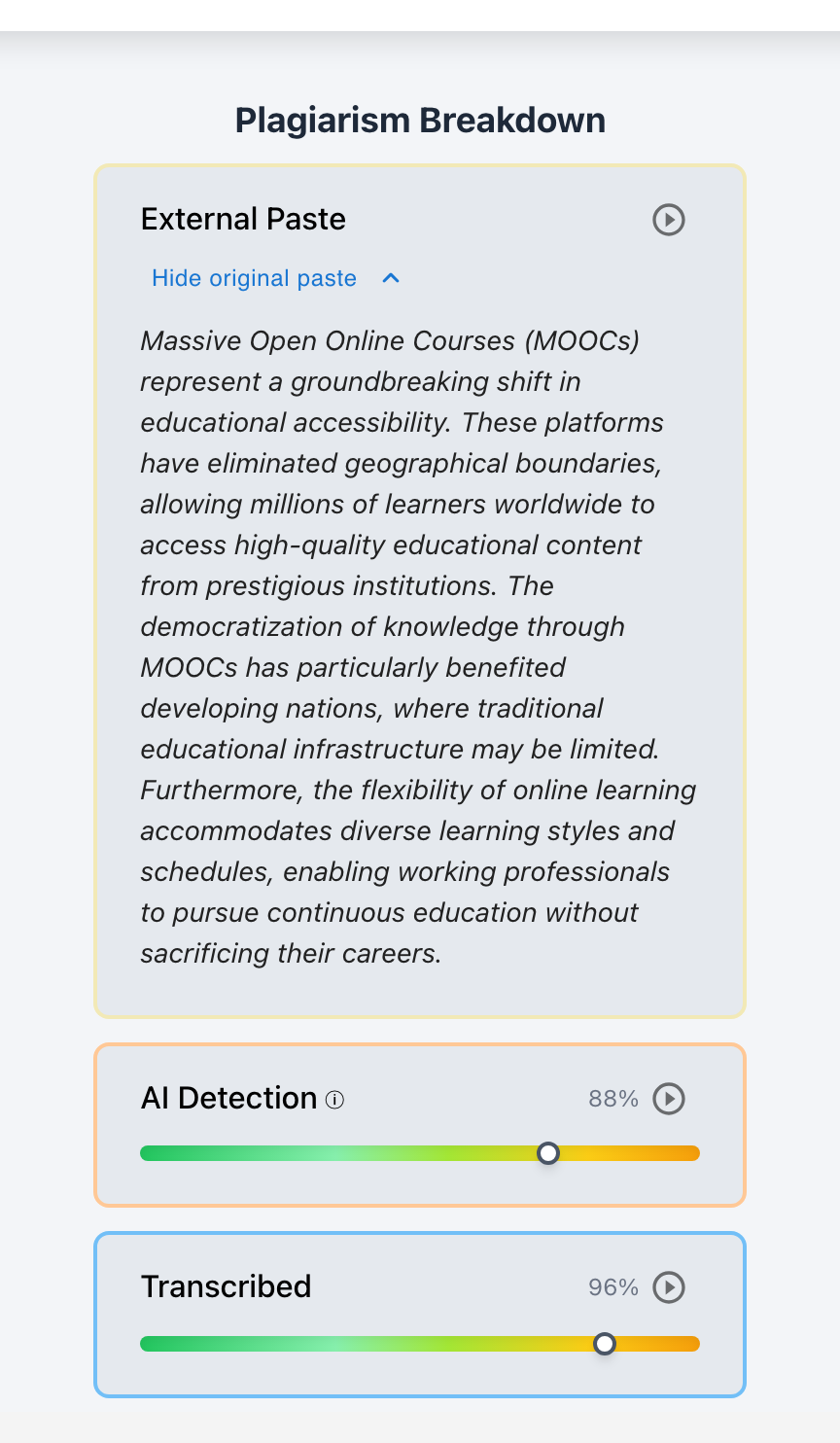
Unlike basic LMS editors that simply record a generic “paste event,” Checkmark's External Paste Buffer Inspector captures and permanently archives the exact text that was pasted into the document, complete with a timestamp and a direct “Jump to Playback” button.
- Permissible vs. Illicit Paste Differentiation: In timed exams, students frequently copy and paste short quotes directly from the provided digital prompt or source documents. Checkmark indexes the exam prompt and source materials; if a student copies a 20-word excerpt from Document A, the system identifies it as an Internal Source Paste (Permissible).
- External Script Preservation: If a student pastes 500 words from an unapproved external source, Checkmark preserves the full raw clipboard content—even if the student immediately deletes or attempts to re-type over the pasted block. This provides indisputable forensic documentation for integrity hearings.
3. Transcription Cadence & IKI Variance Analytics
To counter second-screen optical transcription, Checkmark deploys real-time statistical modeling of Inter-Key Intervals (IKI):
- Biometric Rhythm Modeling: Analyzes typing velocity distributions, inter-keystroke timing, and pause entropy across syntactic boundaries.
- Transcription Alert Flags: If a student types 600 words with a coefficient of variation (CVIKI) below established human composing thresholds, accompanied by a KFR < 3% and zero formulation pauses at clause transitions, Checkmark generates a private educator-only Transcription Cadence Alert.
- Protective Non-Punitive Flagging: Alerts are visible solely to instructors and testing coordinators, preventing automated student-facing accusations and serving as a trigger for a supportive evidence review.
4. Integrated Multi-Evidence Triad & LMS Passback
Checkmark connects writing telemetry with a comprehensive suite of academic integrity and grading tools:
- Passage-Level AI Confidence Sliders: Rather than assigning a single, arbitrary whole-document AI percentage, Checkmark underlines specific sentences and provides calibrated confidence sliders (typical human drafting style vs. typical AI pattern) supported by linguistic perplexity and burstiness metrics.
- Side-by-Side Plagiarism Matching: Scans billions of live web pages, peer archives, and open-access academic publications, displaying side-by-side textual comparisons with direct links to original sources.
- Teacher-in-the-Loop Rubric Autograding: Automatically evaluates student submissions against custom or LMS-synced rubrics (e.g., AP DBQ 7-point rubrics), generating quote-anchored justifications and criterion point breakdowns that instructors can review, modify, and publish with one click directly back to Canvas SpeedGrader, Buzz LMS, or Google Classroom.
- Zero-Training Enterprise Privacy: Checkmark operates under strict FERPA and COPPA compliance, guaranteeing that student exam submissions and keystroke logs are never cached, monetized, or used to train commercial AI foundation models.
6. Real-World Assessment Case Studies
The following scenarios illustrate how writing telemetry provides decisive clarity in high-stakes timed testing environments across different academic disciplines.
Case Study 1: AP European History 50-Minute Timed DBQ Exam
Authentic Synthesis ValidatedContext & Flag:
A student submitted an articulate 680-word DBQ essay on the Industrial Revolution. A generic static AI detector flagged the essay as “64% Likely AI” due to clean, formal syntax.
Telemetry Investigation via Essay Playback™:
Minutes 0:00–6:45: Student used the scratchpad to code primary sources (Doc 1: Sadler Committee, Doc 4: Ure). Minutes 6:46–42:30: Produced text in authentic 12.4-word P-bursts with a 22.8% KFR (restructuring thesis twice). All 3 paste events matched prompt source excerpts (Internal Permissible Pastes).
Case Study 2: College English 101 Midterm In-Class Bluebook Essay
Camouflage Pasting InterceptedContext & Submission:
A student submitted an 820-word midterm analyzing Martin Luther King Jr.'s “Letter from Birmingham Jail.” The essay contained zero single-block paste events greater than 150 words and low similarity scores.
Telemetry Investigation via Paste Buffer Inspector:
Telemetry revealed six distinct paste drops at exact 3-minute intervals (110–140 words in 0.00s). Checkmark retrieved raw clipboard text containing an external LLM draft with an unprompted comparative analysis of Malcolm X. Active typing was 2.1 minutes with a 0.8% KFR.
Case Study 3: High School Honors Biology Timed Inquiry Response
Neurodivergent Writer ProtectedContext & False Accusation:
A neurodivergent student with an IEP accommodation submitted a highly structured 450-word analysis on cellular respiration. A legacy static detector flagged it as “89% AI Generated” due to uniform sentence lengths.
Telemetry Investigation via Essay Playback™:
Essay Playback™ proved non-linear composition: the student typed 3 headings, drafted Section 3 first, jumped back to Section 1, and deleted 140 characters in Section 2. The session logged 912 keystrokes for 450 words, with a 28.4% KFR and CVIKI of 0.78.
7. The 4-Phase Timed Assessment Verification Protocol
To institutionalize objective, supportive, and defensible writing assessment evaluation, secondary and higher education institutions should adopt this standardized 4-phase protocol:
- LMS Integration: Deploy Checkmark via LTI 1.3 in Canvas, Buzz LMS, or Google Classroom.
- Source Indexing: Upload exam prompt and source documents into registry for automatic permissible copy tagging.
- Rubric Binding: Attach standard analytical rubrics (e.g., AP DBQ 7-point scale).
- Passive Millisecond Logging: Ingest keypress intervals, backspaces, and cursor coordinates without spyware.
- Active Cadence Tracking: Real-time IKI variance modeling and typing cadence profiling.
- Buffer Archiving: Capture and timestamp 100% of clipboard payload data.
- Automated Friction Audit: Verify formulation latency (2–10 min), KFR (≥12%), and IKI variance (CV ≥ 0.50).
- Triage Anomalous Profiles: Flag submissions with KFR < 3% or paste drops > 200 words.
- Multi-Evidence Cross-Check: Review AI sliders, source matching, and Essay Playback™ video scrub.
- Private Consultation: Schedule supportive one-on-one session in neutral environment.
- Shared Playback Review: Screen-share Essay Playback™ to discuss composition decisions.
- Pedagogical Mastery: Celebrate authentic revision struggle or assign restorative revision tasks.
8. Restorative Academic Integrity Conference Script
When telemetry indicates potential unauthorized script pasting or optical transcription, the conversation should remain pedagogical, evidence-based, and calm. The goal is to build trust, uncover underlying academic pressures, and foster growth.
“The AI detector says your exam is 82% fake. You have an automatic zero and must go before the Honor Board.”
- Defensive student reaction
- Damaged teacher-student relationship
- High risk of penalizing honest writers
“Let's open your Essay Playback™ timeline together and look at how your essay came together during the 50-minute exam window.”
- Transparent, visual evidence review
- Focus on cognitive struggle & drafting steps
- Clear pathway for restorative mastery
Teacher: “Thank you for meeting with me today, Alex. I wanted to review your timed DBQ from Tuesday. The focus of these timed assessments is to see how you synthesize primary documents and develop arguments in real time under exam conditions.”
Student: “Okay... did I do something wrong?”
Teacher: “We use Checkmark's Essay Playback™ to see the full composition process. Let's look at your writing timeline together on screen. Notice how at minute 3:15, a 420-word block appears in the editor in 0.00 seconds. When we look at the Paste Inspector, it shows the full text of an essay drafted outside our testing window.”
Student: [Observing the exact timestamped playback] “I panicked before the exam started because I wasn't confident in the Industrial Revolution documents, so I wrote an outline and essay last night and pasted it in.”
Teacher: “I appreciate your honesty in telling me that, Alex. Timed exams can feel overwhelming, and it's understandable to feel anxious about document synthesis. However, the purpose of this assessment is to evaluate your live historical analysis, not a pre-drafted response. Because we can see exactly what happened, let's talk about how you can retake this assessment using live outlining strategies, and we'll practice how to organize your thoughts during that first 5-minute formulation window.”
9. Assessment Coordinator & Department Chair Implementation Checklist
Assessment directors, high school department chairs, and college exam committees can use this practical checklist to audit and modernize their timed writing integrity workflows:
- Explicitly define permissible vs. impermissible pre-writing aids in syllabus exam policies (e.g., whether external scratchpads or digital note sheets are allowed).
- Structure timed prompts around prompt-specific synthesis (e.g., requiring explicit cross-analysis of unseen primary sources or in-class data).
- Replace automatic zero policies with restorative verification protocols that allow students to review process evidence.
- Deploy Checkmark Plagiarism via LTI 1.3 with full LMS integration (Canvas SpeedGrader, Buzz LMS, Google Classroom).
- Enable millisecond keystroke logging, active Inter-Key Interval (IKI) modeling, and Keystroke Friction Ratio (KFR) computation.
- Configure the External Paste Buffer Inspector to archive 100% of clipboard insertion text.
- Ensure all testing tools operate under zero-retention and zero-AI-training privacy guarantees (FERPA/COPPA compliance).
- Train department faculty to interpret pause topography and the 3–8 minute formulation latency window.
- Establish a multi-evidence standard: require instructors to cross-examine Essay Playback™ replays, paste buffer text, and passage-level AI sliders before initiating integrity conferences.
- Provide restorative conference scripts to all humanities and social science teachers to maintain supportive, growth-oriented student discussions.
10. Frequently Asked Questions (FAQ)
1. How does writing telemetry distinguish between a student thinking and a student reading a pre-drafted script off a second screen?
Authentic thinking and second-screen optical transcription produce opposite telemetry patterns after the pause. When a student pauses to think during genuine composition, the subsequent typing occurs in short, variable Production Bursts (8–18 words) with high Inter-Key Interval variance and frequent backspacing (15%–30% KFR) as they test different sentence structures. In contrast, when a student pauses to read an external script on a phone, the subsequent typing is metronomic, continuous, and linear, maintaining a flat 45–60 WPM cadence across hundreds of words with near-zero backspacing (<3%) and no hesitation at complex syntactic boundaries.
2. Can a fast touch-typist be falsely flagged for optical transcription?
No. Expert touch-typists produce high burst speeds (80–110+ WPM), but their telemetry retains the fundamental biometric signatures of cognitive composition: significant formulation pauses at clause and paragraph boundaries, high IKI variance when shifting between common and uncommon words, and standard lexical revision friction (KFR > 12%). Mechanical transcription flags are triggered only when high typing speed is coupled with an unnatural collapse in timing variance, zero boundary planning pauses, and an absence of structural revisions.
3. What if a student writes their essay on scratch paper first and then types it in?
Many students utilize physical scratch paper or digital bluebook note fields to outline their thoughts during the first 5 to 10 minutes of an exam. In these cases, the initial formulation latency is clearly logged, and the subsequent typing reflects natural human transcription of personal notes—accompanied by organic pause adjustments, spelling corrections, and sentence revisions. Furthermore, instructors can easily verify physical scratch paper during proctored exams and cross-reference it against the Essay Playback™ timeline.
4. How does Checkmark's Paste Buffer Inspector handle permissible quotes from the exam prompt?
Checkmark automatically indexes the text of the exam prompt, instructions, and provided reference documents. When a student copies a sentence from a provided historical source or literature passage and pastes it into their response, Checkmark identifies it as an Internal Permissible Paste and links it directly to the source document in the sidebar, preventing false alarms.
5. Why are whole-document static AI detection percentages dangerous for timed exams?
Static AI detectors evaluate only the final text output, measuring statistical word predictability without any knowledge of how the text was created. In timed exam settings, students under stress often rely on simple, formulaic five-paragraph structures and direct vocabulary, which static models frequently misclassify as AI-generated. Telemetry protects these students by proving that their essay was constructed keystroke-by-keystroke over 45 minutes of genuine effort.
6. How does Checkmark Plagiarism protect student privacy during timed exams?
Checkmark strictly adheres to FERPA and COPPA compliance standards. Keystroke telemetry, clipboard archives, and student essays are stored in secure, encrypted cloud infrastructure and are never used to train public or proprietary AI foundation models. Unlike invasive webcam proctoring software, Checkmark captures only interactions within the document editor, eliminating intrusive video surveillance of students' homes and private spaces.
7. How does direct LMS grade passback work with Checkmark's autograder?
Checkmark integrates natively via LTI 1.3 into Canvas SpeedGrader, Buzz LMS, and Google Classroom. When an instructor reviews an exam submission, Checkmark provides a drafted rubric evaluation with quote-anchored justifications tied directly to the student's prose. The instructor retains complete authority to adjust scores or edit feedback before clicking “Publish,” which immediately pushes the finalized rubric scores and comments directly into the LMS gradebook.
To learn more about how Checkmark Plagiarism transforms timed exam integrity through writing telemetry, explore our Essay Playback™ tool or schedule an institutional demo with our academic integrity team.