
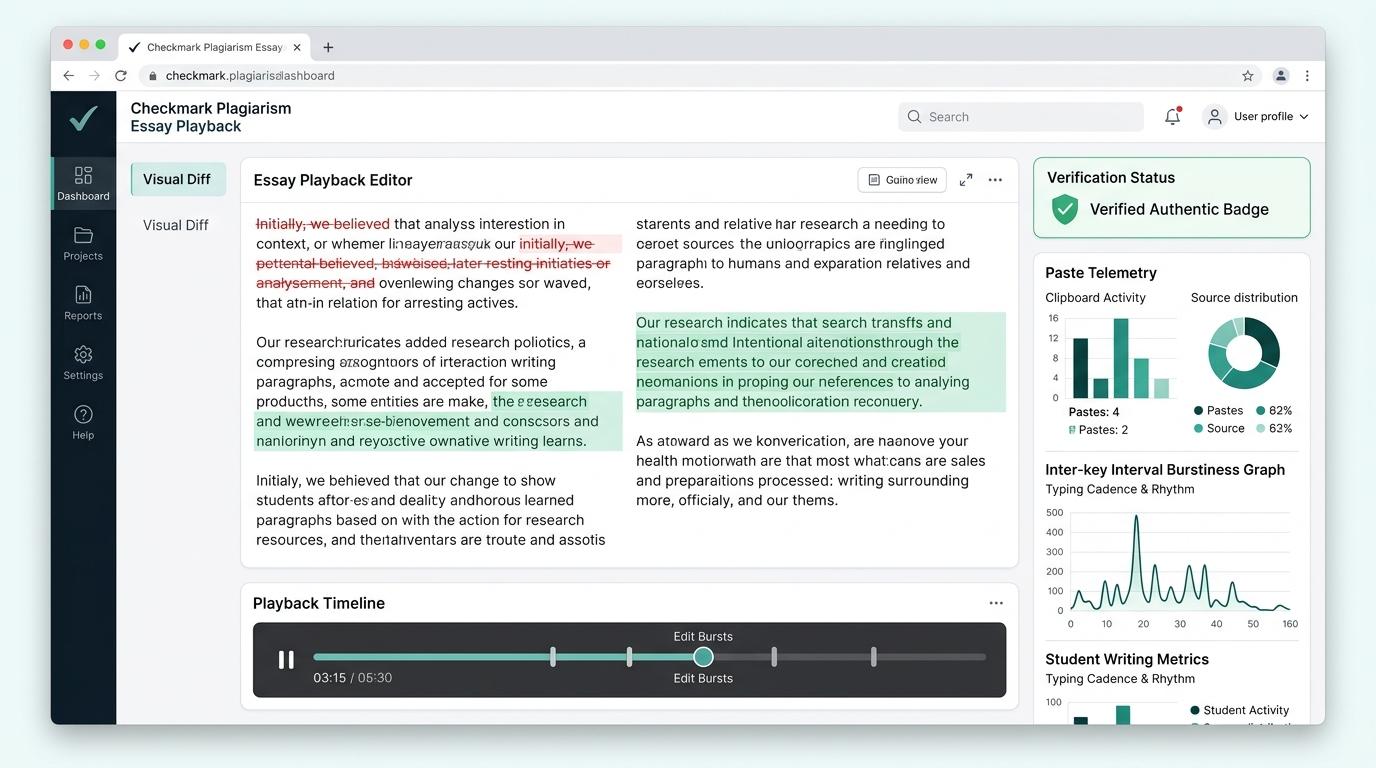
When an educator reviews a student’s document history and notices that three full paragraphs—totaling 400 to 700 words—were abruptly deleted and replaced in a single editing interval, the discovery triggers an immediate diagnostic crisis. Is this sudden pivot evidence of exceptional, high-level metacognitive revision (a student recognizing a flawed line of reasoning, cutting a dead-end argument, and rewriting with a sharper thesis), or does it represent unauthorized clipboard injection (a student hitting writer’s block, prompting an unapproved Large Language Model, and pasting external prose directly into an existing draft)? Standard Learning Management System (LMS) version histories and black-box AI detectors cannot answer this question without guessing. By leveraging the forensic physics of writing telemetry—quantifying deletion-to-insertion latency (Δt), Inter-Key Interval (IKI) cognitive burstiness, and boundary seam coherence—paired with Checkmark Plagiarism’s patent-pending Essay Playback™ and permanent paste text preservation, educators can definitively distinguish authentic drafting from external copying while upholding a supportive, restorative pedagogy: “Stop guessing, start trusting.”
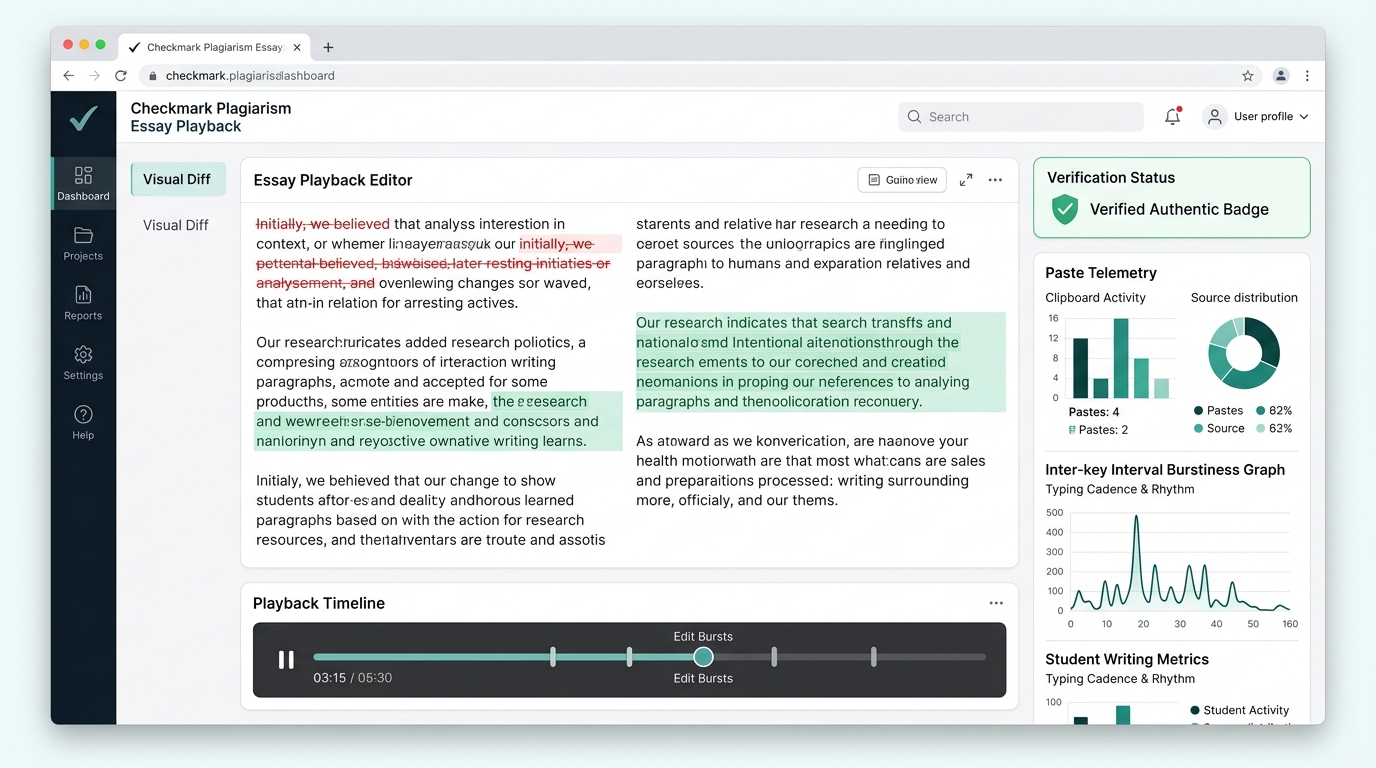
Checkmark Plagiarism provides the pedagogical and technical foundation for process-based academic integrity by combining patent-pending Essay Playback™ with passage-level AI detection, defensible side-by-side plagiarism checking, quote-anchored rubric autograding, and direct LMS integrations for Canvas LMS, Google Classroom, and Buzz LMS.
The Educator’s High-Stakes Dilemma: The Multi-Paragraph Replacement Anomaly
Every humanities teacher, English department chair, and academic integrity officer has encountered the “middle-of-the-draft mutation.”
An instructor sits down to evaluate a persuasive research paper on environmental policy. The student, Jordan, has submitted a 1,400-word draft. When inspecting the document’s progress telemetry or revision activity log, the teacher observes an abrupt structural disruption:
| Timestamp | Author | Action | Content Mutation | Total Word Count |
|---|---|---|---|---|
| Oct 14, 07:12 PM | Jordan Ramirez | Organic Drafting | +312 words (Intro & P1) | 312 words |
| Oct 14, 07:48 PM | Jordan Ramirez | Organic Drafting | +285 words (P2) | 597 words |
| Oct 15, 08:15 PM | Jordan Ramirez | Organic Drafting | +540 words (Draft P3-P5) | 1,137 words |
| Oct 16, 09:02:10 PM | Jordan Ramirez | Block Deletion | -510 words (Cut P3-P5) | 627 words |
| Oct 16, 09:02:14 PM | Jordan Ramirez | Block Insertion | +580 words (New P3-P5) | 1,207 words |
| Oct 16, 09:40 PM | Jordan Ramirez | Organic Drafting | +193 words (Conclusion) | 1,400 words |
Between 09:02:10 PM and 09:02:14 PM—an interval of exactly four seconds—510 words of previous work vanished, and 580 words of sophisticated, highly polished argumentation appeared in their place.
- Student discarded a flawed line of reasoning upon critical reflection
- Re-outlined thesis offline or drafted fresh prose in desktop editor
- Demonstrated high-level cognitive effort and courageous restructuring
- Represents a peak metacognitive learning milestone
- Student encountered late-night writer’s block or fatigue
- Prompted an unapproved LLM (ChatGPT/Claude) or essay humanizer
- Pasted external machine prose directly into an existing draft
- Bypasses formative reasoning and critical composition skills
The Perils of Institutional Guesswork
When faced with this telemetry anomaly, conventional grading workflows force educators into two damaging extremes:
- The Punitive False-Positive Trap: The teacher assumes that because 580 words appeared in four seconds, the text must have been generated by ChatGPT or copied from an essay mill. The instructor issues a zero, files a formal academic integrity violation, and alienates a dedicated student who may have spent two hours outlining and drafting those replacement paragraphs in an offline desktop document or during a library study session.
- The Passive Blindspot Trap: Fearing conflict, parental pushback, or lacking concrete proof, the teacher ignores the anomaly and grades the final text at face value. If the student did in fact bypass the assignment by pasting unvetted AI output into their draft, the student concludes that digital evasion is simple, eroding academic standards and undermining formative learning.
To resolve this dilemma without accusations or anxiety, educators need a granular understanding of writing telemetry physics and access to purpose-built forensic tools designed for pedagogical transparency.
The Forensic Physics of Text Replacement in Writing Telemetry
Digital text entry leaves immutable temporal and kinematic fingerprints. Whether a student is typing in Google Docs, Canvas LMS, Buzz LMS, or Checkmark’s embedded environment, every edit consists of physical interactions between the writer, the keyboard, the operating system clipboard, and the Document Object Model (DOM).
To determine whether a multi-paragraph replacement is authentic revision or unauthorized copying, forensic writing process analysis evaluates three physical dimensions:
Measures the exact time delta between the block deletion event and the arrival of replacement text: Synchronous 0ms Overwrite vs. Extended Cognitive Pauses (15s–600s).
Evaluates Inter-Key Interval variance (log-normal cognitive burstiness vs. flat metronomic retyping) and deletion-to-insertion typo correction entropy.
Audits semantic, syntactic, and register continuity across the boundary seams connecting replaced sections with surrounding untouched paragraphs.
Dimension 1: Temporal Latency & Replacement Mechanics (Δt)
The time delta (Δt) between the deletion of original text and the arrival of replacement text reveals the physical mechanism of the edit.
| Replacement Mechanism | Temporal Delta (Δt) | Telemetry Phenomenology |
|---|---|---|
| 1. Synchronous Overwrite (Atomic Paste) | Δt = 0 ms (Single DOM Mutation) | User highlights 3 paragraphs, presses Ctrl+V. Text buffer is replaced in a single rendering frame. |
| 2. Deletion + Immediate External Insertion | Δt = 200 ms – 3,000 ms | User presses Backspace or Delete, then hits Ctrl+V immediately after. |
| 3. Deletion + Extended Cognitive Pause | Δt = 30 s – 600+ s | User cuts block, pauses to contemplate, then begins typing or re-outlining in place. |
| 4. In-Situ Keystroke Restructuring | Δt = 20 min – 90+ min | User deletes block, then writes 500+ words character-by-character over a prolonged composition session. |
The Physics of the Atomic Swap
When a student highlights three paragraphs (e.g., 2,800 characters) and executes a paste command (Ctrl+V or Cmd+V), the browser DOM performs an atomic replacement:
- The selection range
[IndexStart, IndexEnd]is collapsed. - The clipboard string is decoded and injected at
IndexStart. - The mutation is recorded with a single timestamp.
If Δt ≈ 0 ms, the replacement text originated outside the active document buffer. This confirms a clipboard transfer, but it does not confirm who or what wrote the text on that clipboard.
Dimension 2: Character-Level Insertion Dynamics & Inter-Key Interval (IKI) Physics
When replacement text does not enter via a 0ms clipboard paste—or when a student types replacement text manually while reading from an external source—the telemetry exhibits distinct kinematic signatures.
['T'] → (110ms) → ['h'] → (95ms) → ['e'] → (450ms Word Pause) → ['a'] → (120ms) → ['u'] → (85ms) → ['t'] → (1,850ms Clause Boundary Pause) → [Backspace × 6] → (920ms Typo Fix) → ['w'] → ['r'] → ['i'] → ['t'] → ['e'] → ['r'] ...
- • IKI Range: 60ms to 4,500+ms (Standard Deviation > 80ms)
- • Deletion Ratio: 10% to 22% of total keystrokes (Active syntactic revisions)
- • Composing Pauses: 15s to 120s between major rhetorical shifts
['T'] → (165ms) → ['h'] → (175ms) → ['e'] → (180ms) → ['w'] → (170ms) → ['r'] → (160ms) → ['i'] → (175ms) → ['t'] → (185ms) → ['e'] → (190ms) → ['r'] → ['s'] ...
- • IKI Range: 130ms to 220ms (Uniform distribution, Standard Deviation < 25ms)
- • Deletion Ratio: < 2% of total keystrokes (Near-zero substantive deletions)
- • Composing Pauses: 0s (Linear, steady, uninterrupted text stream)
[Event: 'paste'] → Decoded Payload Buffer: +3,450 characters at Index 1,204 in 0ms
- • IKI: N/A (Instantaneous DOM mutation)
- • Deletion Ratio: 0% at moment of insertion
The Cognitive Science of Inter-Key Intervals (IKI)
During authentic composition, human typing speed is governed by cognitive load theory and psycholinguistics:
- Within-Word IKIs (60ms–180ms): Motor memory handles familiar character sequences automatically (e.g., typing
t-h-eori-n-g). - Between-Word IKIs (200ms–600ms): Short lexical retrieval pauses occur as the brain selects the next word.
- Syntactic & Clause Boundaries (600ms–2,500ms): Commas, semicolons, and periods trigger planning pauses for the next syntactic unit.
- Paragraph & Rhetorical Pauses (5,000ms–60,000+ms): Formulating a new line of reasoning or evaluating thesis alignment produces extended composing silences.
When a student authentically replaces three paragraphs in real time, the telemetry displays high IKI variance, rhythmic bursting, frequent micro-revisions, and substantial backspace activity.
Conversely, if a student manually retypes a block of AI-generated text from a smartphone propped beside their keyboard, their keystroke stream displays metronomic, uniform pacing (140–200ms flat) with zero conceptual pauses and near-zero syntactic rewrites.
Dimension 3: Semantic Continuity, Linguistic Registers, and Citation Seams
When three paragraphs are replaced, the seams connecting the new text to the surrounding untouched paragraphs provide vital diagnostic evidence.
- Vocabulary: Grade 10–11 lexicon (e.g., “important,” “clear factor,” “leads to”)
- Average Sentence Length: 16.4 words; simple and compound clause nesting
- Vocabulary: Postgraduate / LLM-typical lexicon (e.g., “delineate,” “quintessential dichotomy”)
- Average Sentence Length: 28.2 words; highly recursive subordinate clauses
- Citation Alignment: Introduces citations to obscure 1984 treatises not found in bibliography
- Vocabulary: Returns abruptly to Grade 10–11 lexicon
- Rhetorical Continuity: Fails to reference the sophisticated arguments introduced in P3–P5
Diagnostic Seam Signals
- Linguistic Register Dislocation: If the surrounding essay uses direct, student-level phrasing, but the replaced middle three paragraphs suddenly shift to hyper-formal, abstract academic rhetoric (e.g., “It is crucial to elucidate the multifaceted ramifications of...”), this linguistic step-function suggests unapproved external text injection.
- Citation Apparatus Fragmentation: Authentic revision integrates with the writer’s working knowledge. If the replacement paragraphs introduce references, data points, or page citations to specialized sources that never appeared in the student’s research notes, outline, or bibliography, the text likely originated from an external model or third party.
- Cohesion & Topic Sentence Misalignment: An unapproved AI-generated block frequently contains introductory or summary transition phrases that clash with the surrounding narrative (e.g., concluding with “In summary, this essay has demonstrated...” right before paragraph 6 resumes body argumentation).
Comparative Telemetry Matrix: Text Replacement Behaviors
The table below summarizes the key telemetry signals across the four most common student workflows involving multi-paragraph replacements:
| Metric / Signal | Authentic In-Situ Revision | Offline Draft (Paste + Polish) | Covert AI Paste (Raw / Humanized) | Manual Retyping / Optical Copy |
|---|---|---|---|---|
| Insertion Latency (Δt) | Prolonged (20–90 min) | 0ms Paste, then 15–45 min edit | 0ms Paste, then 0–2 min tweaks | Continuous typing stream (12–25 min) |
| IKI Variance Distribution | High variance (SD > 80ms) | High variance during polish | N/A (Instant Paste) | Low variance (SD < 25ms, flat) |
| Deletion-to-Insert Ratio | 10% to 22% (High entropy) | 8% to 18% (Active polish) | < 1% (Surface edits only) | < 2% (Typo fixes only) |
| Composing Pauses (> 15s) | Frequent (Syntactic & idea) | Present during integration | Absent | Absent (Uninterrupted flow) |
| Original Paste Preservation | None (Native Keystroke) | Permanent snapshot matches outline | Permanent snapshot matches LLM syntax | None (Native Keystroke) |
| AI Confidence Slider | Human Style | Human Style | AI Pattern | AI Pattern |
| Seam Coherence | Seamless natural progression | High continuity after polish | Abrupt register dislocation | Abrupt register dislocation |
Checkmark Plagiarism’s Solution: Patent-Pending Essay Playback™ & The Verification Triad
To empower educators to evaluate these complex drafting events with complete clarity and defensible evidence, Checkmark Plagiarism delivers an integrated, multi-dimensional verification architecture.
- 1x to 8x scrubbable chronological video player
- Millisecond-accurate keystroke replay
- Color-coded diff: Red strikethrough for cuts, green highlight for inserts
- Cognitive pause markers > 15 seconds
- Immutable character snapshot of raw external clipboard text
- Persistent audit trail even if text is subsequently rewritten
- Dedicated “Jump to Playback” button positions player at exact paste moment
- Passage-level AI detection with confidence sliders
- Side-by-side plagiarism source quotation matching
- Teacher-in-the-loop rubric autograding with quote anchors
- Direct 1-click grade passback to Canvas and Buzz LMS
1. Patent-Pending Essay Playback™ (1x–8x Timeline Player)
Checkmark’s Essay Playback™ reconstructs the complete lifecycle of a student submission as an interactive, scrubbable video player.
- Speed Scrubbing (1x to 8x): Teachers can watch the essay unfold in real time or scrub through three hours of drafting in 45 seconds.
- Character-Level Diff Tracking: When three paragraphs are deleted, Playback highlights the deleted text in red strikethrough and marks the exact timestamp. When new text is introduced, it is highlighted in green.
- Visualized Cognitive Pauses: Pauses exceeding 15 seconds are indicated by distinct amber markers on the timeline, allowing instructors to see exactly where the student stopped to think, consult sources, or outline ideas.
In examining coastal erosion patterns, early models overlooked tidal sediment dynamics. Initial studies by Miller (2018) claimed that wave frequency was the sole determining factor. However, this hypothesis failed to account for seasonal barrier island migration...
[+580 chars inserted • Keystroke In-Situ • 01:02:14 PM] Recent hydrographic surveys (Dawson & Vance, 2024) demonstrate that sub-surface bathymetry plays a far more decisive role in long-term shoreline destabilization than previously recognized...
2. Permanent Original Paste Text Preservation
One of the greatest vulnerabilities in conventional version tracking tools (such as Google Docs or standard LMS text areas) is that they only store periodic snapshot states. If a student pastes 600 words of raw AI text and subsequently rewrites 15 words, standard version history only shows the net result.
Checkmark Plagiarism solves this through Permanent Original Paste Text Preservation:
- Raw Payload Capture: The instant a paste event occurs, Checkmark creates an immutable, timestamped record of the exact characters introduced from the clipboard.
- Post-Paste Edit Tracking: If the student subsequently modifies, deletes, or paraphrases parts of the pasted text, Checkmark maintains a side-by-side comparison showing the original raw pasted text versus the final submitted version.
- Jump-to-Playback Integration: Every paste event card in the Checkmark sidebar features a dedicated “Jump to Playback” button, instantly positioning the timeline player at the exact millisecond the text entered the document.
3. The Multi-Factor Verification Triad
Checkmark Plagiarism does not rely on a single, isolated metric. Instead, it pairs Essay Playback™ with three complementary evaluation pillars:
A. Passage-Level AI Detection with Calibrated Confidence Sliders
Rather than assigning a single, opaque “whole-paper percentage” that leaves teachers guessing which sentences triggered the score, Checkmark highlights specific passages directly within the document.
- Granular Confidence Sliders: Each flagged passage displays an evidence card in the sidebar showing where the text falls on a calibrated continuum between Typical Human Writing Style and Typical AI Pattern.
- Short-Text Guardrails (<150 Words): Below ~150 words, Checkmark displays
N/Arather than making statistically unreliable guesses on insufficient sample sizes.
B. Defensible Side-by-Side Plagiarism Matching
- Billions of Live Web & Academic Sources: Scans live web pages, open-access journals, digital archives, and institutional repositories.
- Two-Way Linked Evidence Cards: Clicking any highlighted passage in the essay immediately scrolls the sidebar to the exact matching source quote, complete with live, clickable URLs.
- Uncited Source Differentiation: Clearly distinguishes between unintentional citation formatting errors and wholesale uncredited copying, enabling targeted citation instruction.
- Student-to-Student / Peer Match Detection: Detects copying across different sections, cohorts, or historical submissions within the school repository while keeping student data private and secure.
C. Teacher-in-the-Loop Rubric Autograding
- First-Draft Rubric Feedback: Checkmark autogrades essays against custom or LMS-synced rubrics (Canvas LMS, Buzz LMS, Google Classroom), generating criterion-by-criterion point suggestions and quote-anchored justifications tied directly to student sentences.
- Teacher Final Authority: AI grades remain provisional drafts until reviewed, modified, and approved by the educator.
- One-Click Gradebook Passback: Finalized rubric marks and personalized comments sync directly back to the LMS gradebook with a single click.
Illustrative Case Studies: Investigating Multi-Paragraph Replacements
To see how these principles work in practice, examine three illustrative scenarios across secondary and higher education settings. They are composites written for this article and do not describe specific students or institutions.
Case Study 1: The AP English Language Thesis Pivot (Exonerating Authentic Restructuring)
• Composes 520 replacement words character-by-character
• IKI Standard Deviation = 94ms (High cognitive burstiness)
• Deletion Ratio = 16.2% (Frequent syntactic rewrites)
Diagnostic Findings
- Essay Playback™ Audit: Replay confirms Sarah highlighted her middle three paragraphs and deleted them after an extended pause. Over the next 45 minutes, she composed a completely new counter-argument character-by-character, actively testing and revising phrasing.
- AI & Plagiarism Triad: Checkmark’s passage-level AI detection returns baseline human patterns throughout the replacement text. Plagiarism scan shows 0% uncredited matches.
- Pedagogical Outcome: The instructor recognized this as an exemplary demonstration of advanced rhetorical revision. During feedback, the teacher praised Sarah for recognizing that her original argument was superficial and courageously restructuring her essay to build a stronger thesis.
Case Study 2: The College History Outline Expansion (Verifying Legitimate External Drafting)
• Inserts 6 Chicago-style footnotes manually
• Rewrites 85 words of transition sentences
• Deletion-to-insertion ratio during polish: 12.4%
Diagnostic Findings
- Paste Text Preservation Audit: Checkmark’s sidebar stored the raw 650-word pasted payload. Marcus had drafted the section in Microsoft Word on his laptop while on a train commute without Wi-Fi.
- Post-Paste Telemetry: Playback shows Marcus spent 42 minutes inside the LMS editor immediately following the paste, manually formatting footnotes, polishing transitions to connect with Paragraph 2, and checking source dates.
- Plagiarism & AI Verification: Checkmark’s passage AI confidence slider remained in the human zone. Side-by-side plagiarism search verified that all historical quotes were properly attributed to primary source archival documents.
- Pedagogical Outcome: The professor verified the authenticity of the research and used the conference to reinforce best practices for in-document drafting and version backups.
Case Study 3: The Covert Paraphrased AI Insertion (Detecting Evaded AI Copying)
• Changes “moreover” to “additionally”
• Swaps 3 adjectives; zero structural revisions (mutation rate < 0.8%)
Diagnostic Findings
- Permanent Paste Snapshot: Checkmark captured the raw pasted block. Comparison with the final text revealed an edit mutation rate of less than 0.8% (changing only four superficial words).
- Passage-Level AI Detection: Checkmark’s calibrated confidence slider flagged the replacement section (P3–P5) as strongly characteristic of typical AI writing patterns, while P1 and P2 registered as typical human style.
- Seam Analysis: The untouched intro and conclusion contained informal sentence structures typical of high school prose, whereas the replaced middle paragraphs featured highly recursive, postgraduate syntactic patterns (e.g., “This socio-economic bifurcation exemplifies the inherent paradox of early twentieth-century American socio-cultural stratification”).
- Pedagogical Outcome: Using Checkmark’s Playback timeline in a supportive conference, the teacher guided Alex through the telemetry receipts. Alex acknowledged using an AI paraphraser after hitting a late-night roadblock. The teacher allowed Alex to rewrite the section using their own authentic voice for partial credit.
The 4-Phase Educator Verification Protocol
When an educator observes a multi-paragraph deletion and replacement anomaly, following a structured, defensible verification protocol prevents hasty assumptions and protects student trust.
- Open the submission in Checkmark and navigate to Essay Playback™
- Locate the timestamp of the paragraph deletion
- Measure temporal latency (Δt): If Δt ≥ 15 min with active typing, verify IKI burstiness
- If Δt ≈ 0ms (Atomic Paste), inspect clipboard payload and post-paste edits
- Review preserved raw paste snapshot in Checkmark sidebar
- Inspect passage-level AI confidence sliders for isolated pattern spikes
- Audit side-by-side plagiarism matches against web and peer repository databases
- Evaluate linguistic register continuity between P2 and P3
- Check citation apparatus integration against student outline and notes
- Inspect topic sentences for natural narrative cohesion
- Schedule a 10-minute collaborative one-on-one conference
- Screen-share Essay Playback™ timeline as a shared mirror
- Frame questions around writing choices, metacognition, and revisions
Restorative Dialogue Scripts & Conversation Guides
The tone an educator adopts during an integrity conference determines whether the encounter results in defensive conflict or positive student growth. Below are sample conversation scripts for educators:
Teacher: “Thanks for meeting with me, Jordan. I was reviewing your draft on environmental policy, and I noticed that between 9:02 PM and 9:40 PM, you made a significant structural change—deleting your middle three paragraphs and introducing a completely new line of argument. I love seeing substantive revision, so I pulled up our Essay Playback timeline so you can walk me through what prompted that pivot.”
Student: “I realized while writing the conclusion that my second point didn’t support my thesis, so I scrapped it and re-wrote those body paragraphs to focus on sediment data instead.”
Teacher: “That is exactly what skilled writers do. Looking at the playback, I can see where you paused to work out the new sentences and revised your phrasing. That took real effort, and it made your paper much stronger. Great work.”
Student: “I wrote those three paragraphs in Microsoft Word on the bus ride home because I didn’t have Wi-Fi, and then I pasted them in when I got to my desk.”
Teacher: “Understood! That explains the instantaneous paste on the timeline. Let’s look at the rough Word file or your outline notes together so we can verify the drafting trail and make sure your citations match your original sources.”
Teacher: “Looking at the timeline, we see these 580 words pasted in all at once, and our passage-level analysis highlights vocabulary and sentence structures that are very different from your first two pages. Did you use an AI tool or another source to generate this section when you hit a roadblock?”
Student: “Yeah... it was late, I was stuck on the counter-argument, and I used ChatGPT to write it.”
Teacher: “I appreciate you being honest with me right now. Writer’s block is tough, but substituting AI prose bypasses the thinking skills this assignment is designed to build. Here is what we are going to do: we will wipe those three paragraphs, and during office hours tomorrow, we will outline your original idea so you can write them in your own voice for revised credit.”
Syllabus Policy Templates & District Implementation Guidelines
To establish clear, transparent expectations that prevent misunderstandings before assignments are submitted, academic departments should integrate unambiguous writing process policies into their syllabi and student handbooks.
In this course, writing is valued as an iterative, cognitive process of thinking, drafting, and refining ideas. To support authentic skill development, ensure fair evaluation, and protect students from unwarranted academic misconduct flags, our department utilizes Checkmark Plagiarism with patent-pending Essay Playback™.
- In-Document Drafting: All major writing assignments must be composed directly within the designated LMS editor (or approved integrated Google Docs environment) to ensure an authentic writing process record is preserved.
- External Drafting & Paste Disclosures: If you compose portions of an assignment offline (e.g., in Microsoft Word, Scrivener, or mobile note apps due to connectivity limitations), you must retain your timestamped offline working files or version history. When pasting pre-drafted sections into the final submission, include a brief footnote disclosing the external drafting tool used.
- AI Assistance vs. Authorship Fraud: Authorized AI tools (such as spellcheck or teacher-approved brainstorming aids) may be used only when explicitly permitted in assignment prompts. Generating essay paragraphs using Large Language Models (LLMs), paraphrasing tools, or peer copying is prohibited.
- Transparent, Restorative Inquiries: In the event of an anomalous drafting pattern (such as sudden multi-paragraph paste events), instructors will review the Essay Playback timeline collaboratively with the student before making any evaluation decisions.
Enterprise Compliance & Student Privacy Standards
Educational technology leaders and district technology directors must ensure that academic integrity tooling adheres to the highest student data privacy standards:
Student essays and telemetry streams are NEVER used to train commercial, open-source, or internal AI models.
End-to-end encryption in transit (TLS 1.3) and at rest (AES-256) with strict role-based access controls.
Seamless LTI 1.3 integration with Canvas LMS, Buzz LMS, Google Classroom, and Moodle with Single Sign-On.
Frequently Asked Questions (FAQs)
No. A clipboard paste event is merely a digital transport mechanism, not proof of misconduct. Students frequently draft sections offline in desktop word processors during commutes, outline arguments in distraction-free mobile apps, or refine challenging arguments in separate tabs before pasting them into their final submission. Educators must inspect the permanent paste snapshot, post-paste revision telemetry, and passage-level AI confidence sliders in Checkmark before drawing conclusions.
Google Docs version history aggregates edits into coarse periodic snapshots, completely erasing granular keystroke dynamics, composing pauses, and intermediate paste mutations. If a student pastes 600 words and subsequently modifies 10 words, Google Docs only displays the final merged state. Checkmark’s patent-pending Essay Playback™ captures every keystroke, pause, deletion, and paste event with millisecond accuracy, preserving the original raw pasted text permanently.
When a student legitimately composes in an external application, they will possess corroborating artifacts: timestamped local file creation dates, mobile note modification logs, or working research outlines. In Checkmark Plagiarism, educators can audit whether the pasted text exhibits natural vocabulary continuity with the rest of the essay and review the student’s subsequent in-document editing behavior. During a brief restorative conference, the student can share their external working notes to verify authentic provenance.
Authentic composition exhibits high Inter-Key Interval (IKI) variance (ranging from 60ms for fluid word chunks to 3,000ms+ at clause boundaries), frequent syntactic pauses, and an 8% to 22% backspace deletion ratio. When a student manually transcribes text while looking at a phone or secondary monitor, the telemetry reveals flat, metronomic typing (140–200ms uniform IKI), zero conceptual pauses, and near-zero syntactic reorganization.
Generic AI detectors frequently produce high false-positive rates when analyzing short text snippets. Checkmark Plagiarism enforces an honest short-text guardrail: for passages under ~150 words, the AI confidence report displays N/A rather than making statistically unreliable guesses on insufficient sample sizes. In such cases, educators rely on Essay Playback™ keystroke dynamics, side-by-side plagiarism source matching, and oral conferences rather than speculative probability scores.
Educators should introduce Essay Playback™ on the first day of class as a supportive, protective learning tool. Teachers explain that writing telemetry protects honest students from false AI accusations, documents their authentic hard work, and enables instructors to give meaningful feedback on their revision habits. When conducting process conferences, teachers use Playback collaboratively as a visual mirror to celebrate effective revision choices.
Checkmark Plagiarism integrates natively with major Learning Management Systems via LTI 1.3 standards. Teachers can review student drafts, inspect Essay Playback™ timelines, and autograde submissions against custom rubrics directly inside their LMS workflow. Once the teacher reviews, adjusts, and approves the quote-anchored rubric scores, a single click passes the finalized grades, rubric criteria breakdowns, and personalized comments straight back into the Canvas, Google Classroom, or Buzz LMS gradebook.
Conclusion: Stop Guessing, Start Trusting
Sudden, multi-paragraph text deletions and replacements represent the defining crossroads of modern digital writing instruction. Handled with blunt assumptions and opaque black-box tools, these anomalies breed mistrust, false accusations, and student alienation.
By embracing the forensic physics of writing telemetry—scrubbing through drafting sessions at 1x to 8x speed with patent-pending Essay Playback™, auditing unalterable paste snapshots, and cross-referencing passage-level AI confidence sliders—educators can confidently celebrate authentic revision while addressing unauthorized shortcuts with clarity, evidence, and care.
Stop guessing. Start trusting. Equip your department with the transparent, defensible writing process forensics of Checkmark Plagiarism today.