
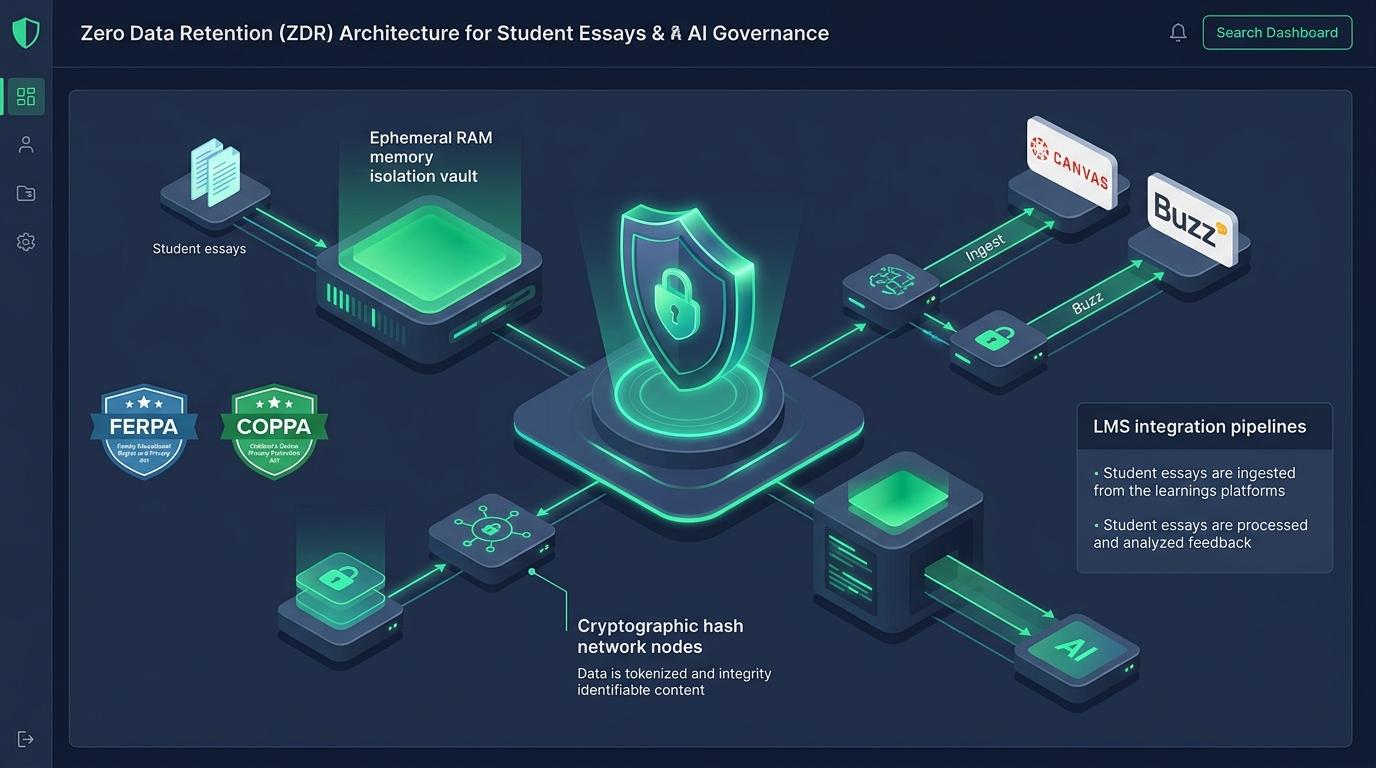
As generative AI detectors, automated rubric grading engines, and writing analysis tools proliferate across K-12 school districts and higher education institutions, District Chief Technology Officers (CTOs), Chief Information Security Officers (CISOs), and EdTech Directors face an urgent data governance imperative: preventing student essays, personal reflections, and intellectual property from being cached, stored, or ingested into commercial Large Language Model (LLM) training pipelines. Under federal statutes including the Family Educational Rights and Privacy Act (FERPA, 34 CFR Part 99) and the Children’s Online Privacy Protection Act (COPPA, 15 U.S.C. §§ 6501–6506)—as well as strict state statutes like New York Education Law § 2-d, Illinois SOPPA (105 ILCS 85/), and California SOPIPA (Cal. Bus. & Prof. Code § 22584)—school districts are strictly prohibited from allowing third-party vendors to retain, commercialize, or train machine learning models on student work. Superficial “opt-out checkboxes” in vendor dashboards fail to prevent intermediate logging, staging cache ingestion, or irreversible parameter memorization in foundation models. This technical guide deconstructs the mechanics of AI data leakage, explains the permanent parameterization trap of deep neural networks, provides a 10-point technical procurement audit matrix, offers contract redlining templates, and demonstrates how Checkmark Plagiarism provides verifiable True Zero-Data-Retention (ZDR) architecture, ephemeral in-memory execution, and salted cryptographic hash vaults to keep student writing permanently sovereign.
Checkmark Plagiarism (checkmarkplagiarism.com) empowers school districts, IT directors, and academic leaders with enterprise academic integrity that unifies calibrated passage-level AI detection, two-way linked plagiarism matching, quote-anchored rubric autograding, and patent-pending Essay Playback™ keystroke process telemetry within a mathematically verifiable Zero-Data-Retention (ZDR) security architecture integrated natively via 1EdTech LTI 1.3 Advantage with Canvas LMS and Agilix Buzz LMS.
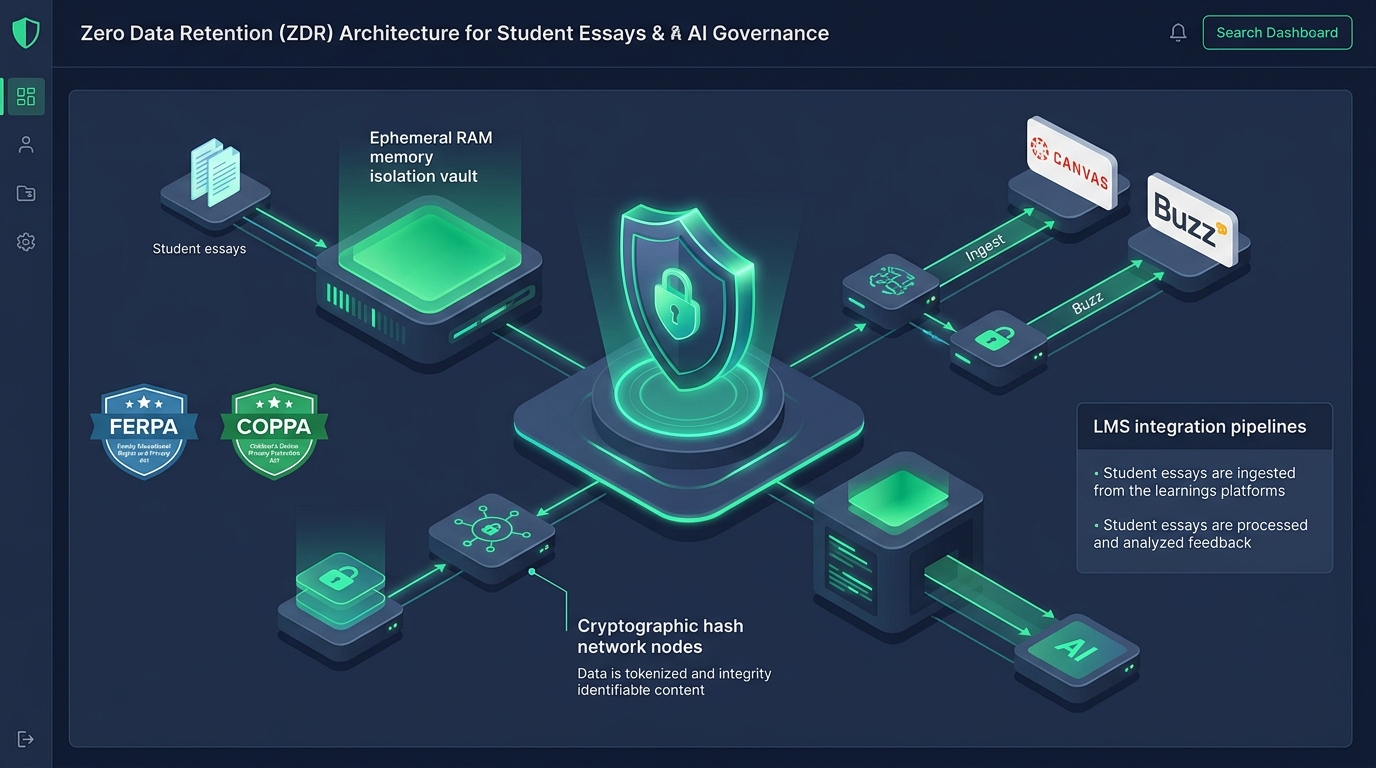
Figure 1: Checkmark Plagiarism’s Zero-Data-Retention (ZDR) Architecture • Ephemeral RAM Processing • Cryptographic Hash Vaults • FERPA & COPPA Enforced
1. The Data Ingestion Reality: How Student Essays Leak into AI Repositories
Over the past three decades, school district software architectures were built around static, transactional databases. Student essays submitted to a Learning Management System (LMS) like Canvas, Buzz, or Google Classroom were stored in relational database tables (PostgreSQL, MySQL) or private object stores (AWS S3, Google Cloud Storage) under strict role-based access control (RBAC). A student’s essay sat passively on disk until an authorized teacher opened it to assign a grade.
The rapid adoption of generative AI writing assistants, automated autograders, and AI detection tools has fundamentally upended this paradigm. Modern natural language processing (NLP) and transformer-based foundation models are not static databases—they are data-hungry probabilistic computing engines that continuously require massive volumes of high-quality human text to refine their neural weights.
1.1 Why Student Writing is Targeted for AI Model Training
Commercial AI developers face a looming “data wall.” Having scraped virtually the entire indexed public web (Common Crawl, Wikipedia, public GitHub repositories, digitized books), foundation model developers struggle with data saturation and model collapse caused by scraping synthetic AI-generated text. K-12 and collegiate student writing is uniquely valuable because it offers:
Organic Developmental Trajectories
Graded writing spanning grades 3 through 12 and collegiate levels provides rich linguistic milestones in vocabulary acquisition, syntactic development, and argumentative reasoning.
Authentic Linguistic Burstiness
Unlike synthetic AI text, student writing exhibits authentic variations in sentence length, idiosyncratic metaphor, colloquial idioms, and natural human cognitive pauses.
Unscraped Domain Synthesis
Student essays synthesize hyper-local historical analyses, niche literary critique, and personal lived experiences that exist nowhere on the public internet.
When edtech vendors fail to implement strict zero-retention protections, student essays submitted for routine classroom grading become free, involuntary training data for commercial AI corporations.
2. Technical Vulnerability Vectors: APIs, Logging, and Parameter Memorization
To establish defensible district security policies, IT Directors and CISOs must understand the three distinct technical mechanisms through which student essays become permanently captured in public and commercial AI repositories.
| Vulnerability Layer | Technical Mechanism | Retention Timeline & Risk Level |
|---|---|---|
| 1. API Payload Retention & Observability Logging | HTTP POST requests logged to cloud storage for “abuse monitoring” and debug telemetry (Datadog, LangSmith, CloudWatch). | Default: 30 days on disk. Stored in unencrypted/shared logs; vulnerable to cloud breaches. |
| 2. Fine-Tuning & Continuous Pre-Training Loops | Text batches tokenized into dataset repositories for secondary R&D, classifier tuning, and model optimization. | Indefinite (Multi-year). Converted into derivative dataset assets sold across vendors. |
| 3. Deep Neural Parameter Memorization (Weights) | Backpropagation gradient descent alters float32 tensor weights inside the foundation model itself. | PERMANENT (Irreversible). Embedded into model parameters; cannot be purged without full model deletion. |
2.1 Vector 1: API Payload Retention vs. Stateless Endpoints
When an edtech vendor sends a student essay to an AI service (such as OpenAI, Anthropic Claude, AWS Bedrock, Google Vertex AI, or an open-source inference endpoint), the data travels as a JSON payload within an HTTP POST request:
{
  "model": "gpt-4o-mini",
  "messages": [
    {
      "role": "system",
      "content": "Analyze this student essay for argumentative coherence and grammatical structure."
    },
    {
      "role": "user",
      "content": "My name is Sarah M., a sophomore at Oakridge High. In this personal narrative, I discuss my family's struggle with housing insecurity..."
    }
  ],
  "temperature": 0.2
}
The Default 30-Day Logging Trap
By default, standard commercial API accounts on major foundation model platforms retain all raw input prompts and output completions on physical cloud storage for 30 calendar days. AI vendors justify this retention under the banner of “Trust & Safety monitoring” and “Abuse Detection.”
During these 30 days:
- The full student essay sits in plain text or standard cloud-encrypted object storage (AWS S3, Google Cloud Storage buckets).
- Third-party observability tools (e.g., LangSmith, Helicone, Datadog, CloudWatch) integrated into the vendor's application stack capture and store the payload.
- Human contractors reviewing flagged accounts may view the raw student submission in plaintext.
Unless a vendor has an explicit, contractually verified Zero-Data-Retention (ZDR) agreement with their upstream AI cloud infrastructure, student essays are actively logged and cached on remote servers.
2.2 Vector 2: Model Fine-Tuning, Continuous Pre-Training, and RLHF
Many edtech vendors do not simply pass text through general-purpose models; they build proprietary “essay grading classifiers” or “academic integrity detectors.” To train these models, vendors funnel collected student essays into two pipelines:
- Supervised Fine-Tuning (SFT): Student essays paired with teacher grades and rubric criteria are tokenized into JSONL datasets. These datasets are fed into backpropagation routines to teach the model how to grade according to specific rubric standards.
- Reinforcement Learning from Human Feedback (RLHF) and Direct Preference Optimization (DPO): Vendor data annotators evaluate paired model outputs generated from student essays, ranking responses to guide the model toward desired educational outputs.
Once a student essay enters a fine-tuning dataset, it is copied across development, staging, and training clusters, multiplying the attack surface across distributed cloud environments.
2.3 Vector 3: The Permanent Parameterization Trap and Model Inversion Attacks
The most dangerous misunderstanding among non-technical administrators is the belief that student data can simply be “deleted” from an AI system upon request under FERPA or state data deletion mandates.
Once a neural network has been trained or fine-tuned on student writing, the student's prose, ideas, and stylistic markers are converted into billions of mathematical weights (floating-point numbers). A neural network is not a database; you cannot run a DELETE WHERE student_id = X query on model weights.
- Data stored as discrete, indexed rows.
- Individual records can be located instantly.
- Cryptographic erasure is mathematically verifiable.
- Data dissolved into billions of weight matrices.
- Individual documents cannot be isolated or extracted.
- Only remedy is destroying and retraining entire model ($$$).
How Model Inversion and Prefix-Matching Extract Student Writing
Research in machine learning security (Carlini et al., 2021, “Extracting Training Data from Large Language Models,” USENIX Security Symposium) has demonstrated that transformer language models can memorize rare and unique training sequences and reproduce them verbatim.
If a student writes an essay containing a unique biographical narrative, a specialized phrase, or personal disclosures, an external user interacting with that commercial model can execute a prefix-matching or model inversion attack. By providing an opening prompt that matches the initial tokens of the student's text, the model's next-token probability distribution will emit the verbatim continuation of the student's private essay:
This represents an irreversible breach of student privacy that no post-hoc data deletion request can remediate.
3. Federal & State Statutory Frameworks: The Legal Illegality of AI Model Ingestion
Allowing student writing to be cached or used for commercial AI training violates core federal privacy mandates and escalating state student data privacy legislation.
| Legal Authority | Statutory Mandate | Technical Compliance Requirement |
|---|---|---|
| FERPA (34 CFR Part 99) |
“School Official” exception requires strict educational purpose and bars unauthorized redisclosure. | Vendor must operate under “direct control” of district; zero secondary use or commercial AI training permitted. |
| COPPA (15 U.S.C. §§ 6501–6506) |
Prohibits commercial profiling and data retention for children under 13 without verifiable parental consent. | Districts cannot consent to commercial AI training on behalf of K-8 students; data must be purged immediately. |
| NY Education Law § 2-d | Mandates a Parents’ Bill of Rights and strict commercialization bans; its implementing regulations (8 NYCRR Part 121) require alignment with the NIST Cybersecurity Framework. | Vendor must execute Data Privacy Agreement (DPA); zero commercialization; mandatory breach notification timeline. |
| Illinois SOPPA (105 ILCS 85/) |
Prohibits student data profiling, targeted advertising, and commercial exploitation of student records. | Strict prohibition on algorithmic R&D; full breach indemnification; mandatory deletion upon contract termination. |
| California SOPIPA (Cal. Bus. & Prof. Code § 22584) |
Bans K-12 student profiling, selling student data, or retaining data beyond educational purpose. | Immediate data purging; absolute prohibition on using student essays to train proprietary commercial models. |
3.1 FERPA (34 CFR Part 99) and the “School Official” Exception
Under FERPA, student essays, writing drafts, and teacher grading feedback constitute Education Records protected under 34 CFR § 99.3. Educational institutions may only share these records with third-party software vendors without explicit parental consent under the narrow “School Official” Exception (34 CFR § 99.31(a)(1)(i)(B)).
To qualify as an authorized School Official, an EdTech AI vendor must satisfy four non-negotiable legal criteria:
- Performs an Institutional Service: The vendor performs an institutional service or function for which the school would otherwise use employees (e.g., grading essays, checking for plagiarism).
- Under Direct Control: The vendor must remain under the direct control of the school district with respect to the use and maintenance of education records.
- Strict Redisclosure Prohibition (§ 99.33): The vendor is strictly prohibited from disclosing student data to any third party (including upstream cloud providers or sub-processors) without prior written consent.
- Purpose Limitation: The vendor may only use the data for the specific educational purpose authorized in the contract.
Ingesting student essays into an AI model training set, secondary data lake, or foundation model cache violates the “direct control” and “purpose limitation” mandates of FERPA. Once data is absorbed into model weights, the district loses direct control, triggering an actionable FERPA breach.
3.2 COPPA and K-8 Student Protections
The Children’s Online Privacy Protection Act (COPPA) strictly regulates the collection and use of personal information from children under 13 years of age. While schools can consent on behalf of parents for purely educational services (school-authorized consent), the Federal Trade Commission (FTC) has clarified in its COPPA FAQs that a school’s consent is limited to the educational context, and that operators may not use data collected under school consent for another commercial purpose, such as a vendor’s own product development or model training.
If an EdTech vendor captures writing from elementary or middle school students and uses that data to improve its general machine learning models, the vendor and the district face severe regulatory enforcement and financial penalties from the FTC.
4. The “Opt-Out” Illusion vs. True Zero-Data-Retention (ZDR) Architecture
Many commercial EdTech vendors attempt to placate district IT leaders by adding a settings toggle labeled “Do not use my data for AI training.” District CISOs and IT Directors must understand why policy-only “opt-outs” are technically insufficient to ensure compliance.
| Technical Dimension | The “Opt-Out Checkbox” (Flawed / Risky) | True Zero-Data-Retention (Checkmark Standard) |
|---|---|---|
| Enforcement Mechanism | × Relies on honor-system policy promises | ✓ Enforced mathematically and architecturally in code |
| Server Storage Execution | × Essays stored in vendor cloud database / disk | ✓ 100% ephemeral in-memory (RAM) processing only |
| API Payload Logging | × 30-day API payload logging on cloud disks | ✓ Direct contractual & technical API zeroization |
| Peer Plagiarism Repository | × Multi-tenant plain-text essay pools | ✓ Salted cryptographic hash vaults (MinHash / LSH) |
| Observability & APM | × Observability tools log full prompts & text | ✓ Strict PII redaction prior to ephemeral compute |
| Security Attack Surface | × High attack surface for cloud breaches | ✓ Zero persistent plain-text disk footprint |
4.2 The Five Pillars of True Zero-Data-Retention (ZDR)
100% Ephemeral In-Memory Execution (RAM Only)
Student submissions are processed strictly within volatile RAM compute containers. Zero plain-text essay bytes or intermediate inference states are written to physical disk or non-volatile storage.
Immediate Memory Zeroization (Explicit Buffer Clearing)
Upon completing analysis, the memory buffer allocated to the student submission is immediately overwritten with zero-byte sequences (memzero / memset_s), preventing memory scraping.
Contractual & Technical API Zeroization
All external infrastructure connections enforce enterprise zero-logging headers, ensuring upstream foundation model providers never retain, log, or review payloads.
Isolated Cryptographic Hash Vaults (MinHash / LSH)
Cross-student plagiarism matching operates exclusively on irreversible mathematical fingerprint vectors salted with district-specific keys, eliminating plaintext essay pools.
Binding Data Privacy Agreements (DPAs)
Commitments that zero student records are stored, trained upon, or commercialized are backed by legally binding Data Privacy Agreements (DPAs).
5. Checkmark Plagiarism’s Enterprise Security & Privacy Architecture
Checkmark Plagiarism was engineered from the ground up to solve the academic integrity challenge without compromising student data privacy, intellectual property, or institutional compliance.
Perplexity & burstiness analyzed in ephemeral memory.
Keystroke timeline rendered; paste buffers preserved.
Teacher-in-the-loop rubric scoring with draft approval.
5.2 Isolated Cryptographic Hash Vaults (Salted MinHash / LSH)
A major challenge for district IT leaders is enabling cross-student plagiarism detection (detecting when Student B submits Student A's paper from a different class period or school) without storing student essays in a shared plaintext database.
Checkmark Plagiarism solves this through Salted Locality-Sensitive Hashing (LSH) and MinHash Cryptographic Vaults:
How Cryptographic Hash Vaults Work Mathematically:
- k-Shingle Tokenization: The ephemeral engine breaks the essay into overlapping character/word shingles (e.g., 5-grams to 9-grams).
- Salted HMAC Hashing: Each shingle is concatenated with a district-specific cryptographic salt and hashed through non-reversible functions:
h_i(s) = HMAC-SHA256(Salt_district, s) mod p. - MinHash Fingerprinting: The minimum hash values across multiple permutation families produce a compact MinHash signature vector representing document syntactic topology.
- Locality-Sensitive Hashing (LSH) Bucketing: Signatures are partitioned into hash buckets. Incoming essays are compared for Jaccard similarity without decrypting or reconstructing text:
J(A, B) = |A ∩ B| / |A ∪ B|. - Absolute Irreversibility: It is mathematically impossible for an attacker, rogue employee, or external scraper to reconstruct student prose from MinHash vectors.
5.4 Multi-Dimensional Evidence: Protecting Students from Unfair AI Accusations
District IT Directors must ensure that academic integrity tools protect students from both data leakage and unfair academic accusations. Generic AI detectors rely on single opaque percentage scores (e.g., “94% AI Generated”) that carry unacceptable false-positive rates, particularly for English Language Learners (ELL) and neurodivergent writers.
Checkmark replaces black-box guessing with transparent, multi-dimensional evidence:
Essay Playback™
External Paste Tracking
Passage-Level Confidence
N/A for short answers under 150 words to prevent false positives.
Two-Way Linked Matching
Teacher-in-the-Loop Autograder
6. The 10-Point Technical Procurement Audit Matrix for District IT Directors
Before approving any AI writing assistant, plagiarism checker, or automated grading platform, District CTOs, CISOs, and IT Directors should execute this 10-point technical procurement audit.
| # | Procurement Audit Domain | Technical Verification Requirement | Status |
|---|---|---|---|
| 1 | Upstream AI Model Zero-Retention (ZDR) | Vendor possesses legally binding Zero-Data-Retention (ZDR) contracts with all LLM API providers (OpenAI, Anthropic, AWS). | ✓ MANDATORY |
| 2 | Model Training & Product R&D Ban | Contract strictly bars using student essays for model training, fine-tuning, RLHF, or secondary product development. | ✓ MANDATORY |
| 3 | Ephemeral Memory Execution | Student prose processed in volatile RAM; zero persistent plain-text essay storage on non-volatile disk storage. | ✓ MANDATORY |
| 4 | Cryptographic Hash Peer-Matching | Peer matching utilizes irreversible MinHash / LSH vectors instead of pooled multi-tenant plaintext databases. | ✓ MANDATORY |
| 5 | Observability & APM PII Redaction | Application logging tools (Datadog, LangSmith, CloudWatch) strictly sanitize and exclude student submission payloads. | ✓ MANDATORY |
| 6 | Standards-Based LMS Sync (LTI 1.3) | Certified 1EdTech LTI 1.3 Advantage (AGS, NRPS) with zero manual CSV/roster uploads or shadow credentials. | ✓ MANDATORY |
| 7 | SOC 2 Type II & FERPA Attestation | Vendor provides annual SOC 2 Type II report with zero exceptions in Confidentiality and Privacy Trust Criteria. | ✓ MANDATORY |
| 8 | Transparent Multi-Factor Receipts | Tool provides keystroke replay (Essay Playback™) and passage-level analysis rather than opaque black-box scores. | ✓ MANDATORY |
| 9 | Teacher-in-the-Loop Final Authority | AI-generated grades and feedback remain editable drafts; zero automated punitive actions or grade posting. | ✓ MANDATORY |
| 10 | Breach & Legal Indemnification | Vendor provides uncapped indemnification for data breaches and statutory violations (FERPA, COPPA, SOPPA, NY 2-d). | ✓ MANDATORY |
7. Contract Redlining Guide: Essential Clauses for District DPAs
When negotiating Data Privacy Agreements (DPAs) or Master Services Agreements (MSAs) with AI and academic integrity software vendors, district legal counsel and IT Directors must insert non-negotiable clauses that protect student intellectual property and prohibit model training.
8. Illustrative District Audit Scenarios
Note: The districts, figures, and outcomes in these scenarios are hypothetical composites written to illustrate common audit findings. They are not reported results from named districts.
Discovery of 85,000 Student Essays in Commercial S3 Training Bucket
During an annual cybersecurity audit, the district CISO discovered that a legacy plagiarism vendor was transferring student essays into an unencrypted AWS S3 bucket labeled internal-nlp-dataset-v2. The vendor claimed that stripping document headers constituted “de-identification.” However, student essays routinely contained personal disclosures, regional sports team names, and teacher references in the body prose that easily re-identified students.
Blocking Model Inversion Vulnerabilities in Sensitive SEL Narratives
District technology leaders discovered high school humanities teachers copying and pasting 10th-grade personal narrative essays—many detailing sensitive mental health struggles and socioeconomic hardships—into public consumer AI tools and unapproved browser extensions to generate feedback comments.
Eliminating Centralized Plaintext Repository Risks Across 18 Districts
A regional consortium representing 18 school districts maintained a shared academic integrity archive of 400,000 plaintext student essays. A state privacy compliance audit flagged this cross-district database as a violation of SOPPA and NY Education Law § 2-d because inter-district sharing lacked parental authorization.
9. Step-by-Step IT Implementation Protocol: Securing District Writing Workflows
District IT Directors and CISOs can follow this four-phase operational blueprint to secure their district’s academic writing and grading pipelines.
Phase 1: Discovery & Shadow AI Audit
- DNS & Firewall Inspection: Query firewall and SWG logs for unapproved AI domains and browser extensions.
- Extension Whitelisting: Enforce managed browser policies that block unapproved DOM-scraping extensions.
- Vendor DPA Audit: Audit active contracts against the 10-Point Technical Procurement Matrix.
Phase 2: Policy Codification & Board Approval
- Formalize ZDR Mandate: Present administrative policy requiring Zero-Data-Retention for all AI writing tools.
- DPA Standardization: Adopt the NDPA standard agreement with Checkmark’s mandatory redlines.
- Update AUP: Align Acceptable Use Policies for educators and students.
Phase 3: Secure Enterprise Deployment
- LTI 1.3 Advantage Integration: Deploy Checkmark across Canvas LMS, Buzz LMS, or Google Classroom.
- Enterprise SSO: Enforce identity federation via Google Workspace or Microsoft Entra ID with MFA.
- Initialize Hash Vaults: Configure private cryptographic salt for district cohort isolation.
Phase 4: Continuous Verification & Auditing
- Empower Teachers: Train departments to use Essay Playback™ (1x–8x scrub speed) for supportive writing conferences.
- Monitor Autograding: Preserve teacher final grading authority before gradebook passback.
- Quarterly Audits: Review sub-processor lists and annual SOC 2 Type II reports.
10. Frequently Asked Questions (FAQs) for District Technology Leaders
1. What is the difference between an API “opt-out” and true Zero-Data-Retention (ZDR)? ↓
An “opt-out” checkbox is a policy promise where the vendor agrees not to use your data for model training, but raw student text is still transmitted, logged to physical cloud disks for 30 days, and processed through multi-tenant databases. True Zero-Data-Retention (ZDR) is an architectural standard where data is processed 100% in volatile memory (RAM) and immediately zeroized (memset), with zero plaintext disk storage, zero logging, and zero model training.
2. Can a student essay be deleted from an AI model after it has been trained? ↓
No. Deep neural networks convert text into billions of mathematical weights via gradient descent backpropagation. You cannot locate or delete an individual student essay from trained model parameters. The only way to remove the data is to completely discard and retrain the model from scratch at massive computational expense. This is why preventing initial data ingestion via ZDR architecture is critical.
3. How does Checkmark detect peer plagiarism without storing student essays in a database? ↓
Checkmark utilizes Salted Locality-Sensitive Hashing (LSH) and MinHash Cryptographic Vaults. Incoming essays are converted into irreversible mathematical signatures (MinHash vectors) salted with a district-specific key. These mathematical fingerprints allow instant Jaccard similarity comparison across submissions without storing, pooling, or exposing a single sentence of raw plaintext student prose.
4. Does FERPA allow districts to use AI autograders and AI writing detectors? ↓
Yes, but only under strict conditions. The vendor must qualify as an authorized “School Official” under 34 CFR § 99.31(a)(1)(i)(B). This requires that the vendor operate under the direct control of the district, use student data solely for the designated educational purpose, never redisclose the data, and never use student essays for secondary commercial purposes or machine learning model training.
5. Why are single percentage AI detection scores legally risky for school districts? ↓
Single percentage scores (e.g., “88% AI Generated”) are opaque black-box outputs that lack transparent evidentiary backing and carry elevated false-positive risks for non-native English speakers and structured student writers. Accusing a student based solely on a black-box score violates procedural due process. Checkmark eliminates this risk by pairing passage-level AI confidence sliders with patent-pending Essay Playback™, allowing teachers to verify authentic writing through complete keystroke dynamics, revision history, and paste tracking.
6. How does Checkmark prevent student data exposure through third-party observability tools? ↓
Checkmark’s ephemeral compute architecture strictly sanitizes all logging streams. Telemetry and application performance monitoring (APM) tools capture system-level performance metrics (latency, memory utilization, error codes) without logging HTTP request payloads, student PII, or essay text.
7. How does Checkmark integrate with Canvas LMS, Buzz LMS, and Google Workspace? ↓
Checkmark is certified under the 1EdTech LTI 1.3 Advantage standard. It embeds directly within Canvas LMS and Buzz LMS assignments, synchronizes rosters automatically via NRPS, and returns finalized grades and rubric feedback directly to the gradebook via AGS. For Google Workspace, Checkmark integrates natively with Google Docs and Google Classroom, supporting enterprise SAML 2.0 and Microsoft Entra ID single sign-on.
11. Conclusion: Stop Guessing, Start Trusting with Zero-Retention Integrity
In the era of generative artificial intelligence, school districts no longer have to choose between adopting advanced educational technology and safeguarding student data privacy. By rejecting legacy vendors that warehouse student intellectual property for commercial machine learning R&D, District IT Directors, CISOs, and School Boards can establish a secure, defensible academic integrity standard.
Ready to Secure Your District’s Writing Pipelines?
Protect student intellectual property, eliminate AI training leaks, and ensure 100% FERPA/COPPA compliance with Checkmark Plagiarism’s verified Zero-Data-Retention (ZDR) architecture.