
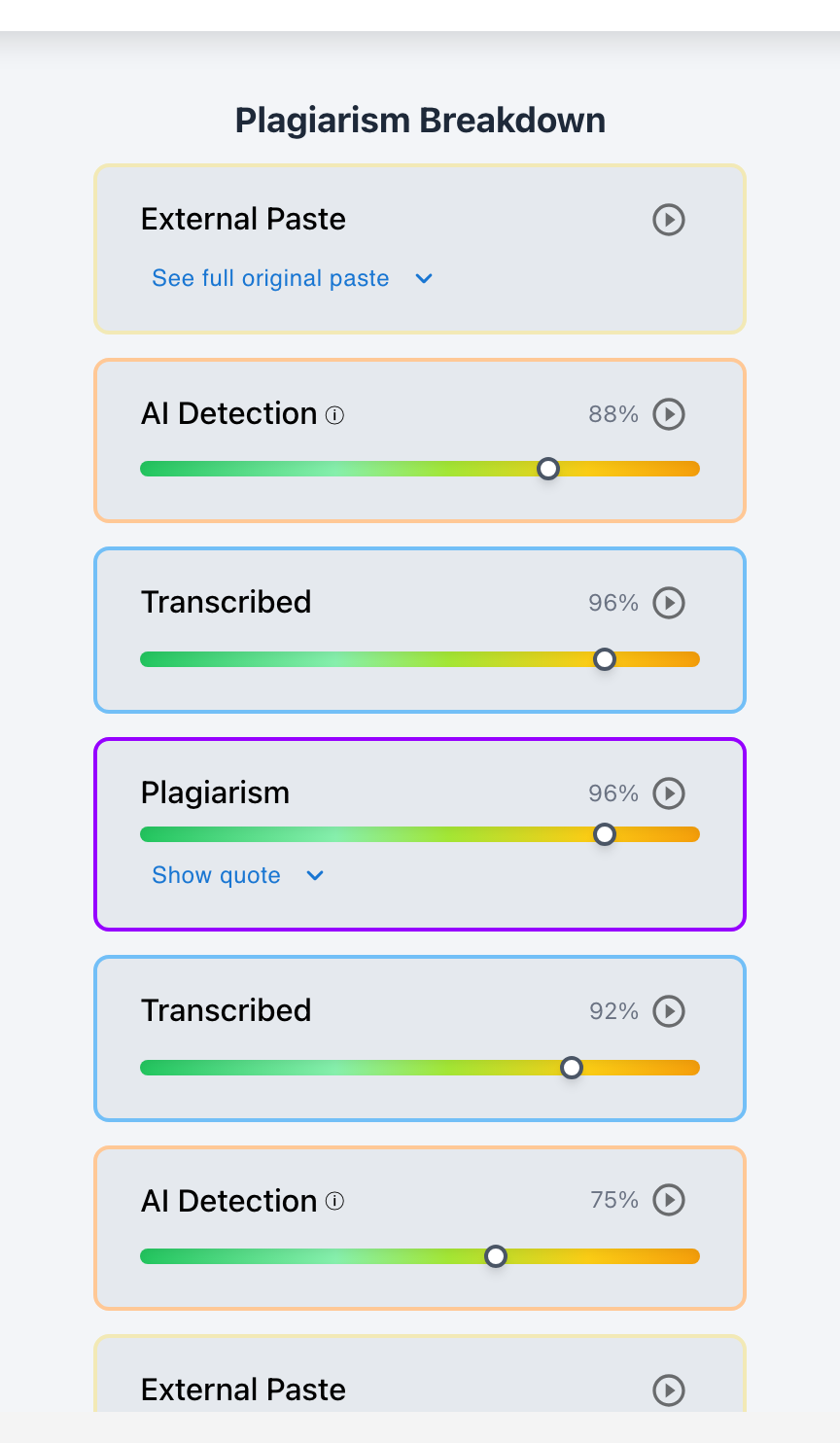
Holistic writing-process evidence and keystroke playback provide defensible clarity where single AI detection percentages create false certainty.
The Growing Dilemma in High School Writing Integrity
For high school English, history, and science teachers reviewing dozens of essays and lab reports each week, managing artificial intelligence in student assignments has evolved from a theoretical policy question into an immediate daily challenge. When an educator opens a document submitted through Google Classroom or Canvas and suspects AI assistance, the central question is rarely about policy intentions—it is about evidence.
Holistic writing-process evidence and keystroke playback provide defensible clarity where single AI detection percentages create false certainty.
Attempting to resolve suspected AI use with a single percentage score can lead to adversarial student conferences, parent disputes, and unverified assumptions. High school educators need practical, defensible methods to evaluate genuine authorship while fostering transparent writing habits.
Why Single Detection Scores Are Indicators, Not Proof
A fundamental principle of modern assessment design is that a single AI probability score is not evidence of misconduct. Large language model detectors operate on statistical text perplexity and burstiness. While useful as initial triage indicators, they cannot verify whether a student:
- Used an LLM for initial brainstorming or outline ideation before writing independently.
- Pasted pre-written notes or interview transcripts from another document.
- Retyped machine-generated text by hand to evade simple paste flags.
- Naturally writes in a formal, low-burstiness style (a frequent occurrence among multilingual and neurodivergent students).
Treating an algorithmic score as a verdict undermines the teacher-student relationship. Defensible integrity decisions require examining how the work developed over time.
The Value of Writing-Process Evidence and Keystroke History
To move beyond speculative detection scores, high school departments are increasingly looking at writing-process forensics. Rather than analyzing only the final static snapshot, process evidence captures the entire composition timeline.
Key forensic signals include:
- Typing Rhythm & Revision Density: Natural human composition involves pauses, backspacing, reworded clauses, and steady keystroke cadence. In contrast, sudden massive block insertions often indicate uncredited copying or transcription.
- Essay Playback: Tools like Checkmark's Essay Playback allow educators to review a keystroke-by-keystroke replay of the document's construction, providing concrete visual evidence of authentic writing progression.
- Side-by-Side Source Proof: Highlighting exact matched passages alongside original citations helps teachers distinguish between naive patchwriting and deliberate plagiarism.
A Restorative 4-Step Framework for Student Writing Inquiries
When an assignment shows anomalous writing signals, educators can apply a structured, restorative review process:
- Review the Timeline First: Before contacting the student, inspect the document history and keystroke replay to observe pacing and revision stages.
- Anchor the Conversation in Process, Not Accusations: Begin conferences by asking the student to walk through their argument, outline choices, and source selections.
- Examine Specific Draft Intervals Together: If large sections appeared instantly without corresponding revision history, invite the student to explain their drafting workflow and reference notes.
- Provide Clear Revision Pathways: Where unauthorized assistance occurred, use the opportunity for targeted coaching on source synthesis and authentic voice rather than immediate punitive failure.
Key Takeaways for High School Educators
- Never rely on single AI scores as standalone justification for academic penalties.
- Prioritize writing-process evidence such as revision timelines, keystroke progression, and intermediate draft milestones.
- Leverage tools designed for transparent insight, including keystroke playback and side-by-side source verification.
- Maintain clear assignment boundaries so students understand exactly where AI tools are permitted and where independent composition is required.