
Executive Summary & Accessibility Mandate
As modern classrooms expand access to assistive technology, millions of students rely on Speech-to-Text (STT) dictation tools—such as Apple Dictation, Google Voice Typing, Microsoft 365 Dictate, and Dragon NaturallySpeaking—under Section 504 plans, Individualized Education Programs (IEPs), or personal verbal processing preferences. However, blunt AI text classifiers and crude revision trackers routinely misclassify authentic voice dictation as unauthorized AI generation or bulk copy-pasting. Because STT engines insert text in streaming multi-word bursts rather than character-by-character keypresses, and spoken language exhibits conversational cadence and oral syntax, superficial tools trigger catastrophic false alarms. Grounded in Checkmark Plagiarism’s philosophy to "Stop guessing, start trusting," this guide demonstrates how multi-dimensional writing telemetry and patent-pending Essay Playback™ distinguish the acoustic, phonetic, and temporal signatures of human voice dictation from 0ms external Large Language Model (LLM) clipboard dumps—safeguarding educational equity and providing transparent, defensible evidence for every learner.
The integration of generative artificial intelligence in academic settings has prompted institutions to deploy automated detection tools and clipboard monitoring scripts. Yet this heightened surveillance has collided directly with modern accessibility mandates, universal design for learning (UDL) frameworks, and student civil rights. Checkmark Plagiarism bridges this evidentiary gap through a triangulated suite integrating patent-pending Essay Playback™, passage-level AI detection, multidimensional source comparison, and teacher-in-the-loop rubric autograding for Canvas LMS, Google Classroom, and Buzz LMS.
The Intersection of Accessibility, Assistive Technology, and Academic Integrity
Under the Individuals with Disabilities Education Act (IDEA) and Section 504 of the Rehabilitation Act of 1973, students with fine-motor impairments, dysgraphia, developmental coordination disorder, repetitive strain injuries, or neurodivergent processing profiles are legally entitled to assistive technology accommodations. For these students, speaking their ideas aloud into a microphone is not a shortcut—it is their primary vehicle for intellectual expression and cognitive formulation.
Furthermore, an increasing number of non-accommodated secondary and higher education students utilize voice typing during mobile brainstorming, long commutes, or active outlining sessions to bypass keyboard fatigue and capture rapid thoughts.
- Apple Dictation / Google Voice Typing / Dragon NaturallySpeaking
- IEP / Section 504 Plan assistive input accommodations
- Fine-motor dysgraphia, tremor, or physical disability mitigation
- High-velocity verbal processing & cognitive drafting
- Static Perplexity & Burstiness text classifiers
- Crude snapshot-based word-count delta logs (e.g. 60s polls)
- Opaque "88% AI Probability" whole-document numbers
- Binary clipboard paste flags marking OS speech bridges as cheating
The Crisis: When schools rely on whole-document AI detection percentages or primitive revision logs, students who dictate their essays are disproportionately subjected to wrongful academic integrity investigations, eroding educator-student trust and compromising legal accommodations.
When school districts rely on whole-document AI detection percentages or primitive revision logs, students who dictate their essays are disproportionately subjected to wrongful academic integrity investigations. To build a fair, non-punitive learning environment, educators and technology leaders must understand the technical mechanisms that differentiate organic vocal composition from automated machine generation.
Why Blunt Detection Tools Trigger False Alarms on Dictated Text
Superficial detection software fails on voice-dictated writing due to three fundamental technical and linguistic disconnects:
Insertion Dynamics
Speech engines insert text in multi-word clause blocks (2–8 words) via WebSocket streaming buffers. Basic version histories poll every 30–60s and misinterpret these rapid multi-word bursts as sudden bulk pastes.
Spoken Linguistic Syntax
Spoken language naturally utilizes paratactic sentence structures, conversational discourse markers, and high-frequency oral vocabulary, triggering low perplexity scores in static AI classifiers.
Binary Paste Classifiers
Lockdown browsers and rudimentary surveillance extensions flag any text appearing without standard ASCII keyboard strokes as EXTERNAL_PASTE_UNAUTHORIZED, ignoring OS accessibility bridges.
1. The Chunk-Insertion Mechanism of Speech Engines
When a human types on a physical keyboard, the application Document Object Model (DOM) receives individual keydown and keyup events separated by discrete inter-key intervals (typically 120ms to 350ms).
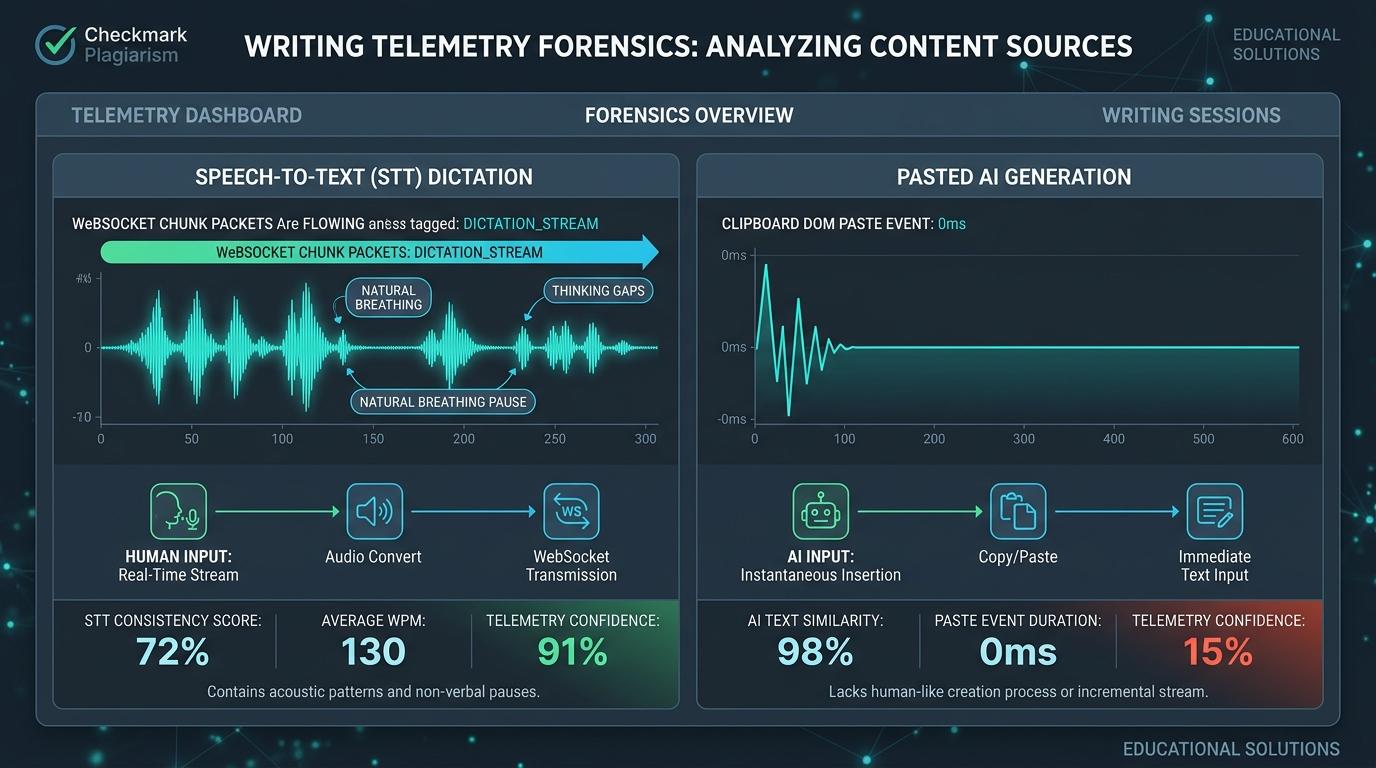
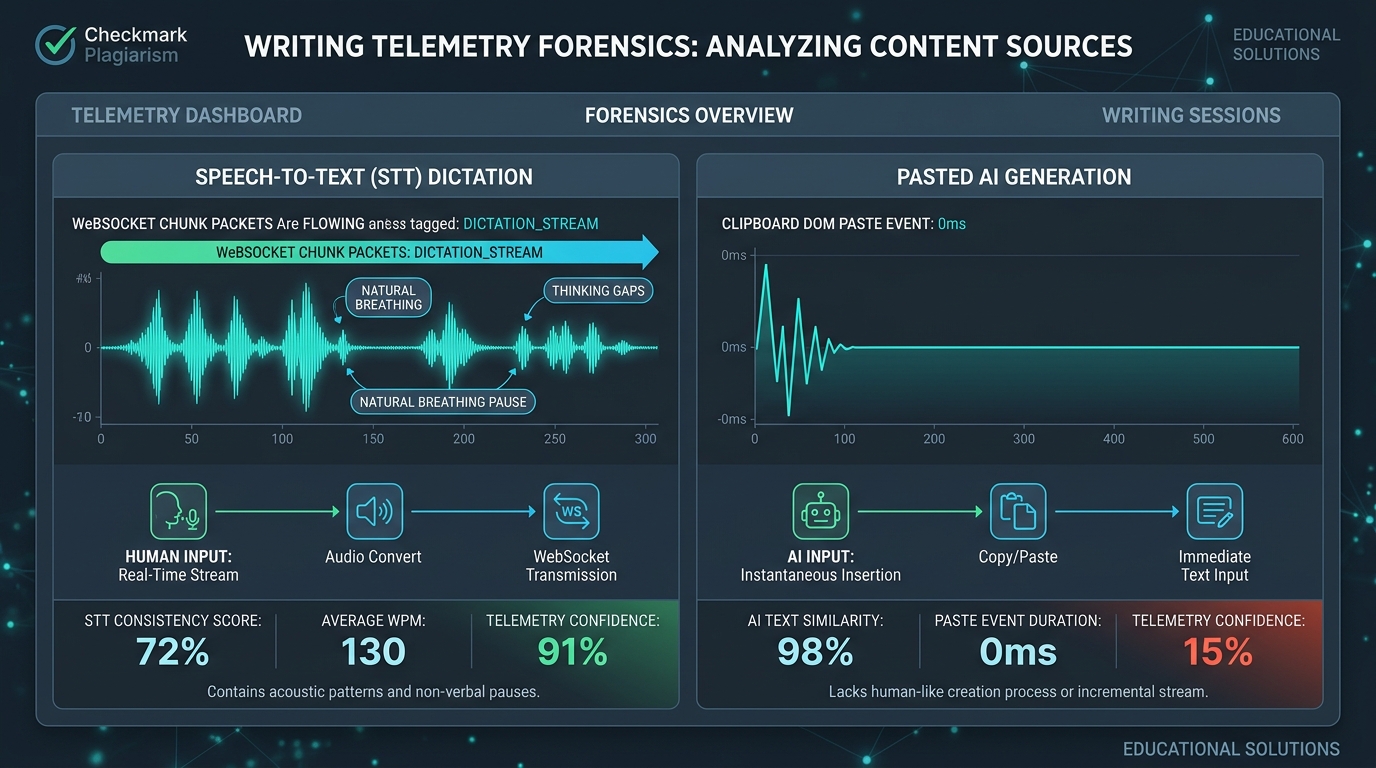
In contrast, speech-recognition engines (such as the Google Web Speech API, Apple Speech Framework, or Microsoft Azure Cognitive Speech) process audio through acoustic neural models and language models running on the device or in the cloud. The engine accumulates phoneme buffers, calculates probable word sequences, and commits text to the active document in incremental multi-word bursts (typically 2 to 8 words per recognition packet).
Crude revision monitoring tools (such as native Google Docs Version History snapshots or standard LMS text area monitors) do not log microsecond telemetry. They poll document length at arbitrary intervals (e.g., every 30 to 60 seconds). When a student speaks a 40-word complex sentence in 12 seconds, the monitor registers a sudden leap of +250 characters with zero recorded keystrokes—identical in appearance to a student pasting text from an external LLM interface.
2. Spoken Language Syntax vs. Keyboard Syntax
Human speech is structurally distinct from formal typed prose:
- Paratactic Sentence Structures: Spoken prose relies heavily on coordination rather than subordination (e.g., using "and," "but," and "so" to link ideas rapidly).
- Oral Disfluencies & Filler Remediation: Spoken drafts often include verbal restarts, colloquial phrasing, and conversational discourse markers that students subsequently edit.
- Lexical Predictability Shifts: Spoken language naturally draws from high-frequency, spoken vocabulary stores.
When passed through static AI detectors that measure Perplexity (word predictability) and Burstiness (sentence variation), the simplified syntactic structures of unedited voice drafts can trigger high AI-confidence scores because the text matches the smooth, low-perplexity statistical patterns common to language models.
3. The Flaw of Binary Paste Classifiers
Many academic surveillance browser extensions and lockdown tools utilize binary clipboard triggers. If text appears in the editor without a corresponding sequence of standard ASCII keypress events, the system flags the entire paragraph as EXTERNAL_PASTE_UNAUTHORIZED. This binary classification fails to distinguish between an operating-system accessibility bridge (STT) and a malicious clipboard injection.
Biometric & Temporal Telemetry: Speech-to-Text vs. Pasted AI
To objectively differentiate legitimate voice dictation from pasted AI generation, writing analytics must examine the multi-dimensional telemetry of the document session. Checkmark Plagiarism models every text mutation as a high-resolution time-series event tuple:
Where: ai ∈ {char_insert, stream_chunk, dom_paste, delete, cursor_nav} represents the mutation action; ti is the millisecond timestamp (UTC); Δti = ti - ti-1 is the temporal delta from the previous event; Δci is the net character count change; pi is the cursor index in the document buffer; and τi is the event metadata tag (e.g. input source payload, clipboard buffer reference).
Telemetry Forensic Matrix: Voice Dictation vs. AI Clipboard Paste
Multi-dimensional event comparison across temporal, volumetric, and syntactic axes.
| Telemetry Dimension | Speech-to-Text (STT) Dictation | Pasted AI Generation (LLM) |
|---|---|---|
| Insertion Time (Δt) | Incremental streaming chunks (120ms – 450ms) | Instantaneous (0ms single event) |
| Insertion Size (Δc) | 2–8 words per recognition packet (10–50 chars) | Entire essay or section (500–5,000 chars) |
| Input Mechanism | OS Accessibility / Web Speech API stream | OS Clipboard DOM paste event |
| Phonetic Errors | Present (homophones, acoustic misinterpretations) | Absent (syntactically & lexically pristine) |
| Cognitive & Breathing Pauses | Periodic (1.5s – 4.5s biological cadence) | Zero during insertion; flatline timeline |
| Micro-Revision Patterns | Heavy voice commands or manual mouse fixes | Global synonym swaps or absent local edits |
| Clipboard Buffer Mirror | Empty or unrelated external copied snippet | Exact 100% essay text preserved in buffer |
1. Insertion Dynamics: Streaming Chunks vs. Instantaneous Payloads
The primary mechanical differentiator lies in the delivery rate and event architecture:
- Speech-to-Text Streaming (Δt > 0, Chunked Δc): Assistive voice engines utilize streaming WebSockets or local speech APIs. As the speaker vocalizes a clause, the engine outputs hypothesis tokens, stabilizes the acoustic model, and commits text in small bursts (10 to 50 characters). The timeline reflects an unbroken stream of micro-chunks delivered across seconds or minutes, matching the natural rate of human speech (typically 120 to 180 words per minute).
- Instantaneous Clipboard Paste (Δt = 0, Massive Δc): When a student copies text from ChatGPT, Claude, or a secondary document and pastes it into the editor, the browser emits a single, atomic
pasteevent. An entire 400-word passage (2,500+ characters) is inserted at cursor indexpiin exactly 0 milliseconds.
2. Phonetic Artifacts vs. Model Perfection
Acoustic speech recognition produces recognizable phonetic error patterns that are virtually non-existent in direct LLM outputs:
Phonetic & Homophone Signatures in Voice Dictation
How speech engine transcription artifacts prove human voice composition.
- Cursor hop to index 0 → Replace "There" with "Their" (Homophone correction)
- Backspace x9 at index 28 → Replace "site able" with "citable" (Split compound correction)
- Cursor select index 52 → Replace "whether" with "weather" (Acoustic homophone correction)
Large language models generate text based on deep contextual embeddings and transformer attention heads. They do not commit phonetic homophone errors or split-word transcription artifacts; their syntax and spelling are grammatically flawless upon initial insertion.
3. Acoustic Pause Cadence & Cognitive Breathing Intervals
Human speech is biologically constrained by respiration and cognitive formulation. When dictating an original essay, a student does not speak continuously like an audiobook narrator. They experience acoustic composing pauses:
During these intervals, the microphone remains active, but zero text is committed while the student formulates their next argument. When plotted on a temporal cadence graph, authentic voice dictation displays a rhythmic breathing-and-utterance wave:
Checkmark Plagiarism’s Multi-Dimensional Telemetry Architecture
To eliminate the guesswork and injustice of opaque AI detection percentages, Checkmark Plagiarism integrates writing process telemetry, deep content matching, and teacher-centric evaluation into a unified, defensible platform.
Checkmark Plagiarism Multi-Dimensional Integrity Suite
Holistic authorship verification and formative grading architecture.
| Flagship Feature | Technical Architecture | Pedagogical Benefit |
|---|---|---|
| Patent-Pending Essay Playback™ | Keystroke-by-keystroke playback timeline with 1x to 8x scrub speeds and event tag markers. | Reconstructs the exact drafting session to prove authentic voice dictation or reveal 0ms pastes. |
| Permanent Clipboard Paste Buffer | Immutable preservation of 100% of external pasted text with jump-to-playback time synchronization. | Captures original pasted payloads even if modified; proves external source origins beyond doubt. |
| Granular Passage-Level AI Analysis | Sentence-by-sentence confidence sliders with strict <150-word N/A guardrails on short text. |
Eliminates misleading whole-paper percentages; isolates specific unapproved machine generation. |
| Defensible Source Comparison | Billions of web pages & academic sources with side-by-side two-way linked quotation cards. | Distinguishes citation formatting errors from copy-paste plagiarism with clickable references. |
| Teacher-in-the-Loop AI Autograder | Formative rubric grading with quote-anchored justifications and direct Canvas/Buzz LMS grade sync. | Accelerates meaningful feedback while keeping educators in full grading and evaluative control. |
1. Patent-Pending Essay Playback™ with Event Tagging
Checkmark’s Essay Playback™ engine captures the raw document mutation stream directly from supported environments (Canvas LMS, Buzz LMS, Google Classroom, Google Docs, and Microsoft Word). When an educator opens a submission report, they can scrub through the entire writing session like a video at 1x, 2x, 4x, or 8x speed.
Crucially, Essay Playback™ applies automated telemetry classification tags to the timeline:
[KEYSTROKE_INPUT]: Character-by-character mechanical keyboard typing.[DICTATION_STREAM]: Streaming multi-word recognition bursts originating from system speech-to-text engines.[EXTERNAL_PASTE]: Instantaneous bulk clipboard insertions originating outside the document buffer.[LOCAL_REVISION]: Cursor repositioning, text deletion, word replacement, or formatting updates.
2. Permanent Paste Buffer Preservation
If a student copies text from an external generative AI chatbot and pastes it into the document, Checkmark Plagiarism’s external paste detector immediately logs the transaction.
Even if the student subsequently spends thirty minutes manually rewriting, substituting synonyms, or deleting sentences to evade traditional detectors, Checkmark permanently preserves 100% of the original clipboard text payload. The educator can click the "Jump to Paste" button on the evidence card to view the exact text that entered the document buffer at timestamp tpaste, rendering "AI humanizer" tools and superficial edits completely ineffective.
3. Granular Passage-Level AI Analysis with Honest Guardrails
Rather than outputting a single, arbitrary document score (e.g., "78% AI"), Checkmark Plagiarism highlights specific sentences and paragraphs directly within the student's text.
- Passage Evidence Cards: Each highlighted section corresponds to a dedicated evidence card in the sidebar featuring a calibrated confidence slider (indicating whether the prose matches typical human writing styles or machine patterns).
- Short-Text Guardrails (<150 Words): Statistical language models cannot reliably analyze text snippets below ~150 words. In these instances, Checkmark displays
N/Awith an explicit notice, preventing false accusations on short-answer prompts, introductory sentences, or brief bullet points. - Educator-Only Privacy Controls: Flag statuses (
Flagged,Resolved,Not Flagged) remain strictly private to teachers and administrators, ensuring students are not stigmatized while evidence is being reviewed.
4. Zero Model Training & Institutional Privacy
Checkmark Plagiarism adheres to rigorous institutional data privacy standards:
- Zero Model Training: Student essays and telemetry streams are never used to train commercial AI models or shared with third-party vendors.
- FERPA & COPPA Compliant: Enterprise-grade cloud security with complete encryption in transit (TLS 1.3) and at rest (AES-256).
- Native LMS Integration: Deep integration with Canvas LMS, Buzz LMS, Google Classroom, and Moodle, supporting direct Single Sign-On (Google SSO / Microsoft SSO) and automated gradebook passback.
Real-World Case Scenarios
The following realistic classroom scenarios illustrate how Checkmark’s writing telemetry protects accommodated learners while accurately isolating authentic academic dishonesty.
11th Grade US History: Dysgraphia and Section 504 Accommodation
Context: Marcus, a junior with diagnosed dysgraphia and a Section 504 plan, submitted a 750-word research essay on the Progressive Era. Because keyboarding triggers severe muscle cramping, Marcus used Google Docs Voice Typing.
The False Alarm: A legacy detector flagged the essay with an "88% AI Generation Probability" and flagged three paragraphs as "bulk pasted text" because 300 words appeared in under two minutes.
Checkmark Telemetry Findings: Essay Playback™ revealed unbroken [DICTATION_STREAM] event tags arriving in 3-to-6 word recognition packets. The playback captured Marcus dictating "muckraking journalists exposed monopolies," which the speech engine initially transcribed as "muck raking journalist exposed mono police." Marcus paused for 3.1s and manually corrected the homophones.
✓ Resolution: Exonerated completely with praise for his historical analysis; department updated its policy to require telemetry audits before questioning accommodated students.
AP Literature: Voice-Drafting on Mobile Commute
Context: Elena used Apple Dictation on her iPhone to draft body paragraphs for an essay on Wuthering Heights while riding the team bus home from an athletic meet, later refining citations on her laptop.
The Concern: The teacher noticed conversational transitions in the opening paragraphs, questioning if an AI chatbot had drafted the text.
Checkmark Telemetry Findings: Telemetry logged a 24-minute mobile voice session with acoustic pauses (averaging 2.4s), followed by an evening desktop session with 142 discrete backspace events, sentence restructuring, and MLA citation insertions. Passage-level AI sliders verified Not Flagged.
✓ Resolution: Instructor provided formative feedback via the Checkmark Autograder, praising Elena's effective multi-device drafting strategy.
College Sociology: Fabricated Speech-to-Text Claim
Context: Julian submitted a 1,200-word sociology paper. When queried about advanced syntax, Julian claimed: "I didn't use AI; I used Apple Dictation to speak the entire paper into my document."
Checkmark Telemetry Findings: The timeline recorded an [EXTERNAL_PASTE] event dropping 1,184 words (7,412 chars) in 0 milliseconds. The preserved paste buffer contained the exact text, complete with the deleted opening chatbot marker: "Certainly! Here is a comprehensive sociological analysis..." Zero voice streaming packets were present.
✓ Resolution: Student admitted to AI use when shown objective timeline logs; assigned a structured restorative rewrite under an academic mentor.
4-Phase Educator Verification Protocol
When an educator or administrator observes a submission with chunked text insertions or unusual syntax, they should follow this systematic, four-phase protocol before drawing conclusions:
Event Stream & Telemetry Audit
- Open Checkmark Essay Playback™ timeline.
- Check event tags:
[DICTATION_STREAM](Streaming voice) vs.[EXTERNAL_PASTE](0ms Drop). - Inspect clipboard paste buffer payload for external chatbot text matches.
Phonetic & Micro-Revision Analysis
- Scrub through playback at 2x or 4x speed looking for acoustic homophones (site / cite, weather / whether).
- Identify speech recognition split compounds or phoneme approximations.
- Observe manual or vocal corrections applied to misheard terms.
Temporal Cadence Evaluation
- Measure pause durations between text chunks (Acoustic breathing: 1.5s–4.5s).
- Verify non-linear cursor navigation and active document revision.
- Check passage-level AI detection sliders for localized vs. universal patterns.
Restorative Student Conference
- Review Essay Playback™ side-by-side with the student in a non-punitive setting.
- Cross-reference documented Section 504 / IEP assistive technology accommodations.
- Focus discussion on argumentation, verbal outlining, and revision growth.
IEP/504 Assistive Technology Accommodation & Policy Framework
To prevent systemic discrimination against students with disabilities, district technology directors, curriculum leaders, and department chairs must establish clear institutional policies governing assistive technology and writing analytics.
District Policy Framework: Assistive Technology Safe Harbors
| Policy Pillar | Administrative Requirement | Implementation Action |
|---|---|---|
| 1. Assistive Tech Safe Harbor | Explicitly authorize STT tools in district academic integrity codes. | Include Apple Dictation, Google Voice, and Dragon in accepted UDL tools. |
| 2. Telemetry-First Evidence Mandate | Prohibit disciplinary actions based solely on static AI scores. | Require Essay Playback™ audit before issuing academic penalties. |
| 3. Automated IEP/504 Profile Alignment | Ensure integrity systems respect documented student accommodations. | Tag accommodated accounts to suppress blunt paste warnings. |
| 4. Zero Student Model Training Guarantee | Ensure vendor contracts ban data ingestion for model training. | Verify FERPA/COPPA compliance and zero-retention vendor guarantees. |
Restorative Student Conference Script: Voice Dictation Inquiry
When an educator reviews a submission with unusual drafting telemetry, the conversation should remain curious, supportive, and restorative. Below is an exemplary dialogue script demonstrating how educators can utilize Checkmark’s Essay Playback™ during a student conference.
Restorative Conference: Supportive Telemetry Inquiry
Exemplary dialogue between Teacher (Mr. Davis) and Accommodated Student (Alex)
"Hi Alex, thanks for meeting with me today. I really enjoyed reading your essay on the constitutional compromises of 1787. Your analysis of the Three-Fifths Compromise was especially insightful."
"Thanks, Mr. Davis. I spent a lot of time working through that section."
"I wanted to look at your drafting process together on Checkmark Playback. I noticed that several of your paragraphs appeared in multi-word chunks rather than letter-by-letter typing, which our system tagged as voice dictation stream. Can you tell me a little bit about your writing setup for this paper?"
"Oh! Yeah, because of my wrist tendinitis and my 504 accommodation, typing for more than ten minutes hurts. I used Google Voice Typing to dictate the first two pages while looking at my outline, and then I went back and fixed the punctuation with my mouse."
"That makes total sense! Let's look at the playback together at minute 08:14. See here how the playback shows your voice stream coming in, and then you paused for three seconds to fix where the speech engine typed 'there' instead of 'their'? That's a perfect example of active revision."
"Yeah! The speech tool always messes up homophones, so I have to watch it carefully."
"You did an excellent job catching those. Next time, feel free to add a quick note in your assignment submission mentioning that you used voice dictation. It helps me support your writing workflow even better. Let's look at your thesis statement next to see how we can make your conclusion even stronger."
Frequently Asked Questions (FAQs)
1. How does Checkmark Plagiarism distinguish voice dictation from a copied-and-pasted AI response?
Voice dictation tools stream text into the document buffer incrementally across time (typically 2 to 8 words per recognition packet every 120–450ms) accompanied by natural acoustic pauses (1.5s–4.5s) and phonetic self-corrections. In contrast, an unauthorized external paste from an AI tool triggers a single, instantaneous DOM paste event where hundreds or thousands of characters drop into the document in exactly 0 milliseconds. Checkmark’s Essay Playback™ tags these events distinctly and captures 100% of clipboard payloads.
2. Can a student fool writing telemetry by reading AI-generated text aloud into a dictation tool?
While a student could theoretically read an AI-generated essay aloud into a microphone, this creates a distinctive telemetry anomaly known as unnatural vocal pacing. When a human dictates original thoughts, they exhibit irregular cognitive formulation pauses (2.0s to 6.0s), rhetorical restarts, and frequent structural self-corrections. Reading pre-written text produces rapid, metronomic verbal delivery with zero composing pauses, zero idea-level revisions, and high passage-level AI detection scores across the entire document.
3. Does Google Docs Version History accurately show voice dictation?
No. Native Google Docs Version History aggregates document changes into broad, periodic snapshots (often 30 seconds to several minutes apart). If a student dictates 150 words in 45 seconds, Google Docs Version History collapses that entire timeframe into a single static diff, making authentic voice typing look identical to a copy-paste action. Checkmark Plagiarism solves this by logging millisecond-accurate mutation telemetry directly within the editor environment.
4. How does Checkmark protect students with IEPs, 504 plans, or dysgraphia?
Checkmark protects accommodated students by providing defensible process evidence. Instead of relying on statistical text classifiers that often penalize non-standard drafting styles, educators can view the student's authentic writing process in Essay Playback™, verifying voice dictation streams, pause dynamics, and personal revision habits to prevent false accusations.
5. Why do static AI detectors assign high AI-probabilities to dictated essays?
Spoken language is naturally more conversational, paratactic, and repetitive than structured keyboard composition. Static AI detectors evaluate text for Perplexity (word predictability) and Burstiness (sentence length variation). The formulaic transitions and simplified syntax common in unedited speech-to-text drafts often trigger low perplexity scores, which blunt classifiers misinterpret as synthetic machine generation.
6. What happens if a student pastes text from a voice-recording app on their phone?
If a student dictates into an external mobile app (like Apple Voice Memos or Otter.ai) and subsequently pastes the transcript into their LMS, Checkmark logs an [EXTERNAL_PASTE] event. However, the educator can immediately inspect the preserved paste payload. If the pasted text contains typical speech-recognition artifacts (phonetic homophones, oral disfluencies, unformatted dialogue), and the student subsequently engages in active in-document revision, the educator has clear context to validate legitimate assistive drafting.
7. Are student voice transcripts or essay submissions stored or used to train AI models?
Never. Checkmark Plagiarism maintains strict institutional compliance with FERPA and COPPA. Student submissions, keystroke streams, and dictation telemetry are strictly encrypted and are never utilized to train general AI models or shared with commercial third parties.
Conclusion: Stop Guessing, Start Trusting
Academic integrity in the age of artificial intelligence cannot be achieved through punitive, black-box percentages that disproportionately harm students with disabilities and diverse learning needs.
By replacing opaque algorithms with the transparent, multi-dimensional evidence of Essay Playback™, writing process telemetry, and defensible source comparisons, educators can uphold the highest standards of integrity while honoring accessibility accommodations. With Checkmark Plagiarism, schools can finally move beyond suspicion and build a culture of authentic student trust.
Protect Accommodated Students and Verify True Authorship
Equip your school or district with Checkmark Plagiarism’s patent-pending Essay Playback™, granular passage-level AI detection, and teacher-in-the-loop autograding for Canvas, Google Classroom, and Buzz LMS.