
The rapid adoption of black-box statistical AI detectors across higher education and secondary schools has created an urgent equity crisis: multilingual writers and English as a Second Language (ESL) students are systematically misclassified as AI cheats: in a 2023 Stanford-led benchmark of seven widely used detectors, the average false-positive rate on authentic TOEFL essays written by non-native speakers was 61.3% (Liang et al., 2023). Traditional AI detectors rely on surface statistical metrics—specifically word-sequence predictability (low perplexity) and sentence length uniformity (low burstiness)—which inherently penalize the constrained vocabulary, formulaic transitional framing, and interlanguage developmental patterns of non-native English writers.
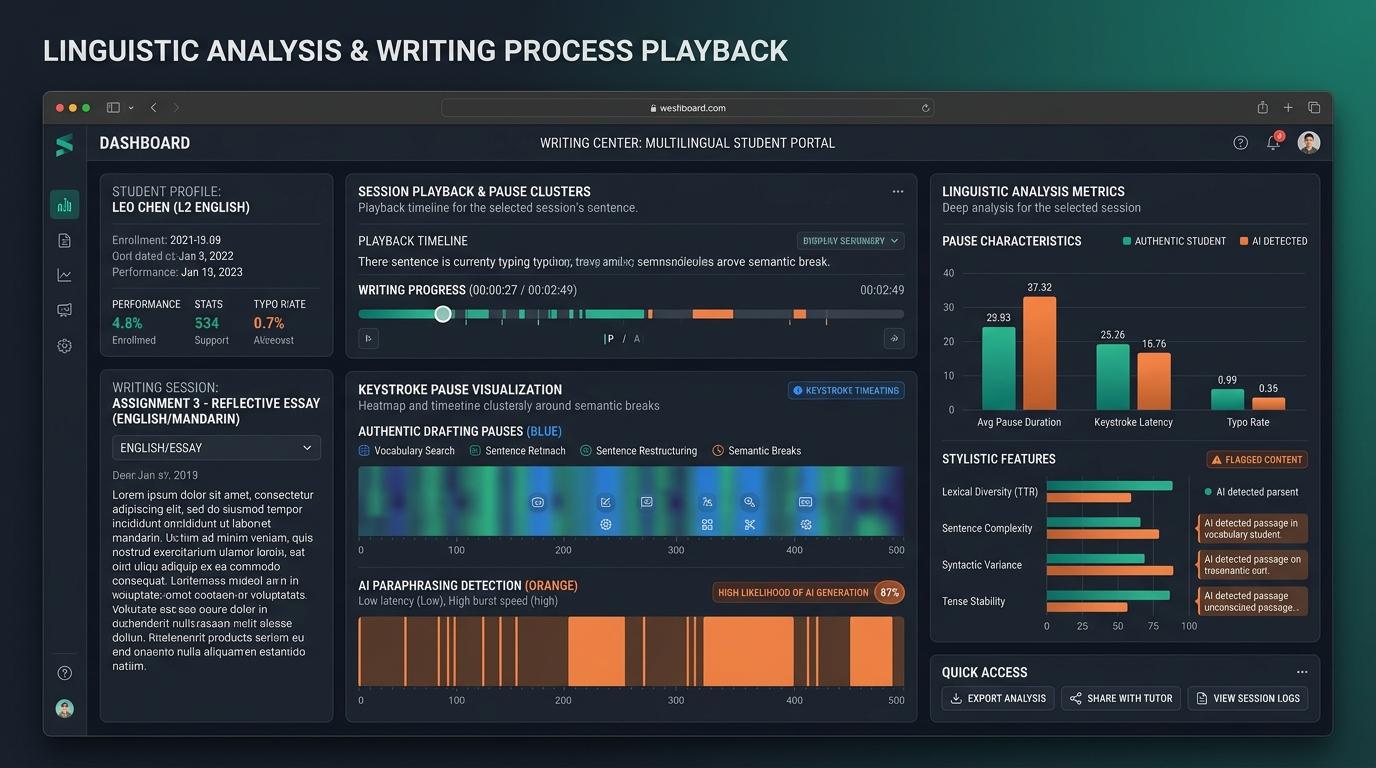
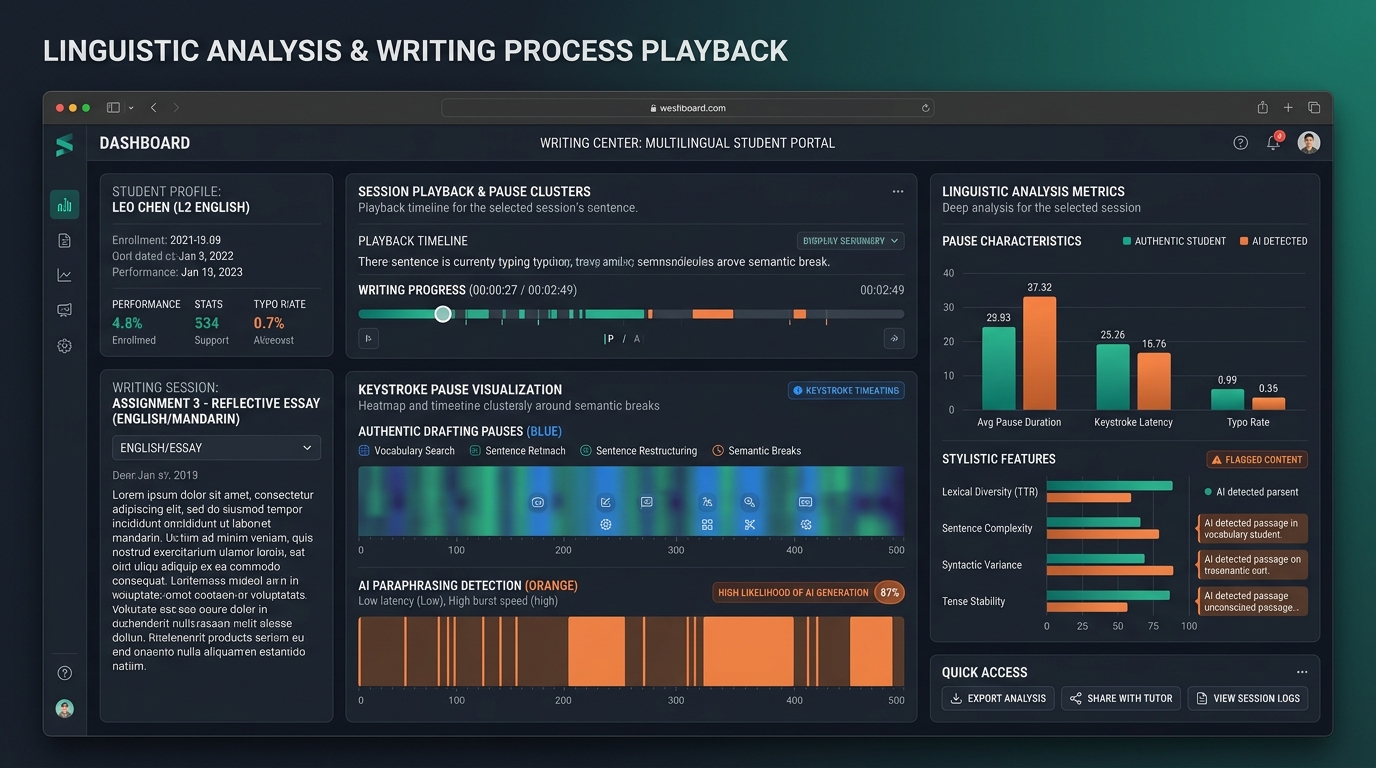
Concurrently, commercial AI paraphrasers and “text humanizers” (e.g., QuillBot, Undetectable AI, WordTune, SpinBot) perturb text by substituting context-blind synonyms (“Rogeting”), introducing bizarre collocation errors and semantic drift while cloaking automated generation. Writing center directors, multilingual writing specialists, and academic integrity committees cannot resolve this dilemma through static text inspection or opaque probability percentages. Differentiating authentic interlanguage development from machine-spun paraphrasing requires a two-pronged diagnostic framework: computational linguistic triage (identifying systematic first-language [L1] transfer calques and semantic coherence vs. fractured collocations and voice collapse) paired with writing process telemetry via Checkmark Plagiarism's patent-pending Essay Playback™. By capturing real-time composing velocity, cognitive pause bursts (P-bursts), revision friction, and external clipboard retention, educators obtain transparent, defensible proof to exonerate honest multilingual students and transform high-stakes integrity investigations into restorative, scaffolded writing consultations.
Checkmark Plagiarism empowers writing centers, composition departments, and academic integrity boards by integrating patent-pending Essay Playback™ writing telemetry with passage-level AI confidence scoring, side-by-side uncited source matching, quote-anchored rubric autograding, and enterprise LTI 1.3 integrations for Canvas LMS, Agilix Buzz LMS, and Google Classroom.
The Multilingual Integrity Crisis: Writing Centers at the Crossroads
Across college campuses, university writing centers, and secondary humanities departments, writing center directors and tutors occupy a delicate, high-stakes position. Historically established as non-evaluative, safe spaces for developmental writing support, writing centers are increasingly caught in the crossfire of institutional panic over generative artificial intelligence.
Faculty members, unsettled by sudden shifts in student prose or alerted by black-box AI detection scores in learning management systems (Canvas LMS, Blackboard, Buzz LMS, D2L Brightspace), frequently refer multilingual international students and English Language Learners (ELLs) to the writing center with instructions to “fix” their AI-flagged papers or explain their suspicious phrasing.
- Writes using authentic L2 interlanguage rules & bilingual glossaries.
- Spends 5+ hours actively drafting, pausing, and translating vocabulary.
- Submits original, honest, intellectually authentic paper.
- Notices rigid transitions and unfamiliar syntactic phrasing.
- Runs paper through legacy LMS automated detector.
- Receives false alarm score: “88% AI-Generated”.
- Evaluates static text strings in isolation.
- Penalizes low lexical perplexity & uniform sentence lengths.
- Outputs devastating whole-paper probability percentage.
Instructor demands: “Go to the writing center and explain your AI score, or face official academic honor code charges.”
Is the student demonstrating authentic interlanguage acquisition, or did they spin machine-generated text through a commercial AI paraphraser to evade detection? How can tutors know without subjective guesswork?
This dynamic creates a profound institutional dilemma with three damaging dimensions:
- The Risk of Discriminatory Injustice: If writing center directors and tutors accept opaque AI detector percentages at face value, they become complicit in penalizing non-native English writers for the natural linguistic constraints of second-language acquisition. This destroys the student's sense of belonging, triggers severe academic anxiety, and alienates international student populations who have invested immense personal and financial resources in their education.
- The Threat to Writing Center Mission: Transforming peer tutors into forensic interrogators degrades the writing center's pedagogical sanctuary. Instead of engaging in student-centered dialogues about thesis development, structural cohesion, and rhetorical voice, tutors are forced into adversarial compliance checks, poisoning the tutor-student relationship.
- The Blindspot of Commercial Paraphrasers: Conversely, if tutors ignore digital tools entirely, students who rely on commercial paraphrase spinners (such as QuillBot, Undetectable AI, WordTune, or SpinBot) to substitute words in stolen or AI-generated drafts bypass essential cognitive drafting stages, graduating without acquiring authentic analytical or rhetorical competencies.
Checkmark Plagiarism was engineered around the foundational philosophy: “Stop guessing, start trusting.” By replacing arbitrary, whole-paper percentage scores with granular passage-level linguistic indicators and patent-pending Essay Playback™ keystroke telemetry, educators and writing center leaders can definitively separate genuine developmental language acquisition from automated synonym spinning.
The Empirical Evidence: Why AI Detectors Systematically Target ESL Writers
To understand why traditional AI detectors fail in writing center consultations, directors and specialists must examine the computational mechanics that govern both statistical detectors and Large Language Models (LLMs).
The Stanford Landmark Study and Follow-Up Findings
In a pivotal 2023 investigation conducted by Stanford University researchers (Liang et al., 2023, Patterns 4(7): 100779, “GPT detectors are biased against non-native English writers”), the authors evaluated seven widely used off-the-shelf AI text detectors on two writing datasets. The authors’ preprint describes the work as a pilot study with relatively small samples:
- Native English Writing: 88 essays written by U.S. eighth-grade students, drawn from the Hewlett Foundation’s Automated Student Assessment Prize (ASAP) dataset.
- Authentic Non-Native Writing: 91 human-written Test of English as a Foreign Language (TOEFL) essays by non-native English speakers, collected from a Chinese educational forum and dated 2020 or earlier, before modern generative LLMs were publicly available.
| Writing Sample Category | Correct Human Classification | False AI Accusation Rate | Underlying Root Cause |
|---|---|---|---|
|
Native English 8th Grade Essays
Standard adolescent English prose
|
Near-perfect | Low | Greater lexical variety produces higher text perplexity, which detectors read as human-written. |
|
Authentic Non-Native TOEFL Essays
Written by international students before LLM release
|
38.7% | 61.3% (average) | Constrained academic lexicon and standard formulaic syntax trigger low perplexity alarms. |
|
TOEFL Essays Flagged by ALL 7 Detectors
Unanimous false positive across all seven detectors tested
|
— | 19.8% (18 of 91) | Roughly 1 in 5 of the human-written TOEFL essays was labeled AI-generated by every detector tested. |
The Stanford researchers reported a stark disparity: detectors that achieved near-perfect accuracy on U.S. eighth-grade essays falsely classified an average of 61.3% of authentic non-native essays as AI-generated, and at least one detector flagged 97.8% of them. More alarmingly, 19.8% of the human-authored TOEFL essays (18 of 91) were unanimously misclassified as machine-generated by all seven detectors.
When the researchers used ChatGPT to enrich the word choices of the non-native essays (prompt: “Enhance the word choices to sound more like that of a native speaker”), the average false-positive rate fell from 61.3% to 11.6%, and only one essay was still flagged by every detector. The authors concluded that the detectors may be penalizing the limited linguistic variability typical of second-language writing rather than identifying synthetic text.
Linguistic Mechanics: Why Interlanguage Mimics AI Models to Detectors
Why do statistical classifiers mistake authentic ESL prose for synthetic text? The answer lies in the two core statistical metrics utilized by generic AI detection algorithms: Perplexity and Burstiness.
What Detectors Assume: AI text chooses statistically probable tokens (Low PPL). Human text uses rare idioms, metaphors, and surprising vocabulary (High PPL).
ESL writers rely on a bounded academic lexicon (e.g., furthermore, consequently, it is evident that). Because these words are mathematically predictable, detectors register low perplexity and label the prose “Machine-Generated.”
What Detectors Assume: AI produces uniform, smooth sentence lengths (Low Burstiness). Native humans alternate between 4-word punchy clauses and 35-word complex sentences (High Burstiness).
Multilingual writers striving for clarity maintain consistent, uncomplicated Subject-Verb-Object (SVO) sentences (14–20 words). This syntactic consistency flattens the burstiness curve, mirroring raw LLM output.
1. Perplexity (PPL) and the Bounded Lexicon
Perplexity measures how “surprised” a language model is by a sequence of words. A human writer with native English mastery frequently deploys uncommon collocations, cultural idioms, conversational metaphors, and rare vocabulary words, generating high perplexity.
In contrast, an English Language Learner naturally operates within a bounded lexicon—a curated mental inventory of high-frequency academic vocabulary acquired through textbooks, vocabulary lists, and formal instruction (e.g., furthermore, in addition, consequently, it is important to consider). Because their word selections are mathematically predictable and statistically common, an AI detector calculates a very low perplexity score, concluding the text was generated by a probabilistic language model.
2. Burstiness (B) and Syntactic Regularity
Burstiness quantifies the variation in sentence length, grammatical architecture, and rhythmic cadence across a document. Experienced native writers naturally intersperse short, punchy declarative statements with lengthy, multi-clause compound-complex sentences.
Multilingual writers, striving for grammatical clarity and precision while managing heavy cognitive load, gravitate toward safe, predictable sentence blueprints—typically Subject-Verb-Object (SVO) constructions averaging 15 to 22 words per sentence. This low variation in sentence length produces a low burstiness score, mirroring the smooth, homogenous sentence distribution characteristic of raw LLM outputs.
The Linguistic Divergence: Interlanguage Development vs. AI Paraphrasers
To establish defensible diagnostic practices, writing center directors and tutors must master the linguistic distinction between Interlanguage (IL) Development and Algorithmic Paraphrase Manipulation.
| Diagnostic Dimension | Authentic ESL Interlanguage (Selinker Framework) | Commercial AI Paraphraser (QuillBot, Undetectable) |
|---|---|---|
| Syntactic Origin | Direct L1 → L2 Transfer (Calques) Syntactic loan logic mirroring native tongue structures (e.g., prepositional phrases, nominal heads). | Context-Blind Token Replacement Synonym graph shuffling (“Rogeting”) that perturbs syntax while attempting to bypass perplexity filters. |
| Semantic Cohesion | High Internal Consistency The underlying argument is logical, human, and unified; evidence clearly connects to the central thesis. | Fractured Cohesion & Semantic Drift Local semantic drift, contradictory sub-clauses, dropped negations, and scrambled logical connectors. |
| Collocation Accuracy | Standard High-Frequency Pairs Natural word pairings with occasional minor preposition shifts (e.g., “participate on” vs. “participate in”). | Bizarre Collocation Mismatches Unnatural pairings that no native or ESL speaker would generate (e.g., “meteorological collision” for weather storm). |
| Grammatical Error Types | Systematic Morphosyntax Rule-based errors: article omissions (the/a), non-count noun pluralization (researches), irregular verb regularization (teached). | Hyper-Complex Nonsensicality Flawless surface grammar, perfect clause punctuation, but complete substantive incoherence. |
| Register & Tone | Uniformly Earnest & Academic Consistent tone throughout the essay reflecting the student's authentic developing academic persona. | Jarring Register Collisions Mosaic patchwork: archaic formal jargon (heretofore, bespoke, ostensibly) grafted onto simple sentence frames. |
| Metacognitive Ownership | Full Conceptual Articulation Student can explain every idea, claim, and source connection in their own words or via translanguaging. | Total Metacognitive Disconnect Student cannot define complex words used in their paper or explain the underlying line of reasoning. |
1. Defining Interlanguage: The Systematic Logic of Second-Language Acquisition
Coined by linguist Larry Selinker in 1972, Interlanguage represents the separate, dynamic linguistic system created by an individual acquiring a second language (L2). Crucially, interlanguage is not an arbitrary collection of mistakes; it is a rule-governed, systematic grammar influenced by:
- L1 Language Transfer (Calques): The direct transposition of the syntactic rules, prepositions, or discourse structures of the native language into English. For example, a native Spanish speaker may write “The proposal of the committee” rather than “The committee's proposal” due to Spanish noun-phrase architecture (la propuesta del comité). A native Mandarin speaker may omit definite articles (the) because Mandarin lacks morphological equivalents.
- Overgeneralization of L2 Rules: Applying a newly learned English grammatical rule where it does not belong (e.g., regularizing irregular past-tense verbs like “teached” instead of “taught” or adding plural markers to non-count nouns like “researches” or “informations”).
- Formulaic Scaffolding: Leaning heavily on introductory transition templates (“First and foremost,” “On the other hand,” “To summarize the above points”) to organize thoughts.
In authentic interlanguage writing, the conceptual core remains intact. Even when surface-level morphosyntactic errors occur, the student’s underlying thought progression is discernible, human, and unified.
2. Deconstructing AI Paraphrasers: The Anatomy of “Rogeting” & Semantic Drift
Commercial AI paraphrasers—such as QuillBot, SpinBot, WordTune, and so-called “AI text humanizers”—do not compose through communicative intent. Instead, they ingest existing text strings and execute algorithmic perturbation:
-
Thesaurus Substitution (“Rogeting”): Replacing content words with statistical synonyms extracted from vector embeddings. Because the algorithm lacks deep semantic comprehension of the specific academic discipline, it selects words that are technically synonymous in a general dictionary but nonsensical in scholarly discourse.
Original: “The economic policies caused significant inflation.”Paraphrased (“Rogeted”): “The fiscal guidelines initiated momentous swelling.”
- Collocation Fracture: In human language, words co-occur in predictable pairings known as collocations (e.g., “conduct research,” “raise an objection,” “deeply concerned”). AI paraphrasers frequently break these natural pairings, producing syntactically plausible but rhetorically absurd phrases (e.g., “execute investigations,” “elevate a protestation,” “profoundly troubled”).
- Semantic Drift and Contradiction: When an entire paragraph is run through multiple iterations of paraphrase spinning, the core thesis drifts. Negations are accidentally dropped, causal relationships are inverted, and historical or empirical claims become distorted.
- Register Collision (Mosaic Jargon): AI paraphrasers often graft archaic, hyper-formal vocabulary (heretofore, amongst, ostensibly, bespoke) onto informal or basic sentence frames, resulting in an unnatural stylistic dissonance that no human writer—native or non-native—would produce spontaneously.
Telemetry Forensics: What Authentic ESL Composing Looks Like in Real Time
When static text inspection yields ambiguous results, writing center directors must look beyond the frozen words on the page. Writing is a cognitive, temporal process. By examining keystroke dynamics and writing process telemetry, educators can observe the exact cognitive expenditure of the student during composition.
• Telemetry Signature: Variable typing velocity (15–35 WPM), frequent localized deletion friction, and clustered cognitive pauses at clause boundaries.
• Telemetry Signature: Infinite keystroke velocity (0 to 520 words in 120ms), zero cognitive pauses, zero revision friction. Full spun paragraph captured in Checkmark's External Paste Inspector.
• Telemetry Signature: Constant linear typing speed (65–85 WPM) with total absence of planning pauses (>5s) and zero backspacing friction. Complex academic words typed flawlessly without hesitation.
The Cognitive Architecture of Second-Language Writing
Cognitive models of writing (Flower & Hayes, 1981; Kellogg, 1996) describe composing as a process that draws heavily on working memory. For an ESL writer, those demands come with the added work of composing in a second language, so they must simultaneously coordinate:
- Macro-planning: Formulating arguments, evaluating textual evidence, and structuring rhetorical progression.
- Translation & Lexical Retrieval: Translating concepts conceived in L1 into L2, navigating bilingual mental lexicons, and consulting digital dictionaries or translation tools.
- Morphosyntactic Monitoring: Manually applying English grammatical rules (subject-verb agreement, tense consistency, article selection).
- Typing & Motor Execution: Physically inputting text while monitoring screen feedback.

The Incontrovertible Telemetric Signatures of Authentic L2 Writing
Because of this multi-layered cognitive load, authentic ESL writing generates unmistakable, verifiable telemetry in Checkmark Plagiarism's Essay Playback™:
- Cognitive Pause Clusters (P-Bursts): Authentic L2 writers exhibit significant pauses (ranging from 3 to 45 seconds) immediately preceding complex content words, nominalized phrases, or transitional sentences. These pauses represent lexical searching, L1 → L2 mental translation, or dictionary lookup.
- Recursive Revision Friction (R-Bursts): Multilingual writers continuously self-monitor. In Essay Playback™, this appears as rapid backspacing at word boundaries (e.g., typing “the”, deleting it, typing “a”, deleting it, selecting “this”), changing verb tenses mid-sentence, or reordering adjective-noun clusters.
- Variable Velocity Cadence: Authentic typing occurs in uneven bursts: a sudden burst of 5 to 8 words representing a pre-planned clause, followed by an abrupt halt while the student plans the next syntactic segment.
- Micro-Drafting and Translation Pasting: When ESL students legitimately use bilingual tools (like DeepL or Google Translate), they paste individual words, short phrases, or single sentences—subsequently editing the pasted English words in real time to fit their sentence syntax.
The Telemetric Signatures of AI Paraphraser Fraud
In stark contrast, when a student submits an essay generated by an LLM and spun through an AI paraphraser, the writing process telemetry reveals total absence of authentic composing behavior:
- The Instantaneous Clipboard Dump: An entire 300- to 800-word section appears in the document in a single millisecond. Checkmark’s External Paste Buffer Inspector flags this event, captures the exact pasted text, and logs its external origin.
- Mechanical Second-Screen Transcription: If the student attempts to evade paste detection by manually retyping text displayed on a second monitor or mobile device, Essay Playback™ reveals a robotic, flat keystroke velocity (e.g., a steady 65–85 words per minute) with zero cognitive pause bursts, zero sentence-level restructuring, and virtually no backspacing friction. The student types complex, multi-syllable academic terminology without pausing to think, consult a source, or correct a single conceptual thought.
Comprehensive Telemetry & Linguistic Diagnostic Matrix
Writing center directors and tutoring coordinators can use this comprehensive matrix during staff training and student consultations to categorize writing anomalies objectively:
| Diagnostic Indicator | Authentic ESL Drafting | Legitimate MT Scaffolding | Automated Paraphraser | Second-Screen AI Copy |
|---|---|---|---|---|
| Syntactic Calques (L1) | Common; mirrors native language phrase logic | Pervasive; faithfully preserves L1 syntax | Rare/Erratic; syntax arbitrarily reshuffled | Absent; hyper-polished standardized English |
| Semantic Cohesion | Coherent, unified line of academic reasoning | Clear thesis; underlying logic is human & sound | Severe semantic drift; disjointed arguments | Generic, shallow; predictable LLM flow |
| Lexical Collocations | Standard high-frequency; occasional mis-pairings | Accurate literal lexical translations from L1 | Fractured; bizarre token swaps (“momentous swell”) | Perfect, standard academic collocations |
| Keystroke Velocity | Low/variable (15–35 WPM); distinct clause pacing | Bursts of typing mixed with small phrase pastes | N/A (Instantaneous paste event in milliseconds) | Steady, robotic (60–90 WPM) no rhythm change |
| Cognitive Pauses (P-Bursts) | Frequent (5–45s pauses at content boundaries) | Frequent pauses between typing and checking MT | Nonexistent in drafting; entire block is inserted | Absent; student never pauses to plan ideas |
| Revision Friction (R-Bursts) | High backspacing, local word & article changes | Active editing of pasted phrases to adjust syntax | Zero revision within document editor | Negligible; only minor mechanical typos fixed |
| External Clipboard Buffer | Clean or short phrase/word lookup captures | Short single-clause translation transfers | Massive block paste of complete paragraphs | Clean clipboard (typed off second screen) |
| Metacognitive Defense | Explains full meaning, rationale, and L1 root | Explains ideas and why translation was needed | Cannot define complex vocabulary substitutions | Cannot explain logical leaps or source links |
Step-by-Step Writing Center Diagnostic Protocol
When a faculty member refers an ESL student to the writing center due to a flagged AI score or suspicious phrasing, directors and peer tutors should execute a standardized, non-punitive diagnostic protocol. This workflow protects student dignity while uncovering authentic writing realities.
Non-Punitive Intake & De-Escalation
Establish psychological safety immediately. Clarify that writing center tutors are developmental allies, not honor code enforcers.
Linguistic Micro-Analysis of the Text
Examine highlighted passages for authentic L1 calques vs. algorithmic “Rogeting” synonym replacements:
- Interlanguage Check: Are errors consistent with the student's native language grammar (articles, prepositions, verb tense regularizations)?
- Paraphraser Check: Are disciplinary terms distorted by bizarre synonyms (e.g., “command cohort” for control group)?
- Cohesion Check: Does the overall argument hold together despite non-standard phrasing?
Launch Essay Playback™ Timeline Replay
Open Checkmark's patent-pending Essay Playback™ and scrub through the writing session at 2x to 4x speed:
- Verify authentic cognitive pause clusters (P-bursts) preceding complex sentences and paragraph transitions.
- Observe recursive backspacing friction (R-bursts) as the student self-corrects grammar and word choices.
- Confirm that writing velocity fluctuates naturally rather than remaining flat or instantaneous.
Audit External Clipboard & Paste Retention
Inspect Checkmark's External Paste Buffer Inspector:
- Legitimate Scaffolding: Pasting a single translated vocabulary term or a cited quote from an open-access PDF.
- Unauthorized Paraphrasing: Pasting multi-paragraph blocks containing QuillBot rephrasings of uncredited secondary sources.
Metacognitive Dialogue & Translanguaging
Engage the student in reflective conversation:
Formative Coaching or Advocacy Dossier
How Checkmark Plagiarism Empowers Writing Centers & Protects Multilingual Writers
Checkmark Plagiarism is engineered from the ground up to eliminate the injustices of black-box detection while providing educators with transparent, multi-dimensional writing intelligence.
| Feature Pillar | Technical Capability | Pedagogical Advantage for Writing Centers |
|---|---|---|
| Patent-Pending Essay Playback™ | Reconstructs full drafting session keystroke-by-keystroke with 1x to 8x playback scrubbing. | Exonerates falsely accused ESL students with visual proof of cognitive labor, pause clusters, and drafting cadence. |
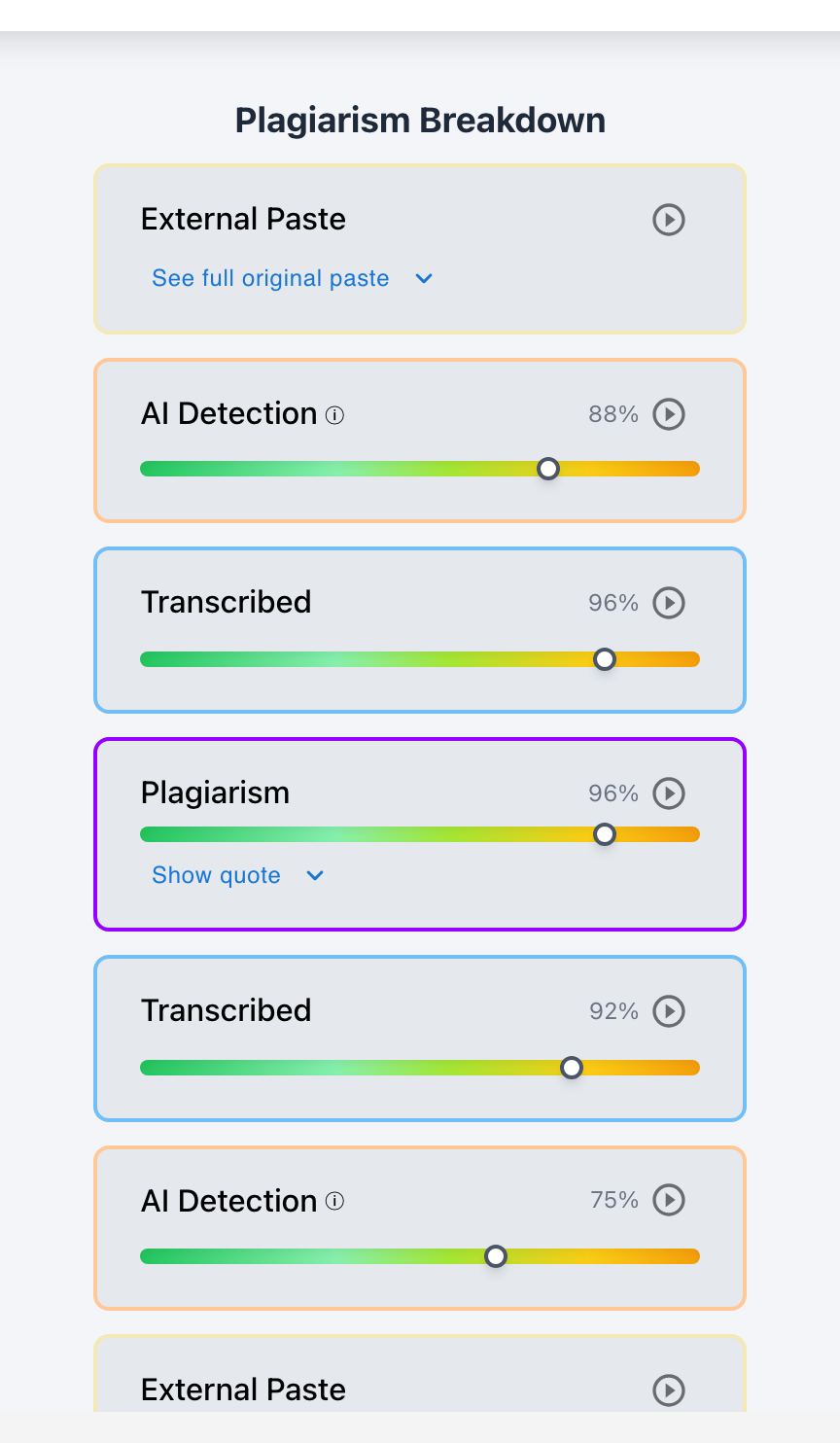
| Passage-Level AI Confidence Sliders | Underlines specific sentences with calibrated confidence scales (typical human vs. AI pattern); displays N/A guardrail under 150 words. | Eliminates destructive whole-paper scores; isolates human prose from machine inserts with pinpoint precision. |
| External Paste Buffer Inspector | Captures & permanently stores complete external clipboard text even if subsequently edited or rewritten. | Detects QuillBot & spinner injections even after the student spends 40 minutes manually rewording the pasted block. |
| Side-by-Side Plagiarism Matching | Scans billions of live pages; highlights uncited source quotes with synchronized two-pane side-by-side text alignment. | Distinguishes developmental patchwriting from deliberate theft for supportive citation and paraphrase coaching. |
| Educator-Only Flag Statuses | Integrity flags (Flagged, Resolved, Not Flagged) are strictly private to educators and writing specialists. | Prevents automated, traumatic accusations sent to students; allows tutors to resolve flags once authenticity is confirmed. |
| Zero-Retention Privacy Architecture | Zero model training on student work; encrypted at rest & in transit under strict FERPA and COPPA compliance. | Guarantees international and domestic student intellectual property is never monetized or fed into commercial LLMs. |
Institutional Recommendations for Writing Program Administrators (WPAs)
Writing Center Directors and Writing Program Administrators (WPAs) have a unique opportunity to lead campus-wide policy reform surrounding AI detection and multilingual student advocacy.
Ban Sole-Evidence AI Percentage Referrals
Mandate institutional policy stating that no student can be referred for academic misconduct based solely on a whole-paper AI detection percentage. Require multi-dimensional process evidence (Essay Playback™).
Establish Assistive Technology Boundaries
Explicitly differentiate in syllabus policies between authorized digital scaffolding (bilingual dictionaries, spell checkers, single-term translation) and prohibited generative paraphrasing (QuillBot / LLM text generation).
Train Staff in Telemetry & Linguistic Calques
Equip writing center tutors and coordinators to recognize L1 syntactic transfer, cognitive pause patterns, and non-punitive translanguaging revision strategies during student consultations.
Position Writing Center as Advocacy Arbiter
Authorize writing center directors to provide official telemetry-backed authorship validation dossiers to Academic Integrity Boards during contested student misconduct hearings.
Frequently Asked Questions (FAQ)
Q1: Why do commercial AI detectors flag ESL and international student writing at such disproportionate rates?
Commercial AI detectors evaluate text based on Perplexity (word-choice unpredictability) and Burstiness (sentence-length variation). Multilingual writers naturally utilize a more constrained, high-frequency academic vocabulary and construct sentences with consistent, predictable lengths. Because these features match the statistical probability distributions of large language models, detectors misclassify authentic non-native English as machine-generated text.
Q2: What is the fundamental linguistic difference between an interlanguage developmental error and an AI paraphraser signature?
An interlanguage error stems from systematic, rule-governed second-language acquisition, often reflecting direct translation rules (L1 calques) or overgeneralized grammar. Despite minor surface errors, the underlying argument is logically sound. An AI paraphraser signature stems from context-blind synonym replacement (“Rogeting”), which preserves surface grammatical complexity while introducing bizarre word pairings (collocation fractures), register collisions, and nonsensical semantic drift.
Q3: Can a student fake authentic typing dynamics by retyping text from an AI paraphraser on their phone?
No. Writing telemetry in Checkmark's Essay Playback™ captures the cognitive reality of composing. When a student copies or transcribes text from a secondary screen, they type at a flat, robotic velocity (60–90 WPM) with virtually no backspacing friction and an absolute absence of natural cognitive pause clusters (P-bursts). In contrast, authentic writers exhibit frequent pauses (5 to 45 seconds) before complex vocabulary, recursive word corrections, and uneven typing bursts.
Q4: Is using Google Translate or DeepL considered academic dishonesty in college writing?
Policies vary by institution and department, but most writing programs distinguish between translation scaffolding (using translation tools to find the English equivalent of an independently conceived thought) and generative authorship substitution (using an LLM to generate arguments). Machine translation preserves the student's original L1 ideas and syntactic logic, whereas generative AI replaces student cognition entirely.
Q5: How should a writing center tutor respond if an instructor sends a student with an “85% AI” Turnitin score?
Tutors should first reassure the student that automated scores are statistical estimates prone to high false-positive rates on multilingual prose. The tutor should then review the student's draft using Essay Playback™ to verify authentic drafting effort, conduct a metacognitive conversation about the essay's core ideas, and generate a Checkmark Telemetry Summary to help the instructor understand the authentic human labor behind the submission.
Q6: What are “calques” and how do they prove human authorship in multilingual essays?
A calque (or loan translation) occurs when a writer translates a phrase directly from their native language into English word-for-word, preserving the source language’s unique grammatical structure or metaphorical logic. Because Large Language Models are trained on massive corpora of standardized English and generate native-like fluency, the presence of genuine L1 calques strongly indicates authentic, human non-native drafting.
Q7: What is “Rogeting” and why is it common in AI paraphrasing tools?
“Rogeting” refers to the automated, mechanical substitution of words with synonyms from a thesaurus without regard for contextual nuance. Commercial paraphrasers like QuillBot and SpinBot use algorithmic synonym graphs that frequently swap standard academic terms for unnatural or absurd alternatives (e.g., replacing “greenhouse gases” with “verdant structure vapors”), creating telltale linguistic signatures.
Q8: How does Checkmark Plagiarism protect student privacy during writing center investigations?
Checkmark operates under a strict zero-retention architecture. Student submissions are never stored in public databases, never shared with third parties, and never used to train artificial intelligence models. Checkmark is fully compliant with FERPA and COPPA, ensuring international and domestic student intellectual property remains secure.
Protect Multilingual Writers with Defensible Writing Telemetry
Stop relying on biased, black-box percentage scores. Equip your writing center, faculty, and academic integrity committee with Checkmark Plagiarism's patent-pending Essay Playback™ and passage-level writing intelligence.