
Executive Summary & Pedagogical Directive
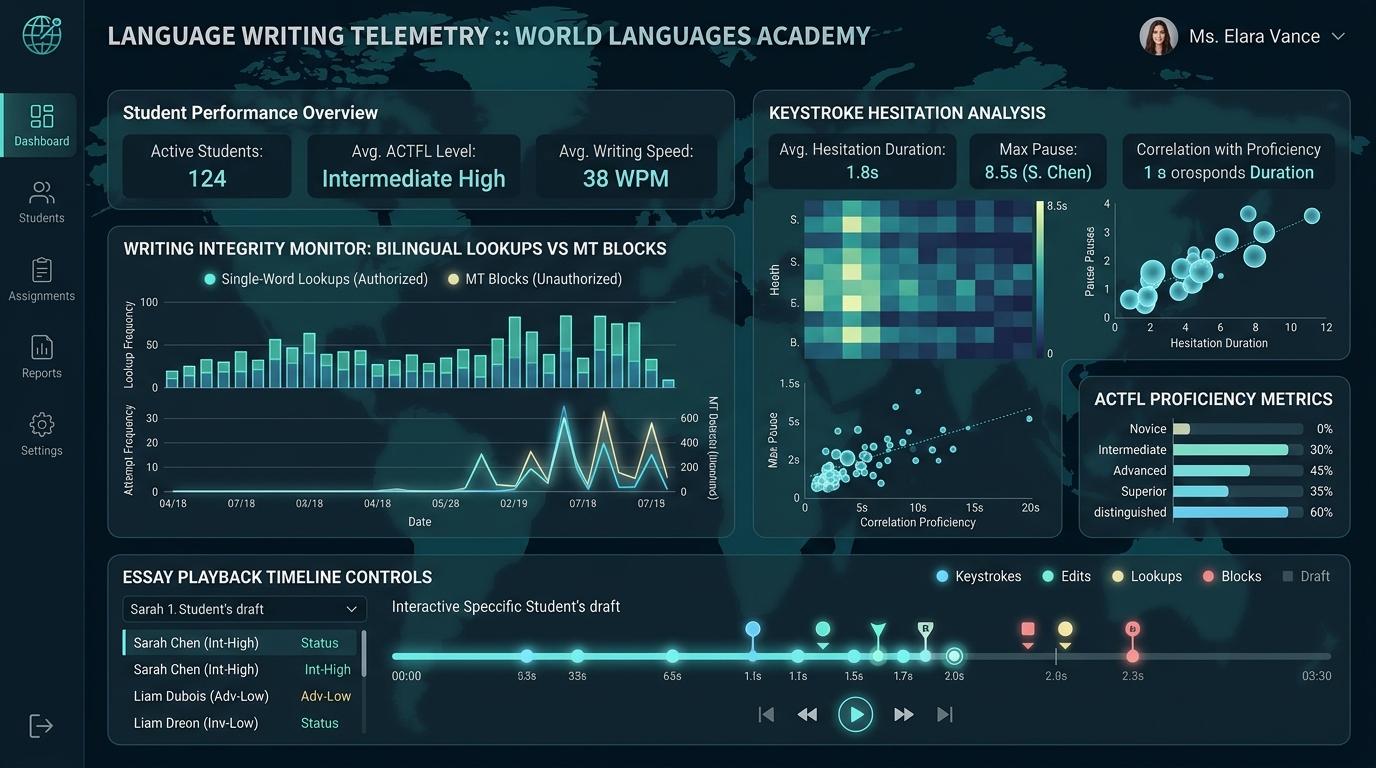
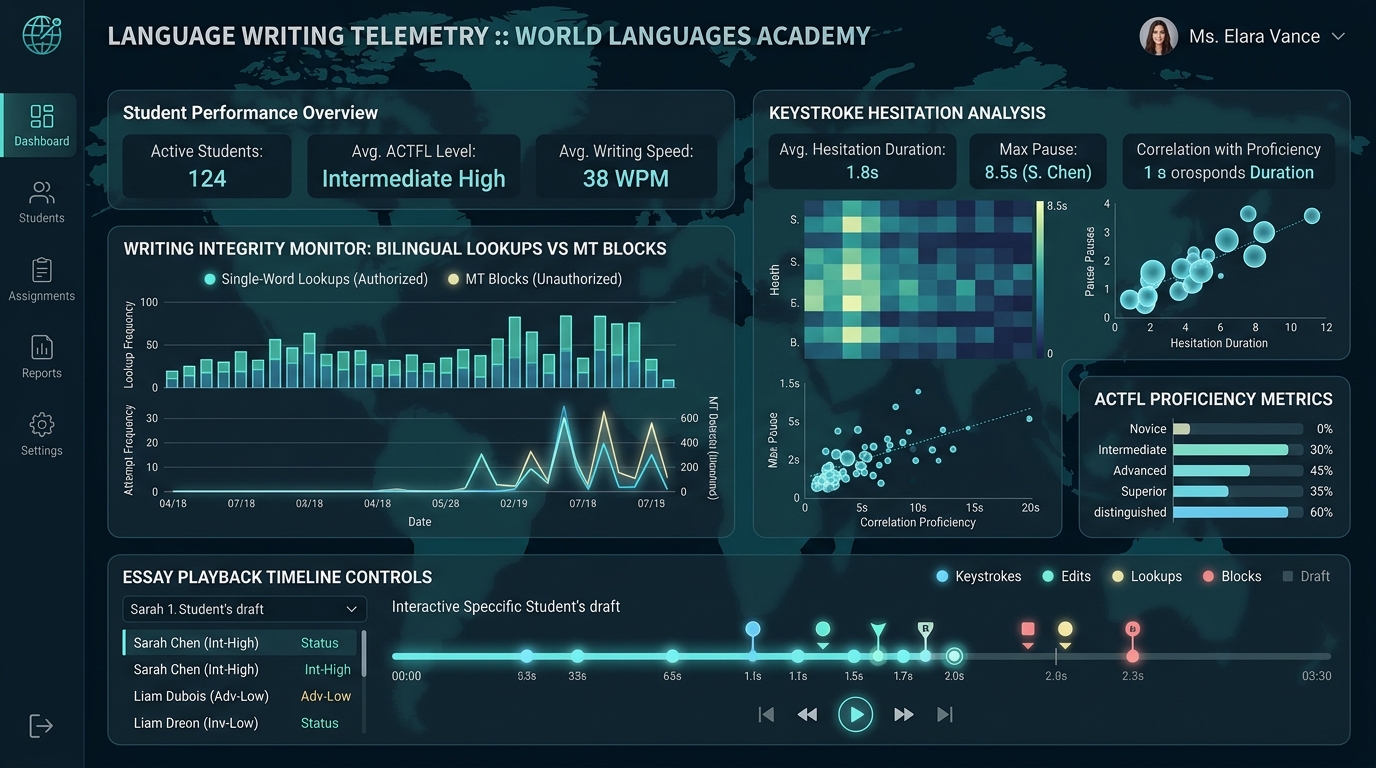
World language educators at the secondary and postsecondary levels face a profound pedagogical crisis: how to distinguish authorized bilingual dictionary lookups (e.g., WordReference, Collins, Duden) from unauthorized cognitive offloading via Neural Machine Translation (DeepL, Google Translate) and Generative LLMs (ChatGPT). Traditional whole-document AI detectors fail catastrophically in Second Language Acquisition (SLA) contexts, producing astronomical false-positive rates on authentic Novice and Intermediate writers due to their naturally constrained lexical variety, while remaining blind to machine-translated copy-pastes. By integrating the ACTFL Proficiency Continuum and Swain’s Output Hypothesis with keystroke dynamics and writing telemetry, departments can objectively differentiate authentic L2 drafting friction—characterized by micro-pause intervals (1,500–4,000ms), single-word insertion bursts, and recursive morphological agreement edits—from the instantaneous zero-millisecond multi-clause block insertions and flatline keystroke cadences of full machine translation. Powered by Checkmark Plagiarism's patent-pending Essay Playback™, External Paste Buffer Inspector, and Teacher-in-the-Loop ACTFL Rubric Autograding, language departments can replace punitive guesswork with transparent, defensible forensic evidence that fosters student linguistic growth.
Across Middle School Exploratory, High School Level I–IV, Advanced Placement courses (AP Spanish, French, German, Italian, Chinese, Japanese, Latin), and University Romance and Germanic Language Programs, educators face a daily forensic crossroads. When students compose essays at home or on classroom laptops, the traditional boundaries of legitimate research have dissolved under the pressure of one-click neural translation engines.
The World Language Pedagogical Paradox: The Permitted Dictionary vs. The Banned Translator
In foreign language acquisition, reference tools are not merely tolerated; their strategic use is actively taught as an essential 21st-century interpretive and presentational communication standard. For decades, teachers have guided students to use digital dictionaries and linguistic databases:
- WordReference & Collins: Contextual noun lookups, verb conjugation paradigms, regional collocations, and prepositional regimen checks.
- Duden, Larousse, & Real Academia Española (RAE): Monolingual definition queries, register distinctions, and semantic nuance lookups for advanced and heritage learners.
- Pleco & HanziCraft: Radical deconstructions, pinyin verification, and stroke order reference for Mandarin Chinese.
- Single-word dictionary queries (e.g., searching an unfamiliar noun)
- Consulting conjugation tables to verify irregular stem changes
- In-situ gender, number, and case inflection adjustments
- Syntactic trial-and-error, word trials, and clause assembly
- Full sentence, clause, or paragraph translation via DeepL / Google Translate
- Prompting generative LLMs (ChatGPT, Claude) to draft essays in English and translate
- Generating complete target-language arguments from native-language outlines
- Zero syntactic engagement, conjugation selection, or lexical struggle
The Core Challenge: When both behaviors occur inside a student's home browser, static text inspection cannot tell them apart. Only keystroke-level writing telemetry captures the physical difference between a 1-word reference lookup and a 500-character translation paste.
When teachers suspect misconduct based on uncharacteristically advanced vocabulary or flawless grammar, they traditionally find themselves trapped in an evidentiary deadlock:
1. The “I Just Used WordReference” Defense
A student accused of submitting flawless counterfactual subjunctive constructions claims they merely “looked up a few words.” Without granular temporal logs, educators cannot objectively prove whether the student spent 45 minutes assembling the grammar or 3 seconds pasting from DeepL.
2. The Catastrophic AI Detector False Positive
Submitting L2 student essays to generic AI detectors (Turnitin, GPTZero) generates false-positive rates exceeding 60%. Novice and Intermediate writers naturally use repetitive sentence stems and restricted vocabulary—the exact mathematical markers detectors flag as synthetic AI text.
Second Language Acquisition (SLA) Theory & Keystroke Telemetry
To establish why writing telemetry provides definitive, scientifically grounded proof in world language education, we must examine the cognitive architecture of Second Language Acquisition (SLA).
The cognitive stages of target language writing and their corresponding telemetric signatures
Learner identifies semantic concept in L1 and searches mental lexicon for L2 lemma.
Learner tests verb endings, tense agreements, word order, and grammatical cases.
Learner identifies gender/number discrepancy, backspaces, and applies correct inflection.
Proves cognitive acquisition occurred in real time, validating academic integrity.
1. Swain’s Output Hypothesis and the ACTFL Proficiency Continuum
Merrill Swain’s seminal SLA research demonstrates that language proficiency does not develop through passive listening or reading alone; it requires communicative output. When learners produce target language prose, they engage three vital cognitive functions:
- The Noticing/Triggering Function: Learners notice the gap between what they want to say and what their current grammar allows them to express.
- The Hypothesis-Testing Function: Learners test grammatical rules (e.g., “Does this German subordinating conjunction push the conjugated verb to the end?”) and adjust based on feedback.
- The Metalinguistic Function: Learners reflect on syntactic relationships, moving from semantic processing (meaning) to syntactic processing (grammatical form).
The American Council on the Teaching of Foreign Languages (ACTFL) defines four developmental proficiency bands, each characterized by distinct syntactic and morphological milestones:
| ACTFL Level | Discourse Unit & Syntax | Morphological & Grammatical Control | Writing Telemetry Profile |
|---|---|---|---|
| Novice (Low/Mid/High) | Isolated words, lists, memorized formulaic phrases, discrete lexical chunks. | High error rate in non-memorized forms; no cohesive devices; present tense default. | High IKI (2,500ms+), frequent accent lookups, short bursts (3–8 chars). |
| Intermediate (Low/Mid/High) | Discrete sentences, recombination of learned elements, emerging paragraph unity. | Control of present tense; emerging past/future; frequent gender/number agreement errors. | Variable IKI (800–2,200ms), active backspacing on conjugations, 1-word dictionary pastes. |
| Advanced (Low/Mid/High) | Paragraph-level discourse, cohesive narratives, complex transitional devices. | Robust control of major time frames (preterite/imperfect, passé composé/imparfait). | Rhythmic drafting (350–650ms IKI), structural reorganization, sentence rewrites. |
| Superior | Extended multi-paragraph discourse, hypothetical syntax, abstract argumentation. | Full idiomatic control, nuanced register, flawless subjunctive mood across complex clauses. | Sustained composition cadences with deep stylistic and rhetorical revisions. |
When a student enrolled in Spanish II or French III (performing at the ACTFL Intermediate-Low band) submits a text containing Superior-level hypotactical subordination (e.g., German double-infinitive clauses with Konjunktiv II or Spanish counterfactual pluperfect subjunctive structures), SLA theory reveals a profound developmental anomaly. Writing telemetry supplies the empirical receipts showing exactly how that text was introduced.
Telemetric Signatures: Legitimate Dictionary Use vs. Machine Translation
Writing telemetry measures temporal, mechanical, and clipboard interactions within the digital writing environment: Inter-Key Intervals (IKI), burst length (characters typed per continuous stroke), deletion/backspace ratios, cursor jumps, and external paste buffer transfers.
| Telemetric Dimension | Legitimate Dictionary Lookup | Full Machine Translation (DeepL/LLM) |
|---|---|---|
| Burst Insertion Size | 1–2 words (5–18 characters) | 150–1,500+ characters (Full clauses/paragraphs) |
| Insertion Duration | 800–3,500ms (Manual typing) or 0ms for single word | 0 milliseconds (Instantaneous OS Clipboard Drop) |
| Pre-Insertion Pause (IKI) | 1,500–6,000ms (Tab switch / search in WordReference) | Long idle window (45–180s), followed by massive drop |
| Post-Insertion Friction | High: Backspaces, gender/number inflection edits | Zero: Text untouched; immediate move to next prompt |
| Typing Cadence (if retyped) | High IKI variance (Hesitations on accents/verb stems) | Isochronous / Flatline (150–220ms steady transcription) |
| Drafting Topography | Sentence-by-sentence composition & recursive revision | Monolithic paragraph blocks dropped in single sessions |
The Telemetric Signature of Legitimate Dictionary Use
When an authentic student encounters a lexical gap, their session displays a clear three-stage micro-behavioral cycle:
The student searched the dictionary, evaluated the suggested terms, and modified their sentence to match the thematic context of the literary text.
The Telemetric Signature of Full Machine Translation
When a student offloads essay generation to DeepL or Google Translate, the writing telemetry leaves an unmistakable forensic fingerprint:
Complex French past subjunctives and idiomatic phrases appear in 0 milliseconds with zero drafting friction, followed immediately by submission.
The Transcription Variant: Manual Retyping from a Secondary Device
Some students attempt to bypass clipboard paste detection by generating translated text on a smartphone and manually typing it character-by-character into the LMS editor. Keystroke telemetry exposes this instantly through IKI variance analysis:
Authentic drafting features high pause variance (fast typing on familiar phrases, deep multi-second pauses before complex verb endings). Manual transcription displays flatline isochronous cadences (160–220ms per key) because the student is copying visual letters rather than constructing linguistic meaning.
Checkmark Plagiarism: The L2 Writing Telemetry & Forensic Suite
Checkmark Plagiarism equips world language departments with purpose-built forensic tools that replace punitive guesswork with transparent, objective receipts.
Patent-Pending Essay Playback™
Reconstructs the entire writing session keystroke-by-keystroke in a 1x to 8x scrubbable video timeline.
- Conjugation Tracking: Watch students test irregular stems (e.g., ella venió → vino) in real time.
- Pause Topography: Visual heatmaps reveal hesitation pauses over specific syntactic nodes.
- LMS Embedding: Replay sessions directly within Canvas SpeedGrader, Buzz LMS, and Google Docs.
External Paste Buffer Inspector
Preserves 100% of unedited external clipboard content at the millisecond of insertion.
- [SAFE LOOKUP]: Pastes of ≤ 2 words (e.g., pomme de terre) tagged as authorized dictionary lookups.
- [MT/AI BLOCK]: Multi-clause drops (> 15 words) flagged with full clipboard receipts and timestamp logs.
- Jump-to-Playback: One-click navigation to the exact second any paste entered the document.
Passage-Level AI Detection
Eliminates aggregate whole-paper scores in favor of granular, sentence-level analysis.
- Calibrated Confidence Sliders: Displays evidence cards showing student style vs. AI patterns.
- Honest Guardrails: Submissions under ~150 words display
N/Ato prevent false-positive guesses. - Humanizer Immunity: Paraphrasers cannot simulate authentic temporal drafting history or IKI rhythms.
ACTFL Rubric Autograding
Accelerates grading while keeping the world language teacher firmly in control.
- ACTFL Rubric Alignment: Evaluates *Language Control*, *Text Type*, *Vocabulary*, and *Mechanics*.
- Quote-Anchored Justifications: Every score is supported by direct quotes from student prose.
- Teacher Final Authority: Grades remain editable drafts until approved and pushed to the LMS.

Real-World World Language Case Studies
The following case studies demonstrate how writing telemetry resolves high-stakes integrity investigations across secondary and collegiate foreign language courses.
Exonerating an Honest Student in AP Spanish Literature
A 650-word Lorca essay on La casa de Bernarda Alba was flagged as “84% AI-Generated” by a legacy whole-document scanner, triggering a formal misconduct hearing.
Essay Playback™ revealed 3 hours 28 minutes of drafting. The Paste Inspector recorded 45 isolated single-word dictionary lookups from WordReference (e.g., bastón, asfixiante, oprobio).
Full exoneration. Heavy backspacing during imperfect subjunctive conjugation proved active syntactic negotiation. The department used the replay to showcase AP-level drafting.
Disproving the “I Only Looked Up Words” Defense in Spanish III
A 250-word cultural comparison contained flawless passive voice and compound subjunctive structures. The student claimed they “only used WordReference for vocabulary.”
Paste Buffer captured 3 massive 0ms paste events accounting for 218 of 250 words. Preserved clipboard text matched DeepL translation outputs. Active editing time: 2 min 14 sec.
Confronted with undeniable clipboard receipts, the student admitted to copying from DeepL. The teacher guided a supportive in-class rewrite at the student's true Intermediate-Low level.
Detecting Smartphone Transcription in French IV AP Prep
An essay featured complex past subjunctive forms (bien qu'il ait fallu...). Standard revision logs showed zero paste events, leading the student to claim total drafting authenticity.
Keystroke telemetry revealed isochronous typing at 62 WPM with an IKI standard deviation of ±18ms. Zero pauses on complex French agreements; oral check showed student could not define ait fallu.
Telemetry proved mechanical transcription from a secondary device. The teacher utilized Checkmark's rubric feedback to assign targeted subjunctive remediation without punitive escalation.

4-Phase World Language Academic Integrity Protocol
To create an equitable, repeatable departmental standard, world language faculties should adopt this 4-Phase Operational Protocol:
Proactive Scaffolding
Establish clear Green / Yellow / Red digital tool permissions in syllabus and model dictionary search strategies in class.
Telemetric Intake
Ingest drafts via Canvas/Buzz LMS with Checkmark enabled. Filter out ≤2-word lookups and flag multi-clause blocks.
Restorative Conferencing
Screen-share Essay Playback™ alongside the student in a non-punitive setting and conduct a 3-minute oral check on flagged grammar.
Remediation & Rewrite
Assign structured in-class rewrite constrained to student's true ACTFL level with brief metacognitive reflection.
Model World Language Syllabus Policy Clauses
Language departments can incorporate these customizable policy clauses into course syllabi and department student handbooks:
1. The Philosophy of Language Acquisition:
Learning a world language requires active cognitive practice—retrieving vocabulary, experimenting with sentence patterns, making grammatical errors, and refining your skills through feedback. Using automated software to generate, translate, or rewrite text deprives your brain of the neural friction required to build genuine fluency.
2. Permitted Digital Tools (The “Word-at-a-Time” Rule):
• You are encouraged to use approved online dictionaries (e.g., WordReference.com, Collins Dictionary, Duden.de) to look up individual words, verify noun genders, or review verb conjugation charts.
• You may use digital keyboards configured for the target language to type accents, umlauts, and special characters.
3. Prohibited Digital Tools:
• You may NOT input phrases, full sentences, or entire paragraphs into machine translation engines (e.g., DeepL, Google Translate, Apple Translate).
• You may NOT use generative AI systems (e.g., ChatGPT, Claude, Gemini) to brainstorm, outline, draft, or translate assignments.
• Translating an essay written in English into the target language using software is a violation of academic integrity.
4. Telemetric Verification & Process Transparency:
This course uses Checkmark Plagiarism writing telemetry to monitor drafting history, keystroke dynamics, and external paste events. Submissions showing instantaneous multi-clause pastes or lacking authentic drafting history will be subject to an oral proficiency review and required resubmission.
Restorative Student Conferencing Scripts
When writing telemetry flags machine translation, teachers can use this supportive script to facilitate an honest, productive conference:
TEACHER: “Thank you for meeting with me, Alex. I was reviewing your essay on Hispanic holidays, and I noticed some really interesting linguistic choices. Let's pull up the Essay Playback timeline together on screen.”
[Teacher opens Checkmark report showing a 220-character paste event from DeepL at minute 4:12]
TEACHER: “Here at minute 4:12, we see this paragraph appear in 0 milliseconds: ‘Bien que nous fassions des efforts considérables...’ That's an advanced subjunctive structure that we haven't covered in French III yet. Can you tell me what was happening as you worked on this section?”
STUDENT: “I was really stuck on how to say what I wanted to say, so I looked up the sentence online to see how it sounded.”
TEACHER: “I completely understand the frustration of feeling like your thoughts are more advanced than your current French vocabulary. That happens to every language learner! But when software builds the sentence for you, your brain doesn't get to practice the grammatical connections. Let's look at how we can express this same idea using the Intermediate structures we've been practicing in class.”
Frequently Asked Questions (FAQ)
1. Does tracking keystroke telemetry violate student privacy laws like FERPA or COPPA?
No. Checkmark Plagiarism is fully FERPA and COPPA compliant. Telemetric data (keystroke timing, paste buffer contents, revision timestamps) is captured strictly within the educational institution's secure digital perimeter. Checkmark enforces a strict Zero-Model-Training Policy: student writing and telemetry data are never used to train public or commercial AI models, sold to third parties, or shared across institutions.
2. How does keystroke telemetry handle logographic and character-based languages like Mandarin Chinese or Japanese?
In character-based languages, students use Input Method Editors (IMEs) (e.g., Pinyin for Mandarin, Romaji/Kana for Japanese) to type phonetic strings that convert into Hanzi or Kanji characters. Checkmark’s telemetry engine is specifically calibrated for IMEs: it captures the conversion selection pause (the micro-hesitation while selecting the correct character from a candidate list) as authentic drafting friction, easily distinguishing manual IME character selection from multi-sentence machine-translated paste drops.
3. How does writing telemetry differentiate between English Language Learners (ELL) and World Language (L2) students?
While the underlying telemetry technology is identical, the instructional objectives differ. In ELL contexts, students frequently use translation tools to bridge vocabulary into English for general academic content. In World Language classrooms, the target language output itself is the primary object of assessment. Checkmark allows teachers to customize threshold sensitivity, ensuring language educators can differentiate isolated dictionary lookups from unauthorized full-clause translation.
4. Can students bypass telemetry by using browser extensions or automated typing scripts?
Automated typing scripts (“paste-as-type” extensions) simulate keystrokes, but they produce a perfectly uniform, isochronous Inter-Key Interval (e.g., exactly 50ms between every character). Human typing in a foreign language is inherently variable, marked by natural cognitive pauses before difficult vocabulary, irregular verb endings, and accents. Checkmark's cadence anomaly detectors instantly flag robotic, non-human typing patterns.
5. What happens if a student writes their draft on paper first and then types it into the computer?
If a student drafts on paper and types their handwritten notes into the digital editor, Essay Playback™ will reflect continuous typing with occasional pauses as they look down at their notebook. However, to eliminate ambiguity, world language departments should establish a clear policy: students are encouraged to compose directly within the digital writing environment, or retain their physical handwritten notes to present during an oral check-in if requested.
6. How does Checkmark integrate with Canvas SpeedGrader, Buzz LMS, and Google Classroom?
Checkmark embeds directly into the teacher's grading workflow. Within Canvas SpeedGrader, Buzz LMS, or Google Classroom, educators can launch the Essay Playback™ timeline, review the Paste Buffer Inspector, and view passage-level AI detection flags directly alongside the submission. Rubric autograder scores and feedback can be pushed to the LMS gradebook with a single click.
7. Why is a single whole-document percentage score dangerous for foreign language essays?
Generic AI detectors calculate a single probability score based on English-centric statistical metrics (perplexity and burstiness). Because beginning and intermediate language learners naturally write with simple sentence patterns and limited vocabulary, their authentic writing closely mimics the mathematical profile of generic AI text. Relying on a single percentage leads to devastating false-positive accusations against honest students. Checkmark eliminates this danger by replacing opaque scores with transparent, visual, and multi-dimensional drafting evidence.
Conclusion: Stop Guessing, Start Trusting in World Language Education
The mission of world language education is to build genuine cross-cultural communication, cognitive flexibility, and linguistic confidence. When academic integrity policies rely on punitive guesswork or flawed black-box detectors, the teacher-student relationship breaks down, and honest learners are unfairly penalized for their developing language skills.
By pairing the ACTFL Proficiency Continuum with Checkmark Plagiarism’s writing process telemetry, world language departments can clearly separate authorized dictionary scaffolding from unauthorized machine translation. With patent-pending Essay Playback™, the External Paste Buffer Inspector, and Teacher-in-the-Loop ACTFL Rubric Autograding, educators have the transparent receipts they need to protect academic standards, support struggling learners, and foster a classroom culture rooted in trust and authentic second-language acquisition.