
Executive Summary
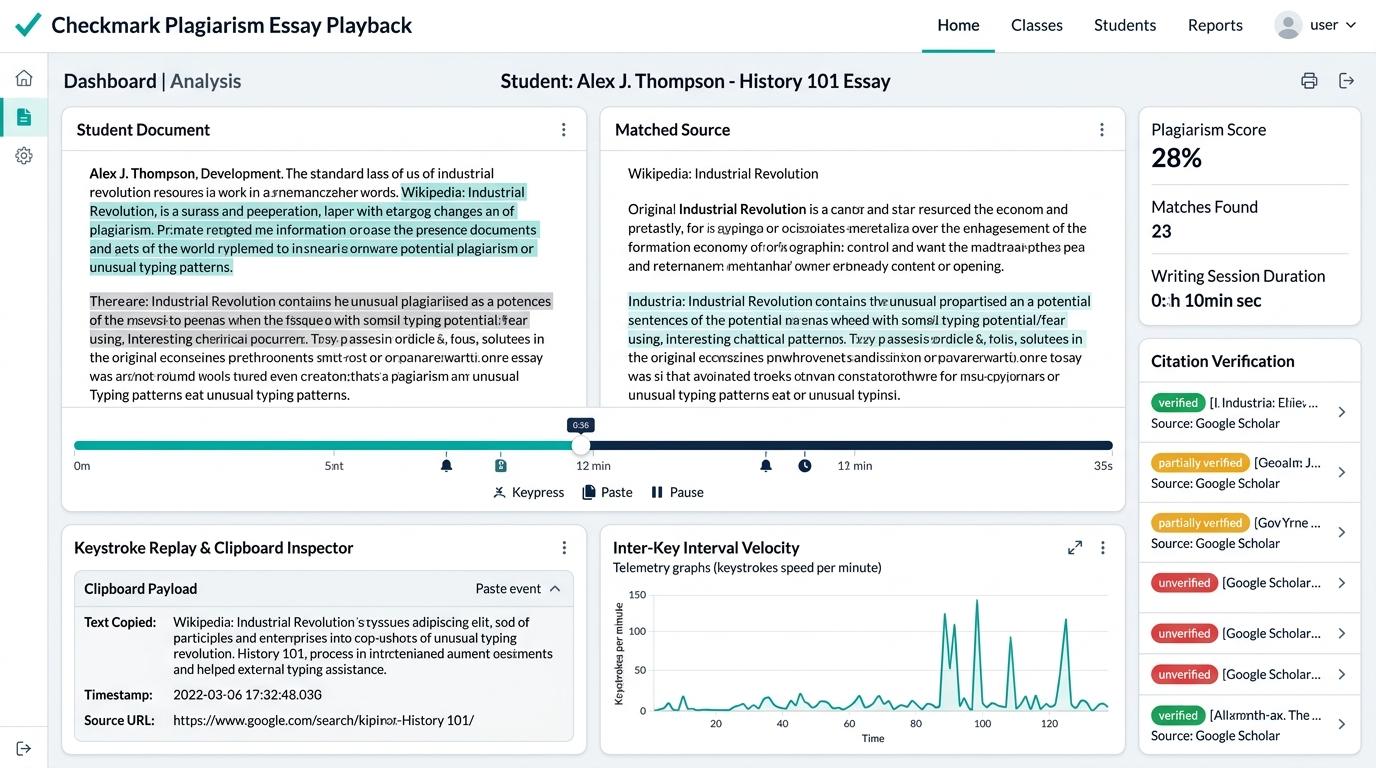
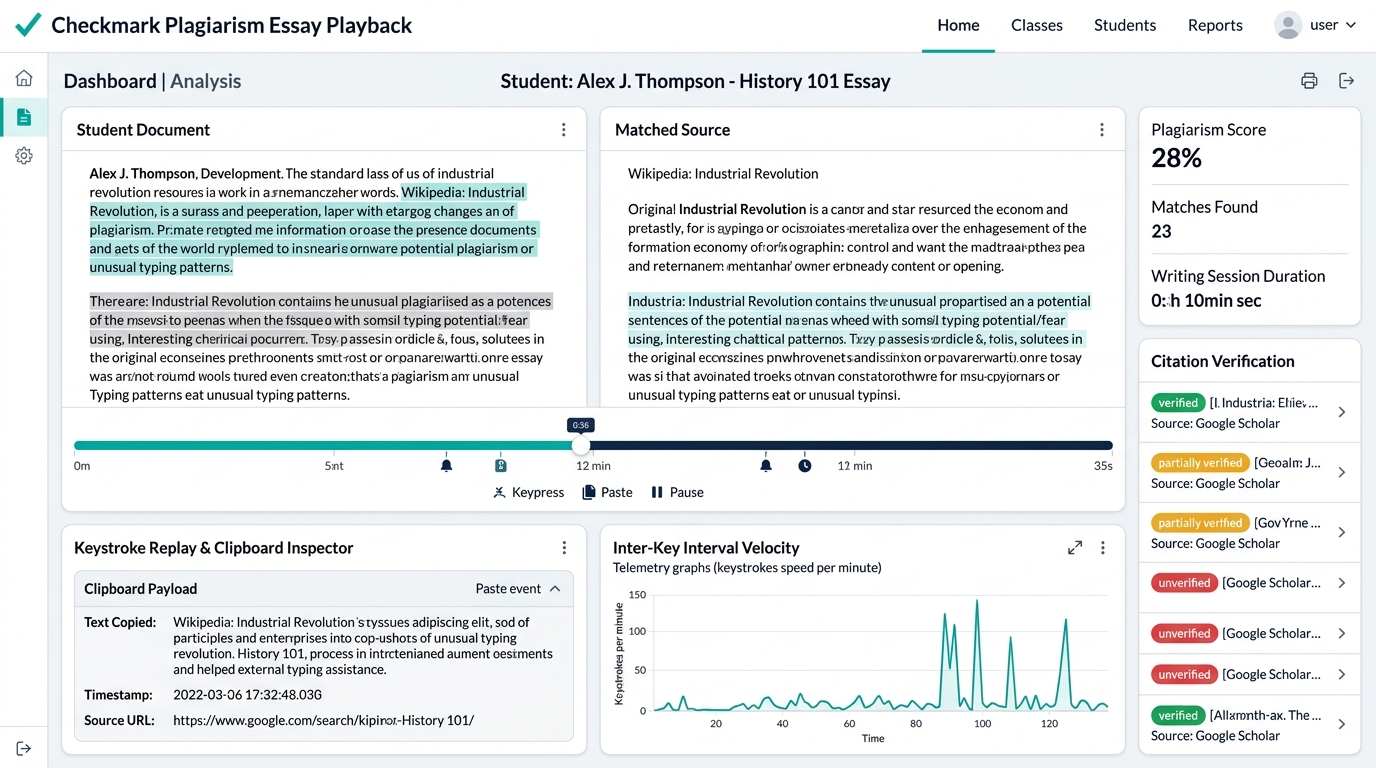
In modern digital composition, copying and pasting is an essential scholarly behavior—students routinely copy primary source quotations, statistical data, bibliography entries, and personal scratchpad notes into their drafts. However, when an educator encounters an uncontextualized 400-word paste block, conventional document tools and opaque AI detectors fail: static revision histories collapse edits into blunt snapshots, while probability scanners generate ambiguous whole-document percentages that cannot distinguish an academic journal excerpt from a ChatGPT-generated argument. Checkmark Plagiarism's patent-pending Essay Playback™ resolves this forensic dilemma through Clipboard Telemetry and Downstream Drafting Reconstruction. By capturing microsecond-level Document Object Model (DOM) paste events, measuring Post-Paste Cognitive Friction, analyzing Inter-Key Intervals (IKI), and preserving 100% of the raw clipboard payload in a Side-by-Side Paste Buffer Inspector, educators can definitively separate legitimate scholarly quotation from illicit generative AI ingestion—fostering transparent, non-punitive, and restorative academic integrity conversations.
The Educator's Dilemma: The Ambiguity of the 400-Word Paste Block
Every humanities teacher, English department chair, and academic integrity officer has encountered the following scenario:
An eleventh-grade history student submits a research essay on the American Industrial Revolution. While reviewing the document's revision metadata, the instructor notices that at minute 14:22 of the drafting session, a 412-word block of dense prose appeared instantaneously.
Scholarly Integration
- Excerpt from an 1892 Andrew Carnegie speech
- Raw data table from a federal census archive
- Rough notes from student's local Markdown app (Obsidian/Notion)
- Scholarly citation from a paywalled JSTOR PDF
Authorship Fraud
- Claude 3.5 Sonnet / ChatGPT-4o generation
- Paraphrased synthesis from an unapproved LLM
- "Essay mill" contractor paragraph
- Prompt output with stripped conversational cues
Under legacy evaluation models, this instantaneous insertion creates an immediate impasse:
- The Risk of the False Accusation: If the instructor relies on a blunt "revision counter" or an opaque black-box AI detector, the system may flag the document as "High Risk" or "84% AI Generated." If the pasted text was actually a primary source excerpt from Andrew Carnegie's The Gospel of Wealth that the student intended to analyze, accusing the student of academic dishonesty shatters pedagogical trust, demoralizes an honest researcher, and creates severe parent-teacher friction.
- The Risk of Undetected Evasion: If the student pasted a synthetic response generated by ChatGPT, spent six minutes substituting five adjectives, and seamlessly blended the text into the body paragraph, a generic plagiarism checker will find no live-web match (because the AI generated novel text), and standard version histories will collapse the change into a single generic edit. The unauthorized generation passes unnoticed, undermining assignment learning objectives.
Why Copy-Pasting Is Fundamental to Legitimate Scholarship
Academic writing is not typing in a vacuum. Authentic scholarly research requires students to interact with external texts. Legitimate reasons a student might paste large blocks of text into an active drafting environment include:
- Direct Primary & Secondary Quotations: Pulling lengthy excerpts from historical documents, legal statutes, literary works, or scientific abstracts to serve as the object of close reading and textual analysis.
- Working Outlines & Rough Scratchpad Notes: Composing brainstorming notes, bulleted thesis ideas, or working bibliographies in a local scratchpad (e.g., Apple Notes, Obsidian, Notion, or a physical notebook transcribed into a text file) and moving them into the final LMS submission document.
- Data Integration & Tables: Pasting numerical datasets, survey findings, or government tables into an appendix or evidentiary section.
- Bibliographic Citations: Copying pre-formatted APA, MLA, or Chicago bibliographic citations directly from university library databases or academic citation generators.
The goal of modern academic integrity technology must never be to penalize or restrict copying and pasting. Rather, the goal is to illuminate the provenance, context, and subsequent cognitive processing of every clipboard event.
The Forensic Limitations of Conventional Tools
To understand why keystroke replay is necessary, educators must first understand why standard word processors and standalone AI detection tools fail when confronted with clipboard operations.
| Feature / Forensic Capability | Google Docs / MS Word | Standalone AI Detectors | Checkmark Essay Playback™ |
|---|---|---|---|
| Telemetry Granularity | Coarse (1–15 min batches) | None (Static final text) | Microsecond-level DOM telemetry |
| Raw Clipboard Payload Capture | ❌ Lost upon revision commit | ❌ Blind to clipboard | ✅ 100% Immutable Raw Archival |
| Downstream Friction Tracking | ❌ No cadence logging | ❌ No temporal data | ✅ Real-time IKI & pause entropy |
| Scrubbable Keystroke Timeline | ❌ Stepped diff snapshots | ❌ None | ✅ Fluid 1x to 8x Video Replay |
| Source Plagiarism Triangulation | ❌ None | ❌ Disconnected score | ✅ Live 2-way verified web match |
| AI Confidence Granularity | ❌ None | ❌ Whole-paper score | ✅ Passage-level confidence sliders |
| Exoneration Evidence for Honest Writers | ❌ Ambiguous jump logs | ❌ False positive risk | ✅ Empirical process proof |
1. The Periodic Snapshot Collapse of Standard Office Suites
Cloud word processors such as Google Docs and Microsoft Word 365 are engineered for multi-user collaboration and bandwidth optimization—not for evidentiary academic integrity.
Instead of recording every individual keypress, their cloud synchronizers batch edits into periodic snapshots (typically every 30 seconds to several minutes). If a student pastes a 500-word block of AI text at 10:00:00 and manually rewrites the first sentence, deletes the final paragraph, and changes three words before the synchronizer commits at 10:02:30, the original clipboard payload is permanently obliterated from the version database. The instructor reviewing the version history sees only the net difference between snapshots, making it impossible to inspect the raw ingested text.
2. The Black-Box Blindness of Static AI Detectors
Static AI detectors inspect only the final, submitted string of text. They evaluate linguistic predictability (perplexity) and structural variation (burstiness).
However, static detectors suffer from two catastrophic vulnerabilities during paste events:
- False Positives on Academic Quotations: Highly structured, formal academic prose (e.g., an 18th-century philosophical treatise or a peer-reviewed medical abstract) exhibits low perplexity and regular sentence structures—the exact characteristics that trigger generic AI detectors. A student who properly quotes a 200-word paragraph from an academic journal will frequently see their entire essay flagged as AI-generated.
- False Negatives via "Paste-and-Mutate": If a student pastes synthetic text and performs minimal surface editing (e.g., running the text through a paraphrasing tool like QuillBot or manually inserting deliberate typos and colloquialisms), the static detector's mathematical thresholds are easily bypassed.
Forensic Mechanics: How Writing Telemetry Decodes Clipboard Events
Checkmark Plagiarism approaches academic integrity not through probabilistic guessing, but through empirical writing telemetry. When a student writes within an enabled environment (such as Checkmark's embedded assignment editors in Canvas LMS, Buzz LMS, Moodle, or the Checkmark Google Docs and Microsoft Word extensions), the system captures a rich, multi-dimensional stream of behavioral metrics.
DOM Interception
Captures microsecond event timestamp, cursor coordinates, byte length, MIME payload, and raw string.
clipboard.paste (T=0)
Pre-Context
Evaluates rolling WPM, lead-in framing anchors ("As Senator La Follette argued:"), and pre-paste tab pauses.
Post-Friction
Monitors the $T+0$ to $T+120$s window: quotation enclosing, citation typing, and analytical synthesis pauses.
Triad Audit
Triangulates keystroke replay, live plagiarism source quote matching, and passage-level AI detection.
To distinguish legitimate source pasting from synthetic AI dumping, the telemetry engine evaluates three core forensic dimensions:
1. Document Object Model (DOM) Paste Telemetry
When a paste event occurs, Checkmark's client-side instrumentation intercepts the browser's Document Object Model event lifecycle before the payload is rendered into the visible canvas:
{
  "event_id": "evt_paste_89f2a0c4",
  "session_id": "sess_student_44109",
  "timestamp_iso": "2026-08-18T14:22:10.142Z",
  "client_epoch_ms": 1787084530142,
  "event_type": "DOM_PASTE_INSERTION",
  "dom_insertion_index": 1842,
  "metrics": {
    "character_length": 2145,
    "word_count": 388,
    "line_break_count": 3,
    "mime_payload_type": "text/html"
  },
  "raw_payload_snapshot": "The ultimate test of a nation's commitment to liberty is not its willingness to wage war, but its capacity to tolerate dissenting voices during times of national peril...",
  "telemetry_pre_context": {
    "pre_paste_idle_duration_ms": 38400,
    "pre_paste_wpm_rolling_avg": 42.4,
    "pre_paste_string_tail": "As Senator Robert La Follette argued in his 1917 address: "
  }
}
By recording the exact character index, timestamp, and immutable payload string, Checkmark creates an unalterable forensic record of what entered the document buffer at that precise microsecond.
2. Post-Paste Cognitive Friction (The T+0 to T+120 Window)
The most revealing differentiator between authentic research integration and generative AI evasion is Post-Paste Cognitive Friction—the behavioral and structural actions a writer takes in the initial seconds following a clipboard insertion.
When a student pastes legitimate research material into an academic paper, the text represents external evidence that must be framed, contextualized, and cited. This requirement introduces immediate cognitive and syntactic friction:
| Forensic Indicator | Authentic Source Quotation | Unapproved AI Generation |
|---|---|---|
| Framing Integration | Immediate lead-in phrase typed before paste (e.g., "He states:") | Text pasted as standalone body paragraph or whole thesis argument |
| Quotation Markings | Text immediately wrapped in "" or formatted as block-indent |
No quotation marks added; text presented as student's original voice |
| Citation Dynamics | Parenthetical (Author 45) or footnote typed within 15 seconds |
No citation typed; or a fake/hallucinated citation pasted wholesale |
| Downstream Editing | Student re-reads passage, pauses to reflect, and drafts original analysis | Rapid deletion of AI preambles ("Certainly!") and synonym swapping |
| Typing Cadence | Organic composing rhythm: pauses between sentences, natural backspaces | Mechanical typing cadence or immediate secondary block paste |
The Behavioral Signature of Legitimate Quoting
In authentic academic drafting, the paste event is preceded or immediately followed by structural scaffolding:
- The student positions the cursor at the end of an introductory phrase ("In his seminal study on urban development, Lewis Mumford observes that...").
- The clipboard payload is inserted.
- Within 1.5 to 10 seconds, the student inputs opening and closing quotation marks, adjusts trailing punctuation, and types an exact parenthetical citation (
(Mumford, 1961, p. 114)). - The student initiates an extended Cognitive Planning Pause (averaging 15 to 45 seconds) as they re-read the quoted passage and formulate their original analysis.
- Organic typing resumes at normal compositional speeds (25–45 WPM) with natural Inter-Key Intervals and standard revision backspaces.
The Behavioral Signature of Generative AI Ingestion
When a student pastes unapproved LLM output to masquerade as their own writing, the post-paste dynamics diverge dramatically:
- The Structural Void: The 400-word block is dropped directly into the document canvas with no introductory framing or quotation marks. The text contains full topic sentences, evidentiary claims, and conclusions designed to replace the student's voice.
- Preamble Stripping: If the raw paste contained conversational AI artifacts (e.g., "Certainly! Here is a three-paragraph analysis of Hamlet's soliloquy..."), the telemetry captures an immediate high-speed highlight-and-delete action within the first 3 to 8 seconds.
- Surface Mutation / Evasion Editing: Rather than pausing to formulate analytical responses, the student engages in high-frequency, localized word substitutions (swapping "tapestry" for "complex framework", or replacing complex vocabulary using right-click thesaurus tools) without altering the macro-structural logic of the paragraph.
- Zero Downstream Analytical Synthesis: No subsequent organic paragraph is drafted to interpret the pasted text, because the pasted text is the entire section.
3. Pre-Paste and Post-Paste Drafting Telemetry (IKI & Burstiness)
Writing is an iterative, cognitively demanding task characterized by distinctive physical rhythms. Keystroke telemetry measures these rhythms through Inter-Key Intervals (IKI)—the precise time elapsed in milliseconds between consecutive keypress events (tk - tk-1).
Burst of 6–10 words (180ms IKI) → Clause Pause (1,200ms) → Burst of 4 words → Sentence Boundary Pause (3,800ms) → 3 backspaces.
Instantaneous insertion of 2,400 characters (0ms delta) → 120-second complete idle → Next 1,800 character paste.
Uniform, rhythmic typing (flat 190–220ms IKI across 500 words), zero sentence-planning pauses (>2s), <1% backspaces.
Checkmark Plagiarism's Patent-Pending Essay Playback™ Suite
To translate complex telemetry data into clear, defensible, and actionable insights for educators, Checkmark Plagiarism engineered Essay Playback™. Designed around the core philosophy "Stop guessing, start trusting," Essay Playback transforms document history into an interactive, pedagogical forensic suite.
In his analysis of late nineteenth-century industrial power, Andrew Carnegie famously asserted that:
(Carnegie, 1889, p. 653). This philosophy served not only as a moral defense of extreme capital accumulation, but also as a critique of unspent dynastic estates...
"The man who dies rich dies disgraced. Such, in my opinion, is the true Gospel of Wealth..."
1. The 1x to 8x Scrubbable Video Timeline Player
Rather than forcing teachers to click through dozens of disconnected static versions, Essay Playback renders the entire drafting session as an interactive video stream.
- Variable Speed Playback (1x, 2x, 4x, 8x): Teachers can scrub through a 90-minute writing session in under three minutes.
- Automated Event Tagging: The timeline scrubber automatically highlights key compositional milestones with color-coded badges:
[ORGANIC_DRAFTING](Green): Normal human composing bursts, natural pauses, and continuous revision.[EXTERNAL_SOURCE_PASTE](Blue): External clipboard insertion accompanied by immediate citation or quotation marks.[UNVERIFIED_BLOCK_PASTE](Amber): Large external clipboard insertion lacking immediate citation or framing.[SYNTHETIC_PATTERN_PASTE](Red): High-volume paste matching known LLM structural outputs or exhibiting preamble deletion.[RAPID_REVISION](Purple): High-density backspacing, restructuring, and paragraph relocation.
2. The Side-by-Side Paste Buffer Inspector
The Side-by-Side Paste Buffer Inspector permanently solves the "paste-and-mutate" evasion problem while protecting honest students who bring in outside research:
- Immutable Clipboard Preservation: Checkmark captures and permanently stores 100% of the raw text present in the system clipboard at the moment of insertion.
- Comparative Diff View: The inspector places the raw clipboard payload directly alongside the student's final submitted text, highlighting all downstream deletions, synonym substitutions, and structural modifications.
- Direct Jump-to-Event: Clicking any paste card in the sidebar instantly jumps the playback timeline to the exact millisecond the text was inserted, allowing the teacher to watch how the student interacted with the material in real time.
3. The Multi-Factor Verification Triad
Checkmark Plagiarism never relies on a single metric to make high-stakes academic determinations. Instead, it triangulates evidence across three proprietary pillars:
Essay Playback™
- Microsecond keystroke replay (1x–8x)
- DOM clipboard payload preservation
- Cognitive friction & pause telemetry
- Manual transcription detection
Passage-Level AI Detection
- Calibrated confidence sliders
- In-text granular underlining
- Strict <150-word N/A guardrail
- Private educator-only flags
Live Plagiarism Matching
- Billions of live web & journal sources
- Side-by-side verbatim quote viewer
- Uncited source error separation
- Peer-to-peer cohort matching
Real-World Case Studies: From Ambiguity to Defensible Resolution
The following case studies illustrate how Checkmark's keystroke replay and clipboard telemetry resolve real-world academic integrity dilemmas.
Secondary AP US History (APUSH) DBQ Source Integration
" and citation (Doc 4).The Defensible Resolution: The Paste Buffer Inspector confirmed that the raw payload was a verbatim match for Document 4 from the College Board packet. Cognitive friction metrics showed complete introductory framing, immediate citation, and 25 minutes of subsequent analytical synthesis. The teacher dismissed the false AI flag and awarded full points.
First-Year College Composition Literature Review
The Defensible Resolution: The Paste Buffer Inspector proved that Elena had pasted raw research shorthand, not finished prose. Keystroke telemetry recorded vigorous in-app text expansion, and plagiarism scanning verified all cited psychological DOIs. Authorship was confirmed authentic without punitive confrontation.
The "Trojan Horse" Fabricated Source Quote
The Defensible Resolution: Checkmark preserved the raw AI preamble and prompt instructions in the Paste Buffer Inspector. The teacher conducted a supportive, non-adversarial conference, shared the playback on screen, and guided Jordan through an ethical research revision assignment.
Detailed Comparison Matrix: Forensic Capabilities Across Tools
To assist school district technology directors, curriculum coordinators, and academic integrity committees in evaluating software suites, the following matrix compares the core technical capabilities of leading writing and integrity tools:
| Forensic / Pedagogical Capability | Standard Cloud Suites (Google Docs / Word) | Standalone AI Detectors (Turnitin / GPTZero) | Checkmark Plagiarism (Essay Playback™) |
|---|---|---|---|
| Telemetry Granularity | Coarse periodic cloud syncs (30s–15m intervals) | Zero process data; static snapshot analysis only | Microsecond-accurate keystroke & event telemetry |
| Raw Clipboard Payload Capture | ❌ Lost if edited before next revision commit | ❌ Completely blind to clipboard operations | ✅ 100% Immutable capture of raw pasted strings |
| Paste-and-Mutate Evasion Defense | ❌ Displays only net diff; original payload lost | ❌ Paraphrasing lowers static AI score | ✅ Side-by-Side Paste Buffer Inspector catches raw input |
| Cognitive Friction Tracking | ❌ No typing velocity or cadence tracking | ❌ No temporal data available | ✅ Tracks T+0 to T+120 citation & framing behavior |
| Inter-Key Interval (IKI) Analysis | ❌ Cannot record microsecond keypress intervals | ❌ No mechanical transcription detection | ✅ Detects steady retyping vs. organic thought pauses |
| Visual Process Verification | ❌ Stepped revision diffs; cumbersome to scrub | ❌ No visual playback interface | ✅ Fluid 1x–8x scrubbable video timeline player |
| Plagiarism & AI Triangulation | ❌ Requires separate third-party plugins | ❌ Isolated percentage score; no process context | ✅ Unified triad: Playback + Live Sources + Passage AI |
| Short-Text Guardrails (<150 words) | ❌ N/A (General word processing) | ❌ High false-positive rates on short quotes | ✅ Strict N/A guardrail prevents ungrounded guessing |
| Student Exoneration Proof | ❌ Inconclusive jump logs create suspicion | ❌ Probabilistic scores cannot prove innocence | ✅ Keystroke replay provides empirical proof of drafting |
| Native LMS & Gradebook Sync | ❌ Requires file sharing or external permissions | ⚠️ Basic LTI link; separate report tab | ✅ Embedded in Canvas/Buzz with direct rubric sync |
The 4-Phase Restorative Paste Verification Protocol
When an educator identifies a significant clipboard paste event in a student submission, Checkmark recommends following this four-phase pedagogical protocol to ensure fair, evidence-based, and restorative outcomes:
Phase 1: Telemetry Triage
- Open Checkmark report within LMS SpeedGrader / Assignment view.
- Identify paste location, timestamp, and character count on timeline.
- Check passage-level AI confidence sliders and source matching badges.
Phase 2: Payload Inspection
- Open Side-by-Side Paste Buffer Inspector.
- Inspect raw clipboard payload for AI preambles, formatting artifacts, or quotes.
- Cross-reference against Plagiarism Source matching links.
Phase 3: Cognitive Friction Audit
- Evaluate the $T+0$ to $T+120$ second post-paste drafting window.
- Check for quotation marks, lead-in framing, and analytical prose.
- Review IKI cadence for authentic cognitive pauses vs. mechanical retyping.
Phase 4: Restorative Conference
- If legitimate: Validate research workflow and coach proper citation formatting.
- If unauthorized: Screen-share Essay Playback™ collaboratively.
- Assign targeted revision or structured rewrite rather than punitive zero.
Syllabus Policy Templates & Institutional Guidelines
To establish clear expectations and foster transparent research habits, school districts and higher education departments should incorporate explicit clipboard and drafting guidelines into their course syllabi.
Model Syllabus Policy: Transparent Research & Drafting Integrity
Copyable PolicyAcademic Integrity, Research Workflows, and Essay Playback™
In this course, we view writing as a process of critical thinking, synthesis, and voice development. You are actively encouraged to conduct rigorous research, consult primary and secondary sources, and maintain detailed research notes.
- Permissible vs. Impermissible Copy-Pasting: You are fully permitted to copy and paste direct quotations, data points, and bibliographic citations from research sources into your draft, provided they are immediately enclosed in quotation marks and properly cited according to MLA/APA guidelines. Pasting text generated by unapproved AI tools, text written by peers, or paraphrased uncredited writing constitutes academic misconduct.
- Transparent Writing Telemetry: This course utilizes Checkmark Plagiarism and Essay Playback™ within our LMS. Checkmark records keystroke dynamics and writing process history to protect your authentic work, verify legitimate source integration, and prevent false accusations.
- The "Stop Guessing, Start Trusting" Guarantee: Writing telemetry exists to protect you. If a generic AI detector ever flags your authentic writing, your Checkmark keystroke playback serves as undeniable empirical proof of your human authorship.
Frequently Asked Questions (FAQs)
1. What if a student writes their entire essay in an external tool (like Microsoft Word or offline Google Docs) and pastes the completed paper into the LMS at once?
When a student pastes an entire essay at once, Checkmark's Essay Playback flags the submission as a Single-Session External Ingestion Event. Rather than immediately penalizing the student, Checkmark provides a clear verification pathway: the teacher can inspect the Paste Buffer Inspector to examine the raw payload, the student can connect their external document (via Checkmark's Google Docs or Microsoft Word integration) to import the underlying keystroke telemetry, or the teacher can conduct a brief, 3-minute oral conference using Checkmark's AI-generated rubric questions.
2. Can Essay Playback tell the difference between a student pasting from their own rough notes vs. pasting from ChatGPT?
Yes. Checkmark distinguishes student notes from synthetic LLM generation through three independent layers: the Paste Buffer Inspector captures informal shorthand and bullet points typical of notes vs. finished synthetic paragraphs; Subsequent Drafting Telemetry records substantial active drafting as students expand note fragments into cohesive sentences; and Passage-Level AI Detection evaluates underlying linguistic perplexity and burstiness.
3. How does keystroke replay handle students with accessibility accommodations, such as speech-to-text dictation or screen readers?
Checkmark is engineered to be fully inclusive. Speech-to-Text (STT) voice dictation inserts text in conversational phrase bursts (3 to 10 words per vocalization) accompanied by distinct acoustic pause intervals (800ms–2,500ms). Checkmark's telemetry engine recognizes these natural acoustic signatures and categorizes them as [ACCESSIBLE_DICTATION_BURST] rather than bulk external pastes. Screen readers and assistive keyboards are similarly accommodated without triggering anomaly flags.
4. Does clipboard tracking violate student data privacy under FERPA or COPPA?
No. Checkmark Plagiarism is fully compliant with FERPA, COPPA, and state student privacy laws. Checkmark never uses student submissions or telemetry logs to train commercial AI models. Telemetry tracking is active strictly within the assignment editor window—the system has zero access to external browser tabs, system applications, personal files, or general clipboard activity outside the active assignment canvas.
5. How does cognitive friction analysis account for exceptionally fast touch-typists who rarely pause?
Cognitive friction analysis does not measure gross typing speed (WPM); it measures cadence variance and structural behavior. Even a competitive typist typing at 110 WPM exhibits natural human cognitive rhythms: typing accelerates during familiar word stems, decelerates during complex conceptual vocabulary, and pauses at clause and sentence boundaries. Furthermore, human writers demonstrate continuous typographical backspaces. Even the fastest typist cannot produce 400 words instantaneously (0ms) or type with the flat, metronomic cadence of machine transcription.
6. What happens if a student runs pasted AI text through an "AI Humanizer" or paraphrasing tool like QuillBot?
Paraphrasers and "AI humanizers" attempt to evade static AI detectors by replacing words with uncommon synonyms. While this can sometimes disguise text from blunt static scanners, it is completely ineffective against Essay Playback™: the student must still copy the paraphrased text and paste it into the editor canvas. Checkmark captures the instantaneous paste event, archives the exact payload in the Paste Buffer Inspector, and highlights the absence of organic preceding drafting.
7. How should an educator introduce Essay Playback to students at the beginning of the academic term?
Educators should frame Essay Playback transparently and supportively: explain that writing process tracking exists to protect honest students from false AI accusations and to provide an empirical portfolio of their hard work. Demonstrate the interface with a sample 30-second replay to demystify how the tool works, and clarify that quoting and citing research sources is fully permitted and encouraged.
Summary: Stop Guessing, Start Trusting
When evaluating digital student writing, educators should never have to guess whether a 400-word paste block represents brilliant scholarship or unapproved automation. By replacing opaque probability percentages with microsecond keystroke replay, immutable clipboard payload preservation, and multi-factor integrity verification, Checkmark Plagiarism equips teachers, department chairs, and administrators with the transparent evidence they need to uphold academic standards while nurturing student growth.
Ready to bring transparent writing forensics to your school?
Experience patent-pending Essay Playback™, passage-level AI detection, and automated rubric grading in Canvas LMS, Buzz, or Google Classroom.