
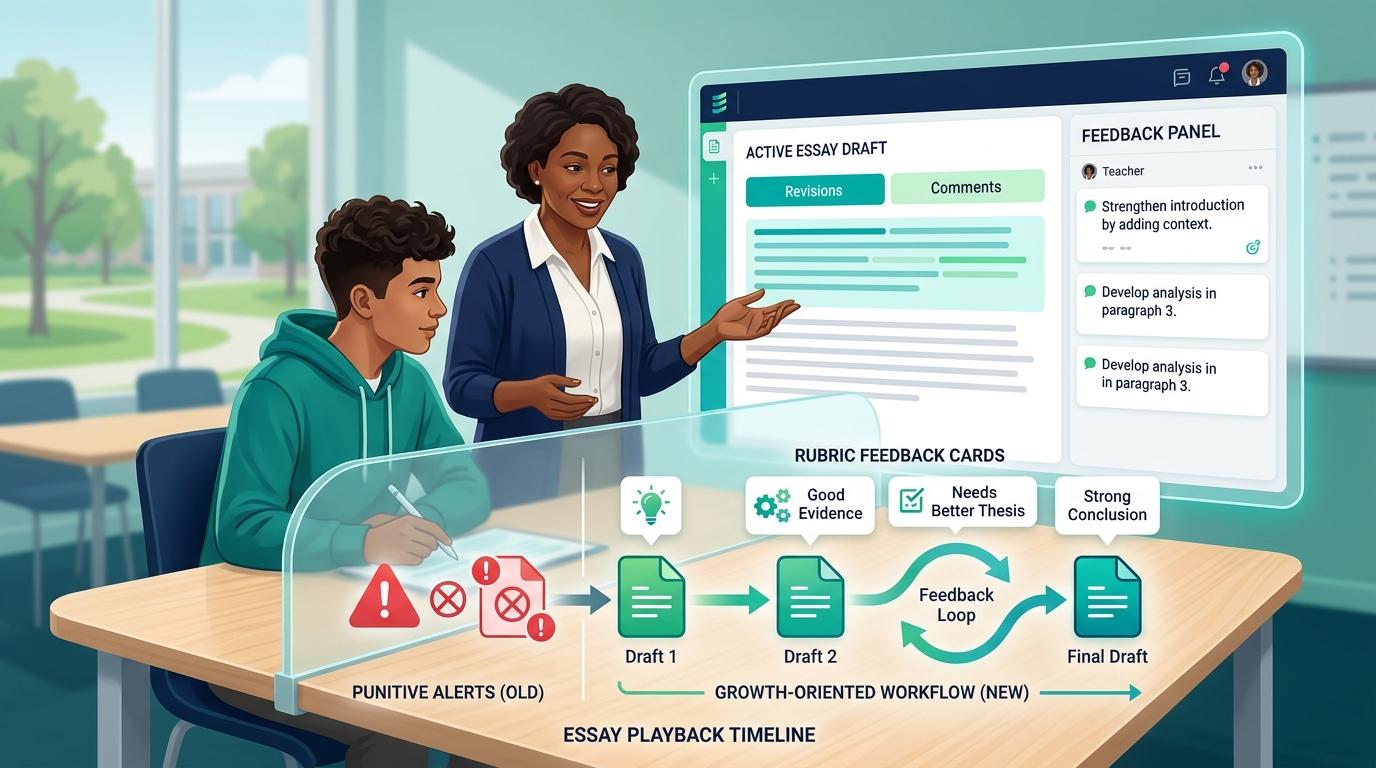
Traditional punitive plagiarism models—characterized by automatic zeros, immediate administrative referrals, and permanent honor code disciplinary marks—have collapsed in the modern secondary classroom. In an era dominated by generative AI assistants, sophisticated paraphrasing tools, and copy-paste drafting, punitive policies foster adversarial teacher-student relationships, disproportionately harm multilingual and neurodivergent learners, and drive students toward covert evasion rather than authentic inquiry. To cultivate genuine writing proficiency, high school English Language Arts (ELA) departments must transition from punitive enforcement to growth-oriented, restorative revision workflows. Rooted in Carol Dweck’s growth mindset theory and Rebecca Moore Howard’s foundational research on developmental patchwriting, this transition reframes writing as an iterative, multi-draft cognitive process. By integrating Checkmark Plagiarism into learning management systems via 1EdTech LTI 1.3 Advantage (AGS 2.0 / NRPS 2.0), departments leverage patent-pending Essay Playback™ (keystroke dynamics and revision telemetry), passage-level AI confidence sliders with short-text <150w guardrails, side-by-side source verification, and teacher-in-the-loop rubric autograding. This comprehensive guide provides department chairs, instructional leads, and secondary educators with the theoretical foundations, operational architectures, restorative syllabus language, calibration rubrics, and real-world case studies required to execute a sustainable departmental transition.
Checkmark Plagiarism provides the foundational infrastructure for this pedagogical evolution by integrating patent-pending Essay Playback™ with passage-level AI confidence sliders, defensible side-by-side plagiarism checking, teacher-in-the-loop rubric autograding, and deep enterprise LMS integrations for Canvas SpeedGrader, Google Classroom, and Agilix Buzz.
1. The Systemic Breakdown of Punitive Plagiarism Policies in Secondary ELA
For decades, the standard high school English syllabus contained a boilerplate “Academic Integrity” clause that read almost identically across thousands of secondary districts:
The Archaic Punitive Plagiarism Protocol
While this rigid model was designed to deter intentional cheating in an era of printed encyclopedias and static term-paper mills, its application today is producing severe institutional friction. The emergence of large language models (LLMs), ubiquitous digital research environments, and automated editing software has rendered traditional zero-tolerance frameworks pedagogically counterproductive and operationally unsustainable.
- Instant Zero (0%) on first flag
- Permanent disciplinary mark
- Opaque whole-paper AI scores
- Extreme anxiety over college GPAs
- Paralysis around blank-page drafting
- Fear of accidental false-positive flags
- Using AI “Humanizers” & paraphrasers
- Manual transcription from second phones
- Outsourcing drafting to avoid detection
- Teacher acts as forensic prosecutor
- Student views teacher as untrusted judge
- Writing instruction collapses into policing
The Pedagogical Pathology of Punitive Models
When high school English departments rely on punitive enforcement as their primary integrity mechanism, four systemic failures inevitably emerge:
When the penalty for a flawed draft is academic catastrophe (a zero that mathematically destroys a semester GPA), students facing time constraints or cognitive overwhelm do not respond by studying harder. Instead, they invest cognitive energy into evasion tactics—routing AI text through multi-tier paraphrasers (“AI humanizers”), prompting models to introduce deliberate typos, or transcribing generated prose from mobile screens. Punitive models do not stop dishonest shortcuts; they merely select for more covert cheating techniques.
Punitive models treat all non-standard or uncredited text as intentional fraud. This disproportionately punishes:
- ELL & Multilingual Writers: Emerging bilingual students rely on formulaic syntax and source-bound “patchwriting” as essential cognitive scaffolds. Generic AI detectors routinely flag their authentic prose as synthetic.
- Neurodivergent Students (ADHD, Executive Function, Autism): Students who compose non-linearly—pasting brainstormed clusters, reorganizing text blocks abruptly—trigger false alarms in primitive surveillance tools.
- Novice Researchers: 9th and 10th graders lacking formal citation training are treated as criminal plagiarists for developmental formatting errors.
Writing is an intensely vulnerable act of self-expression and intellectual discovery. When an educator’s primary tool is a whole-percentage plagiarism or AI detector score, the teacher ceases to be an intellectual mentor and becomes a forensic investigator. Students stop asking for help with thesis formulation or textual synthesis out of fear that admitting confusion will invite suspicion.
Punitive policies almost always operate on final, summative submissions. Evaluating a student’s integrity only at the point of final submission treats writing as a single-event product rather than a cognitive, multi-stage developmental journey. By the time the paper is submitted, the learning window has closed, transforming teacher feedback into an unhelpful post-mortem autopsy.
2. Pedagogical Foundations of Growth-Oriented Revision Workflows
To dismantle the adversarial cycle, secondary English departments must ground their academic integrity frameworks in proven composition pedagogy, developmental linguistics, and cognitive psychology.
Punitive Enforcement vs. Restorative Revision Paradigm
| Evaluation Dimension | Archaic Punitive Model | Restorative Growth Model |
|---|---|---|
| Core Philosophy | “Catch, penalize, record” | “Stop guessing, start trusting” |
| Definition of Writing | Static, single-event summative product | Dynamic, recursive, iterative cognitive process |
| View of Source Errors | Intentional deception & ethics violation | Developmental learning step & cognitive digestion |
| Role of the Teacher | Forensic integrity auditor & prosecutor | Formative writing coach & intellectual mentor |
| Technology Integration | Black-box percentage score (“78% AI”) | Transparent process telemetry (Essay Playback™ & Sliders) |
| Response to Integrity Issue | Disciplinary zero, honor referral, denial of appeal | Scaffolded 48h revision window & 3-min conference |
| Primary Student Motivation | Fear of failure, grade panic, and detection avoidance | Intrinsic mastery of rhetorical craft and authentic voice |
Carol Dweck’s Growth Mindset in Secondary Composition
In her landmark research on cognitive development, Dr. Carol Dweck established that students operating under a fixed mindset believe intellectual capability is an immutable trait. When applied to writing, fixed-mindset students believe they are either “naturally gifted writers” or “bad at English.”
In a punitive classroom, a high similarity flag or an AI detection accusation confirms the fixed-mindset student’s deepest fear: I cannot write, so I must hide my deficiencies.
A growth-oriented revision workflow operationalizes Dweck’s principles by establishing that:
- Writing Ability is an Elastic Muscle: Mastery develops through deliberate practice, cognitive struggle, and iterative refinement.
- Drafting is Hypothesis Testing: Early drafts are expected to contain structural weaknesses, awkward syntax, and imperfect source integrations.
- Revision is the Primary Locus of Learning: Real cognitive growth occurs not during the initial generation of ideas, but during the critical re-evaluation, restructuring, and polishing of rough prose.
Rebecca Moore Howard and the Theory of Developmental Patchwriting
A cornerstone of restorative integrity policy is distinguishing between deceptive academic fraud and developmental patchwriting.
In her seminal composition studies, Dr. Rebecca Moore Howard defined patchwriting as:
“Copying from a source text which may be deleted, supplemented, or have its syntax rearranged, but which nevertheless remains manifestly dependent on the source text.”
Howard proved that patchwriting is not a symptom of dishonesty, but rather a vital, intermediate phase through which novice writers transition into complex academic discourse. When a 10th-grade student encounters dense scholarly prose (e.g., an academic essay on Shakespearean tragedy or a sociological critique of modern media), their cognitive load is maxed out. To make sense of unfamiliar vocabulary and theoretical concepts, the student naturally stitches together fragments of the original source text while attempting to restate the argument.
Verbatim Cut & Paste
Complete structural and lexical dependence; zero authentic student voice or synthesis.
Cognitive Digestion
Rearranging clauses, synonym swapping; grappling with high-level vocabulary.
Mechanical Attribution
Proper signal phrases and MLA citations with structured, formulaic syntax.
Rhetorical Mastery
Seamless conceptual integration in student’s authentic, sophisticated rhetorical voice.
Treating Stage 2 (Patchwriting) as an ethical crime equivalent to buying an essay online destroys a student’s willingness to engage with challenging, high-level texts. A restorative English department explicitly categorizes patchwriting as an instructional opportunity requiring targeted paraphrasing and citation coaching, reserving disciplinary channels exclusively for intentional, wholesale deception.
Multi-Draft Assignment Architecture
To make restorative pedagogy operational, departments must abandon the single-deadline essay format in favor of a structured, three-stage multi-draft architecture:
Formative Discovery Draft (40% Process Weight)
Focus: Claim generation, textual evidence gathering, rough outlining. Telemetry baseline established in Checkmark Playback™. Formative autograder diagnostic with zero penalty for patchwriting or incomplete syntax.
Scaffolded Peer & AI Revision Clinic (20% Iteration Weight)
Focus: Addressing passage-level AI flags, unweaving patchwritten sections, and strengthening evidence integration. Formative tools provide quote-anchored prompts; teacher conducts 3-minute check-in conferences.
Summative Polish & Process Reflection (40% Final Craft Weight)
Focus: Rhetorical polish, mechanical precision, and flawless MLA/APA citation. Playback verification of student edits; teacher approves final grounded grade passback to Canvas/Buzz LMS.
3. Checkmark Plagiarism: The Teacher-Controlled Revision & Verification Suite
Transitioning an entire high school English department from punitive policing to restorative coaching requires purpose-built educational technology. Generic AI detectors and legacy plagiarism checkers were engineered for surveillance and punitive gatekeeping. In contrast, Checkmark Plagiarism provides a multi-dimensional, educator-first verification and coaching ecosystem designed specifically around growth-oriented revision workflows.
Captures keystroke dynamics, typing bursts, pause latencies, and revision frequencies. Features variable scrubbing (1x–8x) and preserves complete original clipboard content on every paste.
Replaces mystery whole-paper percentages with discrete passage-level confidence cards. Calibrated linguistic sliders measure burstiness and perplexity with strict short-text (<150w) guardrails.
Teacher-in-the-Loop AI Autograder Suite
100% Teacher AuthorityImports department rubrics from Canvas or Buzz LMS with custom ELA criteria.
Generates formative suggestions linked directly to verbatim student quotes.
Pushes teacher-reviewed marks and comments directly to Canvas SpeedGrader.
1. Patent-Pending Essay Playback™: Keystroke Dynamics & Process Replay
The centerpiece of Checkmark’s restorative philosophy is Essay Playback™. While traditional detectors inspect only the frozen, final text string, Essay Playback™ reconstructs the entire temporal history of the student’s writing session.
- 00:12:40 [P-Burst] 165 words typed (3 pauses > 5,000ms)
- 00:22:15 [R-Burst] 24 backspaces; restructured thesis clause
- 00:45:12 [External Paste] 340 words inserted (Original text archived)
- 01:10:05 [Cadence] 68 WPM steady typing; 2 minor edits
Clicking any essay passage jumps immediately to its exact moment of creation in the timeline. The original preserved clipboard content remains accessible even if subsequent rewrites modified every word.
- Timeline Scrubbing (1x to 8x Speed): Educators and students sit side-by-side to watch the drafting process unfold: typing an opening sentence, pausing for 45 seconds to consult an outline, backspacing to revise an adjective, reorganizing a topic sentence, and polishing transitions.
- External Paste Buffer Capture & Text Preservation: When text is pasted from an external application, Checkmark logs the paste event with an exact timestamp, character count, and the complete preserved clipboard content. Even if the student subsequently rewrites or deletes that block, teachers can click “Jump to Playback” to inspect the exact original text.
- Transcription & Retyping Telemetry: If a student attempts to evade detection by placing an AI essay on a secondary phone and manually typing it into the LMS, Checkmark flags the anomaly. Human composing exhibits burstiness and pauses; mechanical transcription displays a flat, steady typing cadence with near-zero backspacing.
- Exonerating Honest Students: Essay Playback™ serves as an unassailable shield for students falsely flagged by black-box detectors. An authentic typing log with hesitations and revisions instantly disproves false-positive claims.
2. Passage-Level AI Detection with Calibrated Confidence Sliders
Checkmark rejects assigning a single, whole-document “AI Probability Percentage” (e.g., “78% AI Written”). Such numbers provide zero instructional insight, cannot distinguish between hybrid drafting and complete fraud, and invite adversarial conflict.
“The overarching dichotomy between societal expectation and individual autonomy in Victorian literature is vividly exemplified through Catherine’s internal turmoil...”
N/A to prevent false-positive misclassifications.
3. Defensible Plagiarism Matching & Discrete Uncited Source Badges
Checkmark’s plagiarism engine scans billions of live web pages, academic journals, news archives, and institutional repositories, presenting evidence through a two-way linked, side-by-side comparison interface:
- Direct Quote Comparisons: Clicking an essay passage instantly scrolls the sidebar to the exact source text, highlighting matching lexical sequences and providing clickable URLs.
- Uncited Source Differentiation: Differentiates between a student who copied without attribution and a student who attempted a citation but formatted the author’s name incorrectly. Uncited sources receive a distinct “Citation Formatting Drift” badge, signaling coaching over discipline.
- Peer-to-Peer Cohort Matching: Identifies unauthorized sharing across different class sections, cohorts, or historical terms without exposing student privacy or transmitting drafts to public databases.
4. Teacher-in-the-Loop AI Autograder with Grounded Quote Anchors
Grading multi-draft assignments across 120–150 students can overwhelm English teachers. Checkmark solves this bottleneck with an AI Autograder that operates strictly under teacher final authority:
- Grounded Quote-Anchored Justifications: When Checkmark evaluates a rubric criterion (e.g., “Textual Evidence & Analysis – Level 3: Developing”), it cites the student’s exact sentences, explains how the analysis falls short, and provides concrete suggestions.
- Criterion-Specific Formative Revision Prompts: For formative drafts, the autograder generates sentence-level revision prompts that guide the student’s next writing session.
- Teacher Absolute Authority: AI scores remain internal drafts until the educator reviews, modifies, or approves them. Teachers can adjust scores with a single click or overwrite comments.
5. Enterprise LMS Integration via 1EdTech LTI 1.3 Advantage
Checkmark embeds natively into the primary digital workspaces of secondary schools:
- 1EdTech Certified LTI 1.3 Advantage: Complies with modern educational interoperability standards, utilizing Assignment and Grade Services (AGS 2.0) for bidirectional grade and rubric synchronization and Names and Role Provisioning Services (NRPS 2.0) for secure roster management.
- Canvas LMS & SpeedGrader: Launches directly inside Canvas SpeedGrader as an interactive sidebar. Teachers evaluate Essay Playback™, review passage-level AI cards, and modify rubric justifications without leaving Canvas.
- Agilix Buzz LMS & Google Classroom: Full embedded compatibility with Agilix Buzz project-based mastery paths and native Google Classroom synchronization.
- FERPA and COPPA Compliance: Checkmark maintains a strict zero-model-training guarantee. Student essays are never cached, monetized, or fed into public LLM training corpuses.
4. Real-World Case Studies: Secondary English Department Transitions
The following case studies illustrate how diverse secondary institutions successfully eliminated punitive friction and elevated student writing outcomes using growth-oriented workflows and Checkmark Plagiarism.
Secondary ELA Transition Case Studies at a Glance
| Institution Profile | Core Challenge | Growth-Oriented Outcome |
|---|---|---|
|
Oakridge High School 2,200 Students • 14 ELA Faculty |
Punitive zero policy led to 140+ honor referrals; adversarial parent disputes and grading burnout. |
• 84% reduction in referrals • 18.8% increase in writing mastery • 100% staff adoption in Canvas |
|
Westlake AP Cohort 120 AP Lit & Lang Students |
Students paralyzed by AI false-positive fears; dumbing down vocabulary to avoid detection. |
• Eliminated false-positive stress • AP exam 4+ score rate rose 14% • Authentic rhetoric reclaimed |
|
Metro Urban Academy 380 9th Grade Students (42% ELL) |
High failure rate from accidental patchwriting; students punished for developmental scaffolding. |
• Patchwriting treated as coaching • Essay completion rose to 94% • Zero disciplinary suspensions |
Oakridge High School: Department-Wide Overhaul (2,200 Students)
Background & Challenge: During the 2024–2025 school year, Oakridge High recorded over 140 formal academic dishonesty referrals, resulting in mandatory zeros, contentious parent appeals, and an adversarial climate. Teachers spent up to 10 hours per week acting as forensics investigators while students openly shared bypass techniques.
The Intervention: In August 2025, Department Chair Dr. Marcus Vance led a comprehensive transition to a growth-oriented revision workflow powered by Checkmark Plagiarism integrated into Canvas LMS:
- Policy Overhaul: Eliminated automatic zeros, replacing them with a mandatory 48-hour formative revision window for any draft displaying uncredited text.
- Multi-Draft Canvas Modules: Structured all major writing units into three assignment milestones (Discovery Draft → Peer/AI Revision → Final Polish).
- Essay Playback™ Conferences: Replaced accusatory interrogations with 3-minute restorative playback conferences.
| Key Department Metric | Punitive Policy (2024–25) | Restorative Workflow (2025–26) |
|---|---|---|
| Formal Disciplinary Referrals | 142 referrals | 23 referrals (-84%) |
| Parent-Teacher Integrity Disputes | 68 formal appeals | 4 formal appeals (-94%) |
| Common Assessment Mean Score | 73.4% (C) | 87.2% (B+) (+18.8%) |
| Teacher Time Spent on Integrity Audits | 9.5 hrs/week/teacher | 1.8 hrs/week/teacher (-81%) |
| Multi-Draft Revision Completion Rate | 31% resubmitted | 92% resubmitted |
Westlake High: AP Literature & Composition Cohort
Background & Challenge: Several top-tier AP Literature students experienced severe panic when generic whole-document AI detectors flagged their formal analytical prose as “90% AI Generated.” In response, students began dumbing down their vocabulary and using informal phrasing to avoid triggering false alarms.
The Intervention: AP Literature lead teacher Sarah Jenkins introduced Checkmark’s patent-pending Essay Playback™ and passage-level AI confidence sliders into the AP syllabus:
- The “Integrity Portfolio”: Students maintained writing portfolios in Checkmark, sharing Essay Playback™ timelines during peer reviews to analyze composing pauses and structural rewrites.
- Passage-Level Calibration: Replaced whole-paper percentages with passage-level confidence cards to evaluate whether complex sentences were overly formulaic or genuinely analytical.
Outcome: False-positive anxiety was eliminated; AP exam 4+ score rates increased by 14% year-over-year.
Metro Urban Academy: 9th Grade Literacy Intervention
Background & Challenge: Freshman ELA classes suffered a 38% failure rate on research essays under legacy zero-tolerance policies. Most failures were triggered by 9th graders copying full sentences and making superficial word substitutions (developmental patchwriting).
The Intervention: Freshman ELA coach Elena Rostova deployed Checkmark’s discrete uncited source badges and AI Autograder to scaffold research writing:
- Separating Citation Drift from Plagiarism: Flagged uncredited web matches as “Citation Formatting Drift” rather than academic misconduct.
- Paraphrasing Clinics: Conducted small-group clinics using side-by-side comparison cards to demonstrate how to extract core arguments into student voice.
Outcome: Freshman essay completion surged to 94%, and course failure rates dropped from 38% to 6% with zero suspensions.
5. The 5-Phase Departmental Transition Roadmap
Transitioning a secondary English department from punitive policing to restorative revision requires a structured, collaborative change-management plan. Department chairs should execute this transition across five deliberate phases:
Analyze 2-year historical plagiarism zeros and failure rates across student demographics. Survey faculty and students on AI anxiety and grading fatigue.
Replace zero-tolerance honor code language with restorative revision clauses. Establish the 3-tier AI Continuum (Green/Yellow/Red zones) with administrative approval.
Deploy Checkmark via 1EdTech LTI 1.3 Advantage in Canvas/Buzz/Google Classroom. Configure master rubrics with quote-anchored AI autograding.
Conduct blind-grading calibration sessions with sample student essays. Train teachers on 3-minute Restorative Writing Conferences using Essay Playback™.
Review quarterly LMS telemetry (revision volume, playback usage, flag resolution). Present longitudinal writing achievement data to the school board.
6. Restorative Syllabus Policy Language & Departmental Rubric Calibration
To ensure seamless implementation, English departments can directly adopt or adapt the following standardized syllabus language and evaluation calibration rubrics.
Department of English Language Arts: Academic Integrity & Writing Growth Policy
1. Our Core Philosophy: Writing as an Iterative Journey
In this course, we believe that writing is a powerful medium of thought, self-discovery, and communication. Authentic writing requires intellectual struggle, curiosity, and continuous revision. Our goal is not to police your every word, but to support your growth as an independent, critical thinker. We operate on a philosophy of trust, transparency, and restorative growth.
2. The 3-Tier Artificial Intelligence (AI) Continuum
3. The Multi-Draft Revision Guarantee
All major writing assignments follow a multi-draft architecture. No single draft defines your final grade: Draft 1 (Discovery Draft • Process Scored) → Draft 2 (Revision Clinic • Iteration Scored) → Draft 3 (Final Polish • Craft Scored).
4. Process Verification & Checkmark Essay Playback™
To verify authentic authorship and protect students from unfair AI false positives, our department uses Checkmark Plagiarism. If your writing triggers an anomaly flag, you will never receive an instant zero. Instead, you and your teacher will review your Essay Playback™ timeline in a 3-minute conference. An authentic drafting timeline clears flags immediately. If unauthorized text entered the document, you receive a guided 48-hour revision window to rewrite the section for full developmental credit.
Departmental Rubric Calibration Matrix: Developmental vs. Fraudulent Writing
To maintain uniform grading standards across all department members, teachers should utilize this calibration matrix when evaluating ambiguous drafts in Checkmark:
| Writing Dimension | Developmental Error (Coach) | Deceptive Fraud (Restorative Action) |
|---|---|---|
| Source Integration & Attribution |
PATCHWRITING:
• Student rearranges syntax, retains source nouns. • Intention: Grappling with dense academic text. • Telemetry: Multiple pauses and word-level rewrites. • Action: Paraphrasing & quotation coaching clinic. |
WHOLESALE CUT & PASTE:
• Entire paragraphs pasted from web or peer paper. • Intention: Evading composition entirely. • Telemetry: Single massive paste with 0 edits. • Action: Mandatory 48-hr supervised rewrite. |
| AI Tool Usage |
HYBRID BRAINSTORMING:
• AI used to brainstorm; essay typed organically. • Telemetry: Bursty keystrokes; 150+ backspaces. • Confidence: Mixed passage sliders. • Action: Add disclosure to process reflection. |
FULL-SCALE GENERATION:
• Complete essay generated and retyped/pasted. • Telemetry: Monotonic typing speed; 0 pauses. • Confidence: Uniform low burstiness cards. • Action: Restorative conference & prompt redraft. |
| Citation Format & Mechanics |
FORMATTING DRIFT:
• Missing parentheses, wrong page, misplaced comma. • Checkmark Badge: “Citation Formatting Drift”. • Action: Formative feedback card with MLA link. |
PHANTOM / FABRICATED CITATIONS:
• Citing non-existent AI hallucinated sources. • Telemetry: URLs pasted with 0 search history. • Action: Require source verification cards & resubmission. |
7. Frequently Asked Questions (FAQs)
FAQ 1: How does a growth-oriented revision policy prevent students from repeatedly submitting AI drafts until they pass?
A growth-oriented policy is restorative, not permissive. Because Checkmark Plagiarism utilizes Essay Playback™, a student cannot simply copy-paste a new AI draft into the editor and expect it to clear. The teacher’s interface preserves every external paste event, character count, and typing velocity metric. If a student attempts to submit another synthetic draft during their revision window, the absence of natural composing pauses, deletions, and sentence restructuring immediately reveals that no authentic writing occurred. The revision policy requires students to actively demonstrate their composing process on the timeline, rendering repeated AI dumping completely ineffective.
FAQ 2: Won’t a multi-draft revision workflow overwhelm English teachers who are already grading 150+ essays?
When implemented correctly with Checkmark Plagiarism, a multi-draft workflow actually reduces overall teacher grading time. In legacy workflows, teachers spend 8–10 hours per week writing repetitive margin comments and acting as forensic integrity investigators. Checkmark’s Teacher-in-the-Loop AI Autograder automatically drafts grounded, quote-anchored rubric justifications and sentence-level revision prompts for early drafts. Teachers simply review, adjust, and approve these suggestions in seconds. Furthermore, by catching writing and source errors during Formative Draft 1, final summative drafts are substantially cleaner and faster to evaluate.
FAQ 3: How should a department handle a situation where a student outright refuses to engage in the revision workflow?
If a student refuses to participate in a restorative conference, declines to revise unauthorized pasted content, or repeatedly engages in verified contract cheating, the department’s standard administrative referral protocols remain fully available. The restorative framework provides every opportunity for redemption and learning; however, intentional bad faith that rejects the learning process constitutes an administrative disciplinary issue. Crucially, because the teacher has documented the entire timeline via Essay Playback™ and preserved clipboard logs, any subsequent administrative referral is supported by unassailable, objective evidence rather than a contested detector percentage.
FAQ 4: How does Essay Playback™ protect English Language Learners (ELL) and neurodivergent students from false AI accusations?
Generic AI detectors analyze static vocabulary and sentence structure, frequently misclassifying the formulaic phrasing of ELL writers or the non-linear organization of neurodivergent students as artificial intelligence. Essay Playback™ bypasses linguistic stereotyping entirely by capturing the physical, temporal process of creation. A multilingual student who spends 45 minutes looking up synonyms, pausing to translate phrases, backspacing, and rewriting sentences generates an unmistakable human typing telemetry signature. This authentic process history completely overrides false-positive detector flags, ensuring equitable protection for all student demographics.
FAQ 5: What is the exact operational difference between developmental patchwriting and intentional plagiarism?
Operationally, developmental patchwriting occurs when a student actively engages with a difficult source, attempting to restate ideas but retaining the author’s underlying sentence structure and key vocabulary due to novice academic skills. Keystroke telemetry reveals active composing struggle: the student types, deletes, consults the source, and rearranges phrases. In contrast, intentional plagiarism involves wholesale copying of text (either via clipboard paste or rapid transcription from a secondary device) without any genuine cognitive restructuring. Checkmark highlights patchwriting with dedicated “Citation Formatting Drift” and source comparison badges, allowing teachers to treat it as an instructional coaching opportunity rather than an ethics violation.
FAQ 6: How can department chairs persuade skeptical school boards and administrators to abandon punitive zero-tolerance policies?
Department chairs should present three compelling arguments supported by data:
- Legal & Accreditation Defense: Punitive zero-tolerance policies based on black-box AI scores expose school districts to legal appeals and parent lawsuits due to documented false-positive error rates. Checkmark’s process-based telemetry provides defensible, objective evidence that protects the district.
- Academic Achievement Metrics: District case studies prove that restorative revision models increase student writing scores by 15–20% and reduce course failure rates by over 80%.
- Alignment with Modern Workforce Skills: In higher education and professional careers, writing is an iterative, multi-draft collaborative endeavor. Teaching students how to evaluate feedback and revise effectively prepares them far better than punitive single-draft testing.
FAQ 7: How does Checkmark Plagiarism integrate into our existing Canvas LMS SpeedGrader or Agilix Buzz environment?
Checkmark is a certified 1EdTech LTI 1.3 Advantage tool. It embeds directly inside the native Canvas SpeedGrader sidebar and Agilix Buzz grading views via Assignment and Grade Services (AGS 2.0) and Names and Role Provisioning Services (NRPS 2.0). Teachers never have to export files, log into external websites, or manually transfer grades. Everything—including Essay Playback™ scrubbing, passage-level AI sliders, quote-anchored rubric justifications, and side-by-side plagiarism matches—is accessible within the teacher’s standard LMS grading screen with one-click grade passback.
8. Summary & Department Leadership Checklist
Transitioning from a punitive integrity culture to a growth-oriented revision framework transforms the high school English department from an adversarial battleground into a vibrant community of authentic writers. By anchoring departmental policy in the pedagogical principles of growth mindset, embracing the developmental reality of patchwriting, and equipping teachers with Checkmark Plagiarism’s transparent verification suite, department chairs can build a modern, defensible, and deeply supportive writing program.
Department Chair Implementation Checklist
For more information on deploying Checkmark Plagiarism across your secondary school district, explore our Writing Playback solutions or contact our Educational Leadership Team to schedule a customized department calibration workshop.