
Executive Summary
When students manually retype text generated by ChatGPT, Claude, or an "AI humanizer" from a secondary screen, phone, or split-window setup, traditional static AI detectors and basic LMS version histories fail. However, the human cognitive writing process leaves an unmistakable biometric signature: organic composition is recursive, characterized by variable burstiness, inter-key pauses at syntactic boundaries, and frequent deletions. By tracking temporal writing telemetry, keystroke dynamics and patent-pending Essay Playback™ provide undeniable, defensible evidence of mechanical transcription—transforming unprovable suspicions into constructive, evidence-backed student dialogues while providing absolute proof of innocence for honest, fast-typing students.
Checkmark Plagiarism solves this verification challenge by uniting patent-pending Essay Playback™ with passage-level AI detection, comprehensive plagiarism checking, rubric autograding, and seamless integrations with Canvas LMS and Google Classroom.
The New Frontier of Academic Evasion: The "Retype Bypass"
In the early days of generative artificial intelligence in the classroom, identifying unapproved AI usage was relatively straightforward. Students copied paragraphs directly from ChatGPT, pasted them into Google Docs or their LMS assignment window, and submitted them without modification. Educators could catch this behavior through basic clipboard monitoring, sudden shifts in formatting, or crude whole-document AI probability scores.
As students became aware of clipboard logging and basic paste detection, evasion tactics quickly evolved:
- Paraphrasers and "AI Humanizers": Students fed raw AI outputs into tools like QuillBot or Undetectable AI to perturb sentence syntax and synonyms, aiming to fool statistical perplexity filters.
- The Secondary Screen / Phone Transcription: Students place their smartphone, tablet, or a second browser window next to their keyboard, displaying an AI-generated essay, and manually type the prose into their assignment document word-for-word.
- Voice-to-Text Dictation: Students read an AI-generated script out loud using browser dictation or accessibility microphones to populate the document.
To a traditional plagiarism detector or a standard static AI detector, a manually transcribed essay appears virtually clean. There are no logged clipboard paste events. The document metadata shows that the student was active inside the document for twenty or thirty minutes. Furthermore, if the student used a humanizer prior to transcription, static linguistic classifiers often return inconclusive or false-negative results.
Yet, to an educator reviewing the submission, something feels profoundly unnatural:
- An 1,800-word research essay was typed from start to finish in exactly 22 minutes.
- The draft exhibits zero backspaces, zero typos corrected mid-sentence, and zero reordered paragraphs.
- Complex, multi-clause sentences containing esoteric vocabulary were typed with a perfectly metronomic cadence—without a single multi-second pause for reflection, vocabulary retrieval, or fact-checking.
Can educators prove that this essay was transcribed rather than organically composed? More importantly, how can institutions establish clear, objective, and non-punitive verification protocols that protect honest students from false accusations while upholding authentic learning?
The answer lies in keystroke dynamics and writing process telemetry.
The Cognitive Science of Writing vs. The Biometrics of Transcription
To understand how keystroke dynamics differentiate authentic composition from mechanical transcription, we must look at how the human brain produces original text compared to how it transcribes existing text.
Idea generation, memory retrieval & structural outline recall.
Micro-Pauses: 2–15sConverting abstract ideas into rapid keystroke bursts.
Typing Bursts: 6–15 wordsImmediate cursor backtrack, rephrasing, typos & deletions.
Backspace: 8%–18% strokesDecades of cognitive psychology research—pioneered by John R. Hayes and Linda S. Flower—demonstrate that authentic writing is fundamentally non-linear, recursive, and mentally taxing. A writer does not conceive a complete, polished 2,000-word text in linear sequence. Instead, the brain operates in continuous feedback loops:
- Planning & Retrieval: The writer pauses to consider what point to make next.
- Syntactic Formulation & Translating: The writer outputs a burst of 5 to 15 words.
- Monitoring & Revision: The writer notices a grammatical misalignment, strikes the backspace key four times, swaps a verb, adds a semicolon, or moves the cursor up two paragraphs to adjust a supporting topic sentence.
In contrast, transcription (copy-typing) bypasses the planning, translation, and structural revision stages entirely. The transcriber’s cognitive load is limited to optical decoding and finger execution:
- Visual Buffer: The eyes read 4–6 words ahead on the secondary screen.
- Motor Execution: The fingers type the buffered words onto the target keyboard.
- Continuous Scanning: The eyes immediately scan the next cluster of words without evaluating argument validity, narrative structure, or rhetoric.
Because the text on the second screen is already complete and syntactically finalized, the transcriber has no reason to pause at major structural boundaries, no reason to reorganize paragraphs, and no reason to delete words to test alternate phrasing.
The Keystroke Dynamics Profile: 5 Biometric Markers
When an essay is composed within a telemetry-aware environment—such as Checkmark Plagiarism’s native Google Docs extension, Canvas LMS integration, Buzz LMS module, or Microsoft Word add-in—every keypress generates precise temporal metadata:
By aggregating these events across the entire writing session, Checkmark extracts five diagnostic markers that definitively distinguish authentic composition from mechanical transcription:
| Biometric Metric | Organic Human Drafting | AI / Second-Screen Copying |
|---|---|---|
| Inter-Key Interval (IKI) | High variance; dynamic burstiness | Low variance; metronomic Gaussian |
| Cognitive Pause Spikes | Frequent at clause & sentence boundaries | Virtually absent at syntactic limits |
| Deletion / Backspace Ratio | 7% – 18% of total keypresses | < 1.5% of total strokes |
| Cursor Trajectory | Highly recursive & multi-directional | Strictly linear (0 to N) |
| Production Velocity (Net WPM) | 18 – 42 WPM (Drafting & Research) | 55 – 90+ WPM (Sustained Copy Speed) |
| Paragraph Rewrite Sessions | Multiple iterative editing passes | Single continuous linear pass |
1. Inter-Key Interval (IKI) Variance & "Burstiness"
The time elapsed between consecutive keystrokes is known as the Inter-Key Interval (IKI). In organic writing, IKIs fluctuate wildly. Within a familiar word like the or because, a student's muscle memory produces micro-intervals of 80–130 milliseconds. However, when transitioning between clauses, choosing a complex adjective, or beginning a new sentence, the IKI spikes to 1,200–4,000+ milliseconds. This phenomenon is known as temporal burstiness.
In transcription, burstiness collapses. Because the student is simply reading and typing pre-formed text, the IKI exhibits a tightly grouped Gaussian distribution. The typing speed remains unnaturally constant regardless of whether the student is typing common conjunctions or advanced philosophical terminology.
2. Syntactic Boundary Pausing (P-Spikes)
In human composition, the duration of a typing pause directly correlates with the cognitive complexity of the linguistic boundary:
- Within-word pauses: ~100–250 ms
- Between-word pauses: ~250–600 ms
- Within-sentence clause pauses (commas, semicolons): ~800–2,000 ms
- Sentence-boundary pauses (periods, question marks): ~2,000–6,000 ms
- Paragraph-boundary pauses: ~5,000–30,000+ ms
When a student transcribes an AI response from a phone, paragraph-boundary and sentence-boundary pauses virtually disappear. The student finishes one sentence, hits the spacebar twice, and begins typing the next complex sentence within 400 milliseconds.
3. Deletion and Backspace Ratio (Revision Entropy)
Normal drafting is messy. Across millions of analyzed student writing hours, native human drafting yields an average deletion ratio of 8% to 15% of total keystrokes. Students make mechanical typos, rethink phrasing, delete half-written thoughts, and fix punctuation.
In mechanical transcription, the deletion ratio drops below 1% to 2%. The only backspaces that occur are immediate, single-character corrections of mechanical slips (e.g., hitting t-e-h instead of t-h-e). One almost never sees macro-deletions (deleting a 15-word phrase to reword it).
4. Cursor Trajectory and Navigational Telemetry
An authentic writer frequently moves the cursor backward into previously drafted text to reread, fix an earlier spelling error, add a transitional phrase, or insert a missing citation. This creates a multi-directional, "hopping" cursor trajectory.
Transcribers exhibit a strictly monotonic, unidirectional trajectory. The cursor starts at index 0, moves continuously forward character by character, and terminates at index N. The student never navigates backward into paragraph 1 while composing paragraph 4.
5. Net Production Velocity vs. Gross Motor Speed
A student who types at 75 words per minute on a standard typing test (like 10FastFingers or Monkeytype) does not compose original essays at 75 WPM. Because drafting requires continuous planning and research retrieval, typical student net drafting speeds range between 15 and 35 words per minute.
When a student submits a 1,500-word essay written in a single 18-minute session—representing a sustained production speed of 83 WPM without an outline or prior draft—they are exhibiting motor copy speed, not original composition speed.
Patent-Pending Essay Playback™: Turning Raw Data into Visual Proof
Raw keystroke logs and millisecond timestamps are invaluable for software algorithms, but department chairs, classroom teachers, and parents cannot be expected to decipher raw statistical distributions.
This is why Checkmark Plagiarism developed patent-pending Essay Playback™.
Telemetry: Net Velocity: 78.4 WPM | Backspace Rate: 0.8% | Pause Variance (CV): 0.12 (Abnormally Metronomic) | Linear Trajectory: Monotonic Forward
Keystroke-by-Keystroke Video Reconstruction
Instead of presenting a single opaque percentage score, Essay Playback™ allows educators to scrub through the entire writing session like a digital video:
- Variable Speed Playback: Watch the essay assemble itself at 1x, 2x, 4x, or 8x speed.
- Visual Pause Indicators: Colored timeline markers highlight long pauses where the student was reading, thinking, or researching.
- Burst Velocity Graphs: Visual waveform displays show organic typing bursts versus unnatural flatlines of metronomic transcription.
External Paste Tracking with Permanent Text Preservation
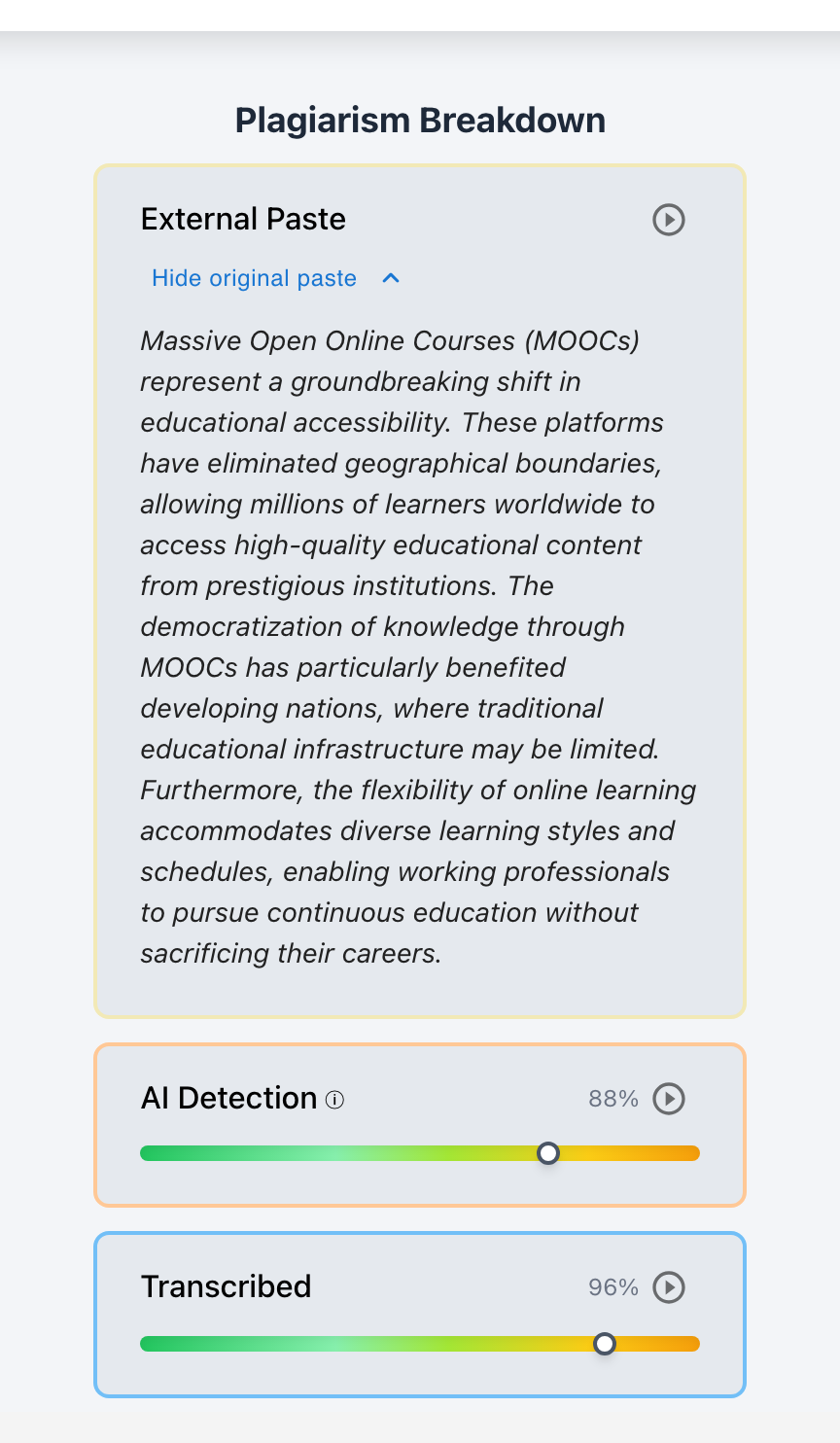
If a student pastes text from an external source, Checkmark immediately logs the timestamp, exact character count, and origin coordinates.
Crucially, Checkmark permanently preserves the original pasted text, even if the student subsequently spends thirty minutes manually rewriting, paraphrasing, or deleting individual words. Clicking the "Jump to Playback" button on any paste card transports the teacher directly to the exact second in the timeline when the paste occurred.
Transcription Detection Engine
When a student types without pasting, but matches the biometric markers of copy-typing, Checkmark’s engine highlights the specific passage directly within the document. In the sidebar, an Evidence Card displays:
- The passage-level calibrated confidence slider (Typical Human Drafting vs. Typical AI Pattern).
- The specific typing velocity, IKI variance, and backspace frequency for that passage.
- Comparative baseline data showing the student’s organic typing rhythm versus the flagged segment.
Classroom Scenarios: How Telemetry Solves Real Integrity Dilemmas
The "Split-Screen" AI Transcription
Context: AP English Literature analysis (1,200 words). Whole-document AI score returned inconclusive (28%).
Investigation: Checkmark Playback revealed all 1,200 words were typed in a single 17-minute session at 71 WPM with exactly 2 backspaces and zero clause-boundary pauses.
The Fast-Typing Prodigy Falsely Accused by Static Detectors
Context: University History research paper (2,500 words). A generic static classifier flagged it as 86% AI due to concise syntax.
Investigation: Checkmark writing telemetry logged 4 hours and 15 minutes of active drafting over 4 sessions, 412 backspaces, 3 thesis rewrites, and authentic high-burstiness variance (CV = 0.84).
The "QuillBot Paraphrase + Retype" Camouflage
Context: Biology lab report synthesis. Student ran an AI summary through QuillBot and manually typed the result into Google Docs.
Investigation: Multi-Factor AI Detection flagged awkward synonym substitutions, Plagiarism Detection caught a 42% peer match to lab partner data, and Keystroke Telemetry confirmed steady 60 WPM copy-typing.
Technical Comparison: How Academic Integrity Tools Evaluate Submissions
Not all integrity platforms evaluate writing in the same way. Understanding the technical differences is vital for district technology directors, curriculum coordinators, and academic integrity boards:
| Feature / Capability | Legacy Plagiarism Checkers | Generic AI Detectors | Checkmark Plagiarism |
|---|---|---|---|
| Core Detection Method | String matching & web indexing | Linguistic perplexity & burstiness | Multi-dimensional: Text, process, sources & rubrics |
| Process Telemetry | None or basic LMS snapshots | None | Patent-Pending Keystroke Telemetry & Essay Playback™ |
| AI Transcription Detection | ❌ Blind | ❌ Blind | ✅ Defensible Biometric Transcription Engine |
| External Paste Preservation | ❌ Logs event only (loses text) | ❌ No capture | ✅ Full original text saved + Jump-to-Playback |
| False Positive Exoneration | High risk on templates/citations | High risk on formal/ESL writers | Near zero: Keystrokes prove authentic drafting |
| Granularity | Side-by-side string matches | Whole-paper score or highlights | Passage-level cards with calibrated confidence sliders |
| Rubric Autograding | ❌ Separate paid add-on | ❌ None | ✅ Integrated teacher-in-the-loop rubric grading |
| Student Data Privacy | Indexes student work in database | Often trains AI models on inputs | FERPA/COPPA compliant; Zero AI model training |
Step-by-Step Teacher Protocol: Investigating AI Transcription with Empathy
When keystroke dynamics flag an essay for suspected transcription, educators should follow an established, non-punitive investigative workflow designed to build trust and preserve student relationships:
Examine passage-level AI confidence cards, cross-reference external plagiarism matches, and review the total active writing duration.
Scrub through the video timeline to check for continuous metronomic typing, absence of planning pauses, or sudden paste injections.
Review preserved paste text. If the student pasted their own handwritten notes or pre-drafted outline, verify the original content.
Generate rubric-aligned criterion feedback to establish a baseline of the essay's academic merits independent of integrity flags.
Play the 30-second playback clip together. Ask open-ended questions like: "Can you walk me through your drafting process for these paragraphs?"
Mark the submission privately as Resolved, Flagged, or Cleared without public LMS stigmatization.
Institutional Policies: Distinguishing Assistance from Authorship Fraud
As schools and universities update their academic integrity policies for the generative AI era, policy language must reflect the difference between authorized cognitive assistance and unauthorized mechanical transcription:
| Category | Student Action | Telemetry & Integrity Status |
|---|---|---|
| 1. Authorized Ideation | Brainstorming topics, outlining, grammar checking | ✅ Permitted (With Citation) |
| 2. Assisted Research | Using AI search to locate primary sources and empirical data | ✅ Permitted |
| 3. Automated Drafting | Generating full paragraphs and pasting directly into editor | ❌ Prohibited (Paste Log Flag) |
| 4. Mechanical Transcription | Generating text on phone; copy-typing text into editor | ❌ Prohibited Authorship Fraud |
Essential District & Syllabus Policy Clauses
Enterprise Privacy, Security & LMS Integration
Implementing keystroke dynamics and writing process analysis at the institutional level requires strict adherence to student data privacy standards and seamless technological integration:
Zero Model Training & Compliance
- Zero AI Training: Checkmark never uses student writing or keystroke telemetry to train commercial AI models.
- Full Compliance: FERPA, COPPA, and GDPR compliant architecture.
- Enterprise Encryption: TLS 1.3 in transit and AES-256 encryption at rest.
Native LMS & Classroom Deployment
- Canvas LMS & Buzz LMS: Embedded into SpeedGrader and assignment submission views.
- Google Docs Extension: Captures drafting keystrokes with zero LMS friction.
- Gradebook Sync: Direct one-click score and feedback sync to your SIS / LMS.
Frequently Asked Questions (FAQ)
1. What if a student is just an exceptionally fast typist? Will they be falsely flagged?
No. Keystroke dynamics does not flag students simply for typing fast. An expert touch-typist composing an original essay still exhibits high temporal variance (burstiness), natural pauses at sentence and paragraph boundaries while formulating thoughts, and an authentic backspace/deletion ratio (typically 6–12%). Transcription detection only triggers when high speed is combined with metronomic intervals, flatline pause variance, zero structural revisions, and absence of cognitive planning pauses.
2. How does Essay Playback™ handle students who write their drafts by hand in a notebook first?
If a student legitimately handwrites an essay in a paper notebook and then types their draft into the computer, they may indeed type with fewer structural revisions. However, Checkmark’s pedagogical workflow accounts for this: the student simply shares their handwritten notebook draft during the conference, and the teacher marks the educator flag as Cleared / Resolved in Checkmark.
3. Can "AI humanizers" or paraphrasing tools bypass keystroke dynamics?
No. Paraphrasers like QuillBot or Undetectable AI manipulate surface vocabulary and syntax to reduce statistical predictability for static AI detectors. However, they have zero control over the physical, temporal act of typing. If a student transcribes humanized text from a second screen, their keystroke dynamics still exhibit the mechanical, pause-less signature of transcription.
4. What about students using speech-to-text dictation or accessibility tools?
Speech-to-text dictation tools (such as Apple Dictation, Google Voice Typing, or Dragon NaturallySpeaking) insert words in large, multi-word spoken phrase chunks with distinct acoustic input timestamps rather than mechanical single-character keystrokes. Checkmark’s telemetry engine recognizes recognized assistive technology signatures, ensuring students with IEPs, 504 plans, or accommodations are never unfairly penalized.
5. Does Checkmark store student keystrokes permanently?
Keystroke telemetry is securely tied to the specific assignment submission within your institution’s private tenant for grading and verification purposes. In strict adherence to FERPA and COPPA, student data is never sold, shared, or indexed into public databases, and is never used to train third-party machine learning models.
6. How does keystroke dynamics help when a student is falsely accused by a generic AI detector?
Keystroke dynamics is the ultimate proof of innocence. When a generic detector flags a student’s formal, well-structured essay as "95% AI," the student can feel helpless. Checkmark’s Essay Playback™ provides definitive forensic proof—showing every revision, deleted phrase, structural shift, and multi-hour drafting session—instantly exonerating the student and restoring teacher trust.
Conclusion: Stop Guessing, Start Trusting
The battle over academic integrity cannot be won with black-box percentage scores that create an atmosphere of suspicion and adversarial friction in the classroom. When educators rely on opaque AI detectors that guess based on static text alone, honest students are wrongfully accused, and clever evasion techniques like the "retype bypass" slip through unnoticed.
By combining passage-level AI analysis, comprehensive plagiarism source matching, patent-pending Essay Playback™, and keystroke dynamics, Checkmark Plagiarism provides educators with transparent, defensible evidence.
When you can see the complete writing process unfold keystroke-by-keystroke, you no longer have to guess what happened behind the screen. You can have honest, supportive, and restorative conversations that uphold academic rigor while celebrating authentic student growth.
Ready to bring transparent, process-based academic integrity to your school or district? View a sample report or request a demonstration.